
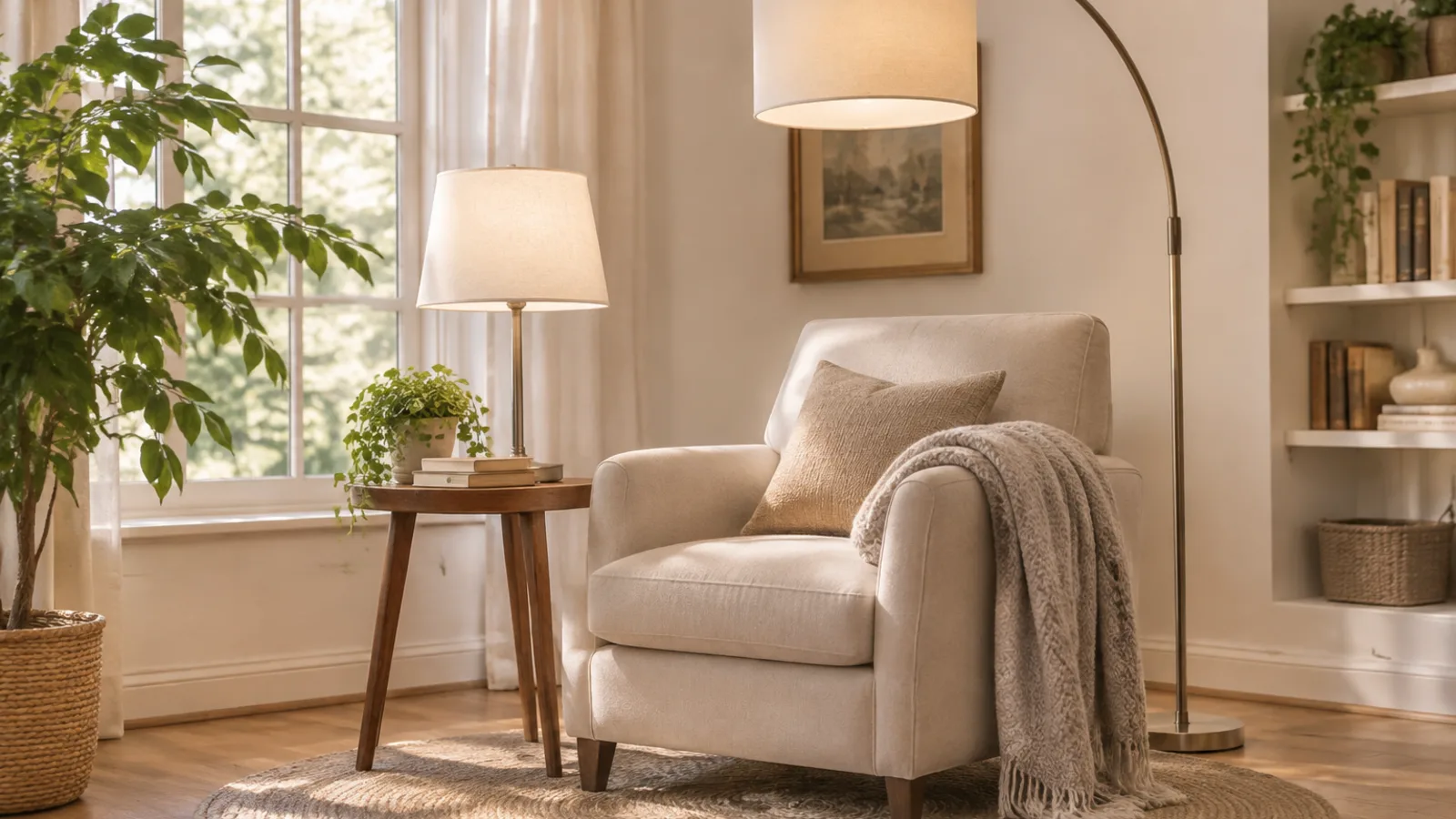
Most corners end up as the most neglected square footage in a room. A chair gets pushed against two walls, a lamp hovers somewhere nearby, and a side table turns up that is either too small or too large. The result looks provisional, as if the furniture is waiting to be moved rather than meant to be there. If you have ever tried to work out how to style an accent chair in a corner and ended up with something that looks marooned rather than considered, the problem almost certainly was not your taste. It was the order of decisions: most advice starts with aesthetics when it should start with geometry. The three things that make a corner read as deliberate are proportion to the rest of the room, lighting that works once the sun goes down, and a side table scaled to the chair rather than to the wall behind it.
Three rules at a glance
- Proportion: as a visual guide, the chair should occupy roughly one-third to one-half of the longer wall it sits against.
- Table height: the side table surface should sit level with or just below the chair's armrest.
- Light layering: combine a floor or wall lamp above the seated shoulder with a second, lower source on the side table for warmth and depth.
Read the Corner Before You Move Anything
Not all awkward corners are the same. A true 90-degree corner where two blank walls meet has completely different constraints from a recessed alcove, a bay-window angle, the dead space behind a sofa arm, or the gap beside a doorway. Identifying your corner type first prevents the kind of problem you discover only after the furniture is already home.
Start with three measurements:
- The length of each wall that forms the corner.
- The ceiling height.
- The swing arc of any door that opens into the space — treat this semicircle as off-limits for furniture.
These numbers tell you the maximum chair width, how tall a chair back can read comfortably, and roughly how much surface area the chair needs to occupy to look balanced rather than lost. Chair backs that stop well below two-thirds of the ceiling height generally sit comfortably in the space; taller backs tend to need wider walls to carry them without feeling heavy.
Next, trace the traffic flow. If the corner sits along a natural path between a door and the main seating area, aim for roughly 30 inches of clear walkway — a common design rule of thumb, though tighter rooms often manage with a little less. The U.S. Access Board's accessibility guidelines recommend wider clearances for accessible routes, which is worth factoring in if the space needs to work for everyone.
Finally, map what else is at play:
- Radiators and air vents — a chair placed over either one is uncomfortable in winter.
- Low windowsills — a chair in front of one blocks both light and view.
- Electrical outlets — your lamp needs one within reach; plan the cord route before you commit to a position.
How to Style an Accent Chair in a Corner: Proportion Rules That Work
The most common mistake in corner styling is choosing a chair that fits the gap dimensionally but reads as the wrong weight for the room. Visual weight — how heavy a piece looks, regardless of its actual size — needs to be in conversation with what is already there.
A fully upholstered barrel chair with a solid back and thick arms reads as a heavy piece. Put it in a room anchored by a low, leggy mid-century sofa and the corner looks unbalanced, as if the furniture came from two different houses. An open-frame chair in cane, rattan, or metal, with visible negative space beneath it, reads as much lighter and usually pairs better with rooms that already have substantial upholstered furniture. Solid backs work in wide corners; open or low backs suit tighter alcoves where you do not want to interrupt sightlines.
Seat height matters more than most guides acknowledge. When the accent chair's seat height is within roughly two inches of the nearest major seating surface — the sofa, the bed, the bench — the pieces read as a cohesive group. That is a rough guide rather than a fixed rule, but mismatches much larger than that tend to make the corner feel disconnected from the rest of the room, whatever the chair itself looks like.
As a general visual guide, a chair tends to look most settled when it occupies somewhere between one-third and one-half of the longer wall it sits against. Less than that and it can look isolated; more and it starts to crowd. In a 36-inch alcove next to a fireplace, for example, a 28-inch-wide slipper chair leaves a few inches on each side — the kind of proportions that tend to read as placed rather than wedged, though room context always varies.
Angle or Flush? The Placement Decision Most Guides Skip
Once you know the chair belongs in the corner, the most useful decision you can make is how it faces. This single choice separates a chair that looks deliberately placed from one that just ended up against two walls.
When to angle the chair: In an open corner — one that is not a true recessed alcove — pulling the chair off the walls at roughly 45 degrees so it faces into the room almost always reads as more intentional. It signals that the chair was positioned for someone to sit and be part of the room, not filed away in a gap. Angling also opens up the corner floor space, so the side table can sit beside the outer arm of the chair rather than being squeezed between it and the wall.
When to keep it flush: In a recessed alcove, a bay-window corner, or a tight walkway where every inch matters, flush placement often works better. The architecture of the alcove itself does the work of framing the chair; angling it in a small recess reduces the usable space without adding visual benefit.
When you angle the chair, the side table moves too — place it off the outer corner of the chair rather than tucked between the chair and the nearest wall. The floor lamp or wall sconce moves to the wall behind and to one side, sending light over the shoulder of someone seated.
Choose a Side Table Scaled to the Chair, Not the Wall
A side table in a corner should serve the person sitting in the chair, not fill the remaining floor space. That distinction changes most of the decisions.
Height is the most important variable. The table surface should sit level with the chair's armrest, or just slightly below it. A table that rises above the arm looks visually dominant. One that sits several inches below forces an uncomfortable downward lean every time someone sets down a glass or a book.
Shape works with the geometry of the corner. Where two walls meet at a hard right angle, a round table softens the meeting point. In wider corners or alcoves, a rectangular or square table often makes better use of the surface and accommodates a lamp base more comfortably.
In a genuinely tight corner, consider these alternatives to a standard side table:
- A C-shaped table that slides over the chair arm keeps the floor completely clear.
- A small nesting pair lets you tuck the smaller piece away when you do not need it.
- A wall-mounted shelf at armrest height works in alcoves where the floor footprint matters most.
Resist the impulse to fill the remaining floor space beside the table with extra objects. One well-chosen item on the table surface — a small lamp, a single ceramic, a book — does more for the corner than a cluster of styled props.
Layer the Lighting So the Corner Works After Dark
A corner that looks calm in the afternoon can read as dim and forgotten at night. That is usually because the only light source is an overhead fixture several feet away, and no one thought through what the corner looks like after dark.
The most useful piece of lighting for a corner chair is a floor lamp positioned just behind and to one side of the chair. The shade should sit slightly above the shoulder of someone seated, angling light down onto a lap rather than across the room. An arc floor lamp works particularly well in open corners: the arc extends over the chair from behind, keeping the lamp base outside the immediate footprint of the seating area and leaving the floor beside the chair clear for the side table.
If the corner is tight and a floor lamp is not feasible, a plug-in wall sconce behind the chair achieves a similar effect with no floor footprint at all. Mount the bracket so the shade sits slightly above seated-shoulder height. For cord management, route the cord behind the chair base and along the baseboard rather than across the floor — or choose a rechargeable lamp that needs no cord at all.
A second, lower light source on the side table adds warmth and depth. A small battery-powered LED lamp at table height creates a layered effect that separates a genuinely designed corner from one that just has a chair and an overhead light. Both sources should share the same warm colour temperature so the corner reads as unified rather than patchwork.
Finish the Corner Without Overloading It
Once the chair, table, and lighting are in place, the corner is structurally complete. Everything added from that point should earn its spot by doing a specific visual job.
A rug grounds the corner and separates it as a distinct zone — particularly useful in open-plan rooms. It does not need to be large. A round rug that sits under the front legs of the chair and extends a few inches beyond the side table is enough to define the moment. The rug should pick up at least one colour already present in the room so the corner connects to the space rather than sitting apart from it.
If the walls behind the chair are bare, one piece of wall art hung so its centre sits at roughly seated eye level creates vertical interest without cluttering the floor. Avoid gallery walls in corners; they compete with the chair for attention and generally make tight spaces feel busier than they should.
A throw draped over the chair arm adds texture and signals that this is a place designed to be used, not just looked at. That single gesture often does more for the warmth of a corner than any other finishing move.
Frequently Asked Questions
Does an accent chair in a corner need a rug underneath it?
Not essential, but a small rug stops a corner chair reading as a gap-filler. A round rug under the front legs and extending a few inches beyond the side table is enough to define the zone without demanding a large footprint. If you already have a large area rug in the room that extends toward the corner, the accent chair can sit on the edge of that instead.
Can you style an accent chair in a very small corner?
Yes — choose a slipper chair, which has no arms and a narrow footprint, and use a C-table so no side-table floor space is needed at all. A plug-in wall sconce eliminates the floor lamp entirely. The real constraint in a small corner is not whether the chair fits but whether it can be sat in and exited comfortably, so check the clearance before you commit.
Should the accent chair match the sofa?
It should relate to the sofa, not match it. An exact match in fabric and colour makes the accent chair look like a leftover from a set rather than a chosen addition. Pick up one element — the leg finish, a colour from the sofa's pattern, or a comparable visual weight — and let the chair differ in everything else.
How do I keep the corner from feeling dark even with a lamp?
A single downward lamp lights the seat but leaves the walls in shadow. Add a second source at a lower level — a small battery-powered LED lamp on the side table works well — and match the colour temperature of both. Generally, lighter wall finishes in the corner help too: a warm off-white reflects more light than a saturated accent colour, and a matte or eggshell finish scatters light more softly than a flat one.
What if the corner is behind a door that swings into the room?
Measure the door's full swing arc and treat that area as off-limits. That usually pushes the chair further into the corner and may require a narrower profile. A floor lamp becomes impractical if the door would hit it, so a wall sconce or a C-table with a built-in USB port is a practical alternative. If the door genuinely precludes comfortable seating, treat the space as a styling vignette rather than a primary seat — a chair with a lamp and a small table that looks considered but is not expected to function as a reading nook.
Putting It All Together
Knowing how to style an accent chair in a corner starts with treating the corner as a design problem before it becomes a shopping list. Measure the walls and ceiling. Trace where people walk and note what cannot be moved. Match the chair's visual weight to the room's existing furniture, not just to the gap. Decide whether to angle the chair toward the room or keep it flush with the walls. Size the side table to the chair arm. Layer the lighting so the corner works at night as well as it does in the afternoon. Then stop.
The corners that read as genuinely designed share one quality: each element has a job, and nothing was added after the job was done. That is what turns an overlooked alcove into the spot everyone gravitates toward — and what distinguishes a well-considered corner from a chair that simply ended up against a wall.

Join the conversation
Sign in — Sign in to join the conversation.