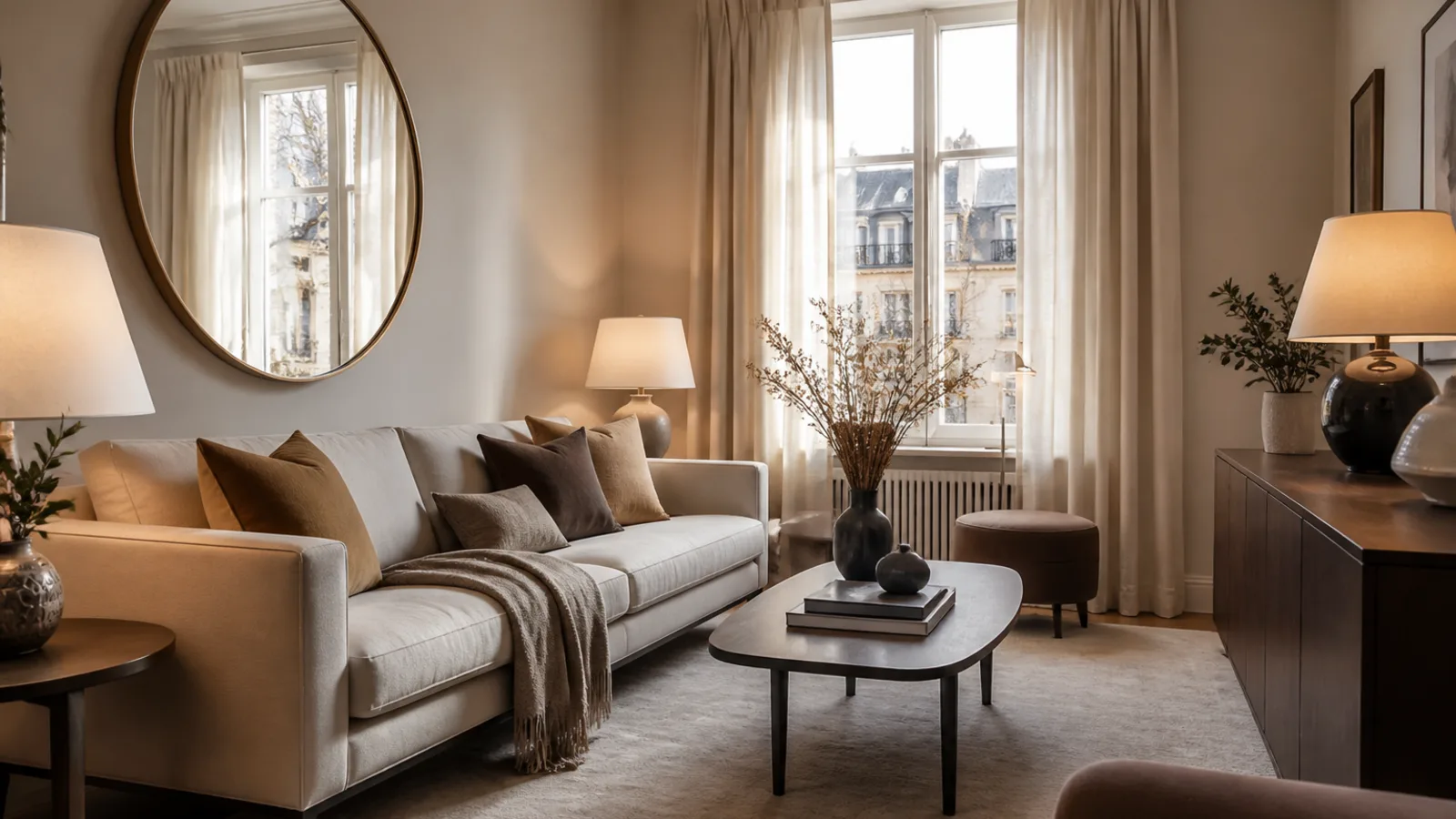
A small living room can feel generous when the layout, scale, colour and lighting are working together. If you are wondering how to make a small living room look bigger, the answer is rarely one magic trick. It is a series of smart choices: the right-sized sofa, clearer walkways, better lighting, fewer visual interruptions and storage that does not shout for attention.
These ideas work in compact city flats, older European apartments, condos, terraces, bungalows and smaller family homes. Each tip is marked for renters, so you can see what is realistic before you move a sofa, buy a rug or pick up a paintbrush.
How to Make a Small Living Room Look Bigger: 15 Designer Tricks
1. Choose a sofa that fits the room, not the fantasy floor plan
Renter-friendly: Yes.
The sofa is usually the largest object in the room, so its scale matters more than almost anything else. A deep sectional with wide arms may be comfortable, but in a compact room it can swallow the floor and make every other piece feel squeezed in.
Look for slim arms, a neat back, visible legs and a depth that suits the room. In many narrow rooms, a sofa depth under about 90 cm or 35 inches feels easier to live with than a very deep lounge sofa, though the right size depends on your floor plan. A compact two-seater or apartment sofa with one occasional chair often feels more spacious than a bulky three-seater.
If you already own a large sofa, reduce the visual weight around it: remove excess cushions, keep throws folded, and avoid placing heavy side tables at both ends.
2. Pull furniture slightly away from the walls
Renter-friendly: Yes.
It sounds counterintuitive, but pushing every piece tight against the wall can make the room feel flatter and more boxed in. Even a small gap behind the sofa can create depth and make the layout look more intentional.
You do not need a dramatic floating arrangement. In a tiny room, moving the sofa forward by just 5 to 10 cm or 2 to 4 inches may be enough. In an open-plan apartment, the back of the sofa can help define the living area without adding another wall or divider.
3. Keep the main walkway clear
Renter-friendly: Yes.
A small room feels much smaller when you have to sidestep furniture. Start by identifying the natural route through the room: from the door to the sofa, from the kitchen to the balcony, from the hallway to the window. Then make that route as easy as possible.
As a general guideline, a main walkway feels best at roughly 75 to 90 cm or 30 to 36 inches wide where possible. Many small homes cannot spare that everywhere, so protect the most important route first. Swap sharp, bulky coffee tables for oval, round or narrow designs, and move plant stands and pouffes out of the path.
4. Use leggy furniture to show more floor
Renter-friendly: Yes.
The more floor your eye can see, the larger the room tends to feel. Furniture with raised legs creates air underneath, which is especially useful for sofas, armchairs, media units and sideboards.
This does not mean every piece needs delicate metal legs. A mix is best. One grounded item can give the room stability, but several boxy pieces sitting directly on the floor will make a small living room feel heavy. If you are replacing only one item, a raised media unit often makes a noticeable difference.
5. Choose a rug that is large enough
Renter-friendly: Yes.
A tiny rug floating in the middle of the room makes the seating area look chopped up. A larger rug visually gathers the furniture and makes the floor feel more continuous.
As a guide, aim for at least the front legs of the sofa and chairs to sit on the rug, if space allows. Try to leave roughly 20 to 30 cm or 8 to 12 inches of bare floor between the rug and the walls so it looks intentional rather than like a too-small carpet. In very small rooms, one generous low-pile rug usually works better than multiple small mats. If you are unsure, mark the rug size on the floor with painter’s tape before buying.
6. Hang curtains high and wide
Renter-friendly: Sometimes.
Curtains hung just above the window frame can make the wall look shorter. Hanging the rod closer to the ceiling draws the eye upward, while extending it wider than the window allows the curtains to sit beside the glass rather than blocking daylight.
Choose lighter fabrics where privacy allows. Sheers, linen-look panels and soft cotton blends tend to feel airier than thick, dark curtains. Renters can look for tension rods, no-drill brackets or existing tracks, but always check your lease before making holes.
7. Use mirrors strategically, not randomly
Renter-friendly: Sometimes.
Mirrors can make a room feel bigger, but placement matters. They work best when they reflect daylight, a view, lamplight, artwork or an open part of the room. A mirror beside or near a window can bounce light across the room, while a mirror opposite a very bright window may create glare in some spaces.
Avoid placing a mirror where it reflects clutter, a television, a dark hallway or a cramped corner. One large mirror usually feels more sophisticated than a cluster of tiny ones. If you lean a mirror against the wall, make sure it is secure, especially in homes with children or pets.
8. Layer the lighting so corners do not disappear
Renter-friendly: Yes.
One ceiling light in the middle of the room often creates glare in one spot and shadows everywhere else. Dark corners visually shrink a small living room, so the aim is to spread light around the space.
Use two or three sources if you can: a floor lamp by the sofa, a small table lamp on a shelf, a plug-in wall light near a reading chair. Warm white bulbs are usually more flattering in living rooms than very cool bulbs, though the best choice depends on your wall colour and daylight. Renters can use plug-in lamps, smart bulbs and battery picture lights without rewiring.
9. Choose a calm, connected colour palette
Renter-friendly: Yes, if using decor. Sometimes, if painting.
A cohesive palette makes a small room feel less visually busy. Warm whites, pale taupes, soft greys, muted greens, gentle blues and sandy neutrals can all work. The best colour is the one that suits your light, flooring and furniture.
White is not the only option. A dark small living room can feel elegant if the lighting is good and the palette is tonal. Problems happen when there is high contrast everywhere: dark sofa, bright white walls, busy rug, colourful cushions, black shelving and lots of small accessories. Choose a direction and repeat it through the rug, curtains, cushions and art.
10. Paint trim, doors or radiators to reduce visual clutter
Renter-friendly: Usually no, unless permitted.
In older homes, small rooms often have many visual lines: skirting boards, picture rails, radiators, doors, window trim and built-ins. If every element contrasts sharply with the wall, the room can feel broken into pieces.
Painting trim, doors or radiators the same colour as the wall can help them recede. This is especially useful in compact period homes, where architectural detail is beautiful but can feel busy. If you rent, get written permission before painting anything permanent.
11. Go vertical with storage
Renter-friendly: Sometimes.
Small living rooms often lack floor space but have unused height. Tall, narrow storage draws the eye upward and frees the floor. A bookcase that reaches close to the ceiling can be more efficient than a low, wide unit that stretches across the wall.
For the best effect, mix closed and open storage. Use cupboards or baskets for everyday clutter, then keep open shelves edited with books, a few objects and some empty space. Renters can choose freestanding shelving; wall-mounted storage should only be installed where allowed and with suitable fixings.
12. Pick multi-functional pieces that stay visually light
Renter-friendly: Yes.
Multi-functional furniture is useful in a small living room, but it can backfire if every piece is chunky. Storage ottomans, nesting tables, lift-top coffee tables and sofa beds can all work when the proportions are right.
Look for rounded corners, slim legs, pale fabrics or open bases. Nesting tables are especially good because they can spread out when you have guests and tuck away afterwards. A storage ottoman can be practical, but if it fills the entire centre of the room, a smaller table plus a basket may feel better.
13. Use fewer, larger decorative pieces
Renter-friendly: Yes.
Many tiny accessories create visual noise. Fewer, larger pieces tend to look calmer and more deliberate. One generous artwork above the sofa can make the wall feel broader than a scattering of small frames.
The same rule applies to shelves and tables. Instead of filling every surface, try a tray, a stack of books and one sculptural object. On shelves, leave breathing room. Negative space is not wasted space; it is what lets the room feel open.
14. Keep window areas clear
Renter-friendly: Yes.
Natural light is one of the strongest tools in a small room. Avoid blocking windows with tall bookcases, oversized plants, dark curtain stacks or high-backed chairs. Low furniture near a window keeps the sightline open and allows light to travel further into the room.
This matters even more in lower-ground flats, courtyard-facing apartments and north-facing rooms. Clean the glass, keep the sill edited and use window treatments that give privacy without stealing all the daylight.
15. Edit ruthlessly and create hidden landing zones
Renter-friendly: Yes.
Clutter shrinks a room faster than almost any paint colour. A small living room needs specific homes for the things that gather there: remotes, chargers, post, toys, blankets, magazines and cables.
Use lidded baskets, trays, media units with doors and small boxes inside drawers. If the living room is close to the entrance, add a slim console or basket for keys and post so they do not land on the coffee table. If the room doubles as a playroom or home office, give each function a boundary and do a quick reset at the end of the day.
Designer Ratio Cheat Sheet for Small Living Rooms
- Sofa to coffee table: Leave around 40 to 45 cm or 15 to 18 inches between them where possible, so you can reach a drink without blocking movement.
- Main walkway: Aim for about 75 to 90 cm or 30 to 36 inches where space allows; in very small rooms, keep at least the main route clear.
- Rug edges: Leave roughly 20 to 30 cm or 8 to 12 inches of visible floor around the rug if the room allows.
- Curtain width: Extend the rod beyond the window frame so open curtains sit beside the glass, not over it.
- Storage: Go taller rather than wider when floor space is tight, and leave some shelf space empty.
Swap This for That
- Swap a bulky skirted sofa for a tailored sofa on visible legs.
- Swap a chunky square coffee table for an oval table, nesting tables or a slim storage piece.
- Swap tiny scattered rugs for one larger low-pile rug that connects the seating.
- Swap one overhead light for a ceiling light plus a floor lamp and table lamp.
- Swap many small ornaments for fewer, larger pieces with space around them.
What to Avoid in a Small Living Room
- Buying before measuring. Measure the room, doorways, stairs, lift access and awkward corners before ordering furniture.
- Choosing a matching furniture set. Several bulky pieces in the same finish can feel heavy and dated.
- Using a rug that is too small. It can make the seating area look disconnected.
- Blocking daylight. Tall furniture, heavy curtains and crowded window sills all make the room feel tighter.
- Relying on one ceiling light. Layered lighting makes the room feel wider, warmer and more usable.
- Assuming everything must be white. Texture, warmth and cohesion matter more than a white-only scheme.
- Filling every corner. Empty space gives a small room confidence.
- Ignoring cable clutter. Visible wires around the television or desk can make the room feel messy even when it is clean.
A small living room does not need tiny furniture. It needs the right furniture, fewer interruptions and clear sightlines.
Quick Layout Ideas by Room Type
Narrow living room
Try this formula: one slim two-seater sofa on the longest unbroken wall, one rounded armchair angled toward the window, an oval or nesting coffee table, and a narrow media unit. Keep the main walkway on one side and avoid placing bulky furniture on both long walls.
Square living room
Try this formula: a sofa facing the focal point, one or two light chairs, a round coffee table and a rug large enough to connect the front legs. Bring the furniture slightly inward so the room does not feel like everything is stuck to the edges.
Open-plan apartment living area
Try this formula: a sofa with a neat back, a generous rug, a compact side table and one floor lamp to mark the living zone. Keep the back of the sofa tidy because it may be visible from the kitchen or dining area. Repeat colours across zones so the whole space feels connected.
Living room with low ceilings
Try this formula: low-profile seating, tall curtains, vertical artwork and a slim floor lamp. Avoid heavy pendant lights that drop too low into the room, and choose furniture that keeps the eye moving horizontally and upward.
Dark or north-facing living room
Try this formula: warm pale walls or textiles, a mirror near a light source, a floor lamp in the darkest corner and light window treatments. A mirror can reflect lamplight as well as daylight, which is helpful in the evening.
Renter-Friendly Fixes That Make the Biggest Difference
- Rearrange the furniture to create a clearer walkway.
- Add a larger rug to unify the seating area.
- Use plug-in lamps instead of relying on the ceiling light.
- Try no-drill curtain solutions if they suit your windows and lease.
- Use freestanding mirrors and secure them safely where needed.
- Choose baskets, trays and closed storage to hide daily clutter.
- Use cushions, throws, art and curtains to create a calmer colour palette without painting.
- Follow product instructions carefully if using removable hooks or picture hanging strips.
Small Living Room Measuring Checklist
- Measure the full room length and width.
- Measure doorways, stair turns, hallways and lift access before buying large furniture.
- Check sofa depth as well as width.
- Allow comfortable walking space around major pieces where possible.
- Compare coffee table height with the sofa seat height.
- Mark rug sizes with painter’s tape before ordering.
- Check curtain height and width before buying panels.
- Account for radiators, fireplaces, balcony doors and window openings.
- Take a photo from the doorway to spot blocked sightlines.
FAQ
What colours make a small living room look bigger?
Soft warm whites, pale neutrals, muted greens, gentle blues and tonal schemes can all make a small living room feel more open. The best choice depends on your daylight, flooring and furniture. A cohesive palette is usually more important than choosing white by default.
Should all furniture be small in a small living room?
No. Too many tiny pieces can make the room look cluttered. It is better to choose fewer pieces with the right proportions: a properly scaled sofa, a generous rug, one or two light accent pieces and storage that suits the room.
Do mirrors really make a small living room look bigger?
Yes, when they are placed well. Mirrors are most effective when they reflect daylight, a view, a lamp or an open part of the room. They are less helpful when they reflect clutter, a television or a dark corner.
How can I make a small living room look bigger without painting?
Start with layout. Clear the main walkway, pull furniture slightly away from the walls, add a larger rug, improve lighting, hang curtains higher if possible and reduce visual clutter. You can also create a calmer palette with cushions, throws, curtains and art.
Is dark paint a bad idea in a small living room?
Not always. Dark paint can make a small living room feel cosy and sophisticated, especially with layered lighting and a tonal palette. It may feel heavy if the room has little light, high contrast everywhere and oversized furniture.
Final Thoughts on How to Make a Small Living Room Look Bigger
The best answer to how to make a small living room look bigger is to create breathing room: choose furniture with the right scale, keep the walkway clear, let in as much light as possible and reduce visual clutter. You do not need a bigger home to make the room feel better. Often, a few thoughtful changes are enough to make the same square footage feel brighter, calmer and far more comfortable.

Join the conversation
Sign in — Sign in to join the conversation.