
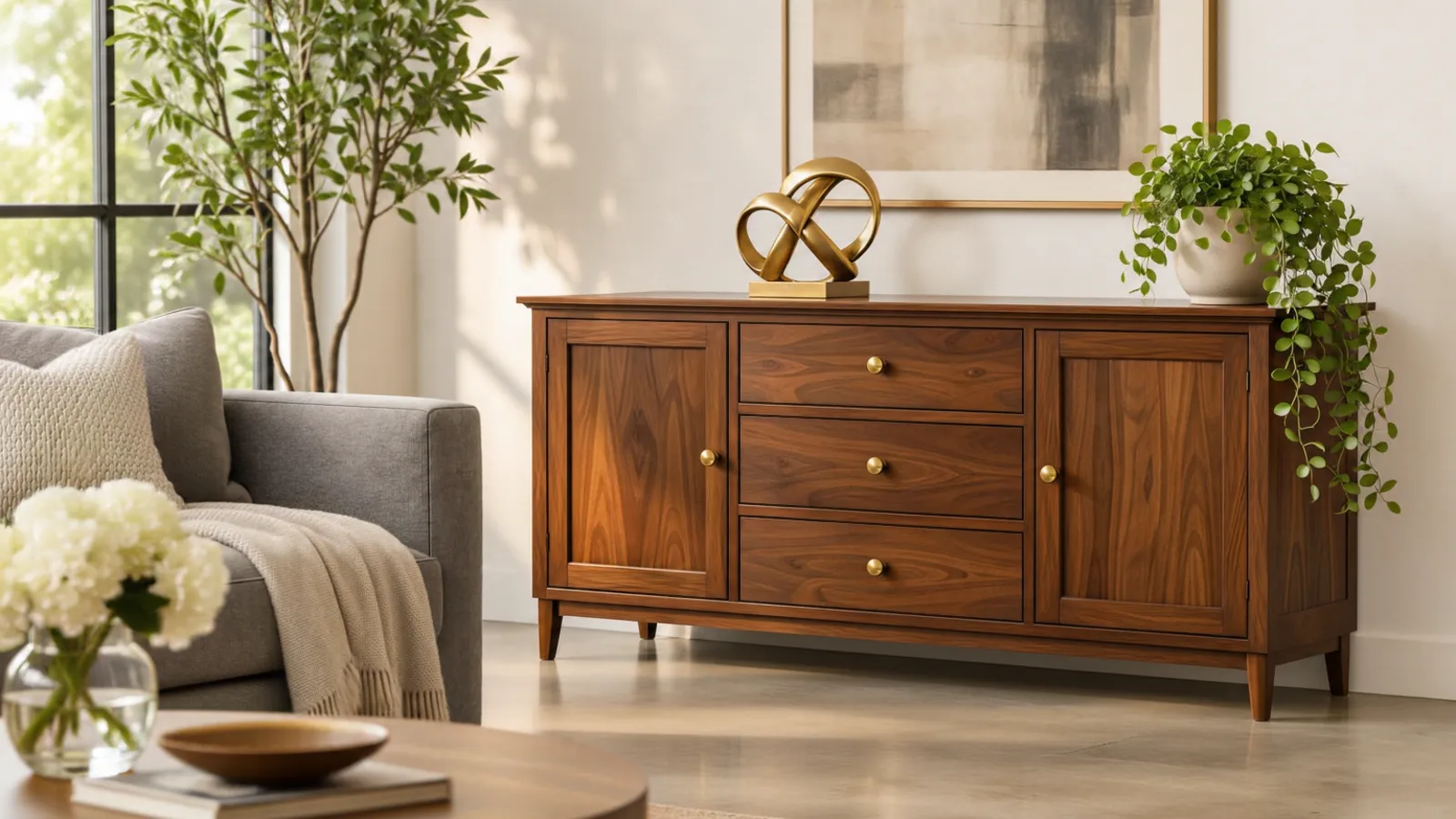
You inherited your grandmother's credenza, or you couldn't resist that velvet Victorian chair at the estate sale. Now it's in your living room, and something feels off. The problem isn't the piece—it's that vintage furniture follows different visual rules than the streamlined modern pieces around it. One carved leg or brass pull can read as timeless or cluttered depending on three factors: scale, finish, and surrounding context. Here's how to mix vintage furniture into a modern home so it feels intentional, not accidental.
Why One Vintage Piece Works Better Than Several
The single most important rule: start with one vintage piece per room. That carved sideboard or tufted armchair becomes a focal point that adds character without overwhelming the space. When you introduce multiple vintage items, they compete for attention and can tip the room from curated to cluttered.
Modern interiors rely on negative space—the quiet areas between furniture that let your eye rest. A single ornate piece provides contrast against that simplicity. It becomes special precisely because it stands alone. The moment you add a second vintage piece from a different era, you're no longer working with intentional contrast. You're working with a collection, and collections need different styling rules entirely.
There's a practical benefit too. Committing to one piece makes the styling decisions easier. You're not trying to balance multiple wood tones, multiple decorative styles, or multiple eras. You're simply asking: does this one piece work with everything else I own?
Match the Scale, Not the Style
Forget trying to match styles—a Victorian chair will never "match" a mid-century sofa, and that's fine. What matters is proportion. Your vintage piece should be sized appropriately for the room and the furniture around it.
A massive oak armoire will dominate a small bedroom, making everything else disappear. Meanwhile, a delicate vintage side table will look lost next to a large sectional sofa. Visual weight matters as much as actual dimensions. A glass-topped vintage table with ornate metal legs feels lighter than a solid walnut modern coffee table of the same size, even though one is "fancier."
The Sightline Test
Stand in the doorway of the room and notice what catches your eye first. If the vintage piece is the only thing you see—if your attention goes straight to it and stays there—it's either too large or too ornate for the space.
A carved wooden bench works beautifully at the foot of a king bed because the bed itself has enough visual weight to balance it. That same bench in a narrow entryway becomes overwhelming. The space can't absorb the detail, so the bench reads as too much.
When in doubt, choose a vintage piece that's slightly smaller than you think you need. It's easier to make a small piece feel substantial (with the right styling and placement) than to make an oversized piece feel appropriate.
Let the Finish Do the Work
Here's where most people get tripped up: they try to match materials. They think a wooden vintage dresser needs to "go with" their wooden bed frame. But modern wood furniture—with its uniform, matte finishes—looks nothing like aged wood with decades of patina. Trying to match them highlights the difference.
Instead, match undertones. A warm-toned walnut credenza pairs beautifully with brass modern light fixtures, even though neither is wood. They share a warm color temperature. That same credenza will fight with cool chrome hardware, creating visual tension that reads as "mismatched."
Polished vintage pieces integrate more easily than distressed ones. A lacquered mid-century dresser or a varnished antique table has a finished, intentional quality. Heavy distressing, chippy paint, or worn edges can read as shabby rather than curated, especially in a clean-lined modern room.
When to Refinish, When to Leave It
Refinish if the piece has visible damage, if the finish is that orange-toned oak stain popular in the 1980s and 90s, or if the form is simple and neutral. A plain wooden dresser with good lines but a bad finish is a perfect refinishing candidate. Strip it, sand it, and apply a clear matte or satin finish. Suddenly it reads as contemporary.
Leave the original finish if the patina is even and attractive, if it's a high-quality finish like French polish or hand-rubbed oil, or if the piece has significant decorative detail that refinishing might obscure. An elaborately carved piece often depends on the way light plays across the existing finish. A fresh coat of stain flattens that dimension.
One important caveat: if you suspect a piece might be a valuable mid-century or antique collectible, research its provenance before refinishing. While updating a 1990s pine hutch is a safe bet, stripping original finish from a documented designer piece can significantly decrease its value. When in doubt, consult an appraiser or antique dealer first.
As a concrete example: a mid-century teak dresser with its original oiled finish is almost always perfect as-is. The warm wood tone and subtle grain work beautifully in modern spaces. But a 1990s pine hutch with orange stain needs intervention. The form might be good, but that finish will always look dated.
Ground the Piece With Modern Context
Even a perfectly proportioned, beautifully finished vintage piece will look out of place if everything around it is also old. The key is surrounding your vintage item with clean-lined modern furniture and minimal accessories. This makes it clear that the antique is a deliberate choice, not a leftover from a previous decorating era.
Think of it as providing a frame. A Victorian armchair looks fussily old-fashioned when it sits on a Persian rug with floral pillows and a fringed lamp nearby. Those elements multiply the "old" signals until the entire corner feels theme-y. But that same chair on a concrete floor, next to a simple glass side table with one sculptural brass lamp? Now it's a statement piece.
Use modern textiles and accessories on or near the vintage furniture. Drape a sheepskin throw over a carved wooden chair. Place a single trailing houseplant on an antique side table. Stack a few large-format art books on a vintage trunk you're using as a coffee table. These contemporary touches create a bridge between eras.
The 80/20 Rule
Aim for roughly 80% modern furnishings and 20% vintage by visual weight. This isn't a precise calculation—you're not measuring square footage. But a quick scan of the room should show mostly contemporary pieces with one (or maybe two, in a very large space) vintage items.
This ratio keeps the vintage piece special. It's the gem in the room, not the dominant theme. When vintage creeps past 30-40%, you've left "modern with vintage accents" territory and entered "eclectic mix," which requires different design skills to pull off successfully.
Quick Reference:
- Keep it to one vintage piece per room
- Surround it with 80% modern furniture and décor
- Match undertones (warm with warm, cool with cool), not materials
- Style the surface with one large object or three coordinated items maximum
- Use solid modern textiles if reupholstering
Color Strategy: Neutralize or Amplify
Your color approach depends entirely on how decorative the vintage piece is. Highly ornate items—anything with carving, inlay, multiple wood tones, or elaborate hardware—need neutral surroundings. Keep the walls white, gray, or warm beige. Choose a simple sofa in linen or leather. Let the vintage piece provide all the visual texture.
An ornate gilt mirror or an intricately carved sideboard is already doing a lot of decorative work. Adding bold color nearby creates competition. The eye doesn't know where to land. Neutralize the space and suddenly the detail on the vintage piece becomes clear and beautiful.
But if your vintage piece is simple in form—a plain teak credenza, a streamlined brass bar cart, a minimal wooden trunk—you have room to amplify with color elsewhere. A jewel-toned velvet sofa, a gallery wall of colorful prints, or vibrant throw pillows all work because the vintage item isn't competing. Its simplicity can handle bold neighbors.
For example, an ornate French provincial dresser needs a quiet wall and minimal décor. But a clean-lined mid-century credenza can easily support a grouping of colorful abstract art hung above it. The credenza's horizontal lines and simple pulls won't fight with the visual energy of the art.
What Not to Do
Don't cluster decorative objects on top of an already ornate piece. If your vintage sideboard has carved details, inlay, or decorative hardware, it doesn't need six vases, a table runner, and a collection of candlesticks on top. One sculptural object or a small plant is enough. Less is more when the furniture itself provides the decoration.
Don't try to match wood tones between vintage and modern pieces. Modern wood furniture typically has flat, uniform finishes that look nothing like the grain and patina of antique wood. Placing them side by side highlights the difference in an unflattering way. It's better to embrace the contrast—pair your vintage wooden piece with metal, glass, or upholstered modern furniture instead.
Don't add more vintage items thinking they'll make the first one feel more at home. One 1920s chair is interesting and intentional. One 1920s chair plus a 1950s lamp plus a 1970s side table reads as "I furnished this room at estate sales." Unless you're skilled at eclectic design, each additional vintage piece from a different era makes the room feel less cohesive, not more.
Frequently Asked Questions
Can I mix different vintage eras in one room?
Not if you want the room to read as modern. Stick to one vintage piece per room unless the additional pieces are extremely minimal or share a unifying finish, like all brass or all dark wood. Multiple eras create an eclectic or collected look, which is lovely but different from a modern room with vintage accents. If your goal is contemporary style with one antique accent, keep it to one.
Should I recover vintage upholstered furniture?
Almost always, yes. Original fabric—especially florals, brocade, or worn velvet—signals "vintage" too strongly and can make the piece look dated rather than timeless. Have it recovered in a solid modern textile like linen, wool, or performance fabric in either a neutral tone or a single bold color. You keep the beautiful frame and bones of the piece while updating its surface to work in a contemporary space. This single change often makes the difference between a piece that looks like a grandma hand-me-down and one that looks curated.
What if the vintage piece is the wrong color for my space?
Paint or refinish wood furniture if the form is good but the finish doesn't work. Brass and metal pieces can be spray-painted in matte black, which gives them a modern edge while preserving their shape. If it's upholstered, reupholstery solves the color problem. For decorative objects like mirrors or frames, consider whether the piece is worth the effort. Sometimes it's better to pass on an item that requires too much intervention, even if it was free or inexpensive.
How do I style the surface of a vintage piece so it doesn't look cluttered?
Use the rule of one or three. Place either one large object—a sculptural vase, a substantial stack of books, a single large plant—or three objects in varying heights that share a color or material, like three matte black candlesticks or three ceramic vessels in different sizes. Avoid doilies, fussy florals, and collections of small tchotchkes. The simpler your styling, the more the vintage piece itself can shine.
What's the easiest vintage piece to start with?
A simple wooden credenza, sideboard, or dresser with clean lines and minimal carving. These provide useful storage, have enough visual weight to feel substantial without dominating a room, and can be refinished if the existing finish doesn't work. Avoid heavily carved pieces, ornate mirrors, or anything with original floral upholstery for your first vintage purchase unless you're prepared to invest in professional refinishing or reupholstery. Starting simple gives you confidence and helps you understand the principles before taking on more challenging pieces.
Learning how to mix vintage furniture into a modern home is less about following rigid rules and more about understanding visual balance. When you match scale, update or work with the existing finish, surround the piece with modern context, and keep your ratio heavily weighted toward contemporary furnishings, that single inherited or thrifted piece transforms from a decorating problem into the most interesting thing in the room.





Join the conversation
Sign in — Sign in to join the conversation.