
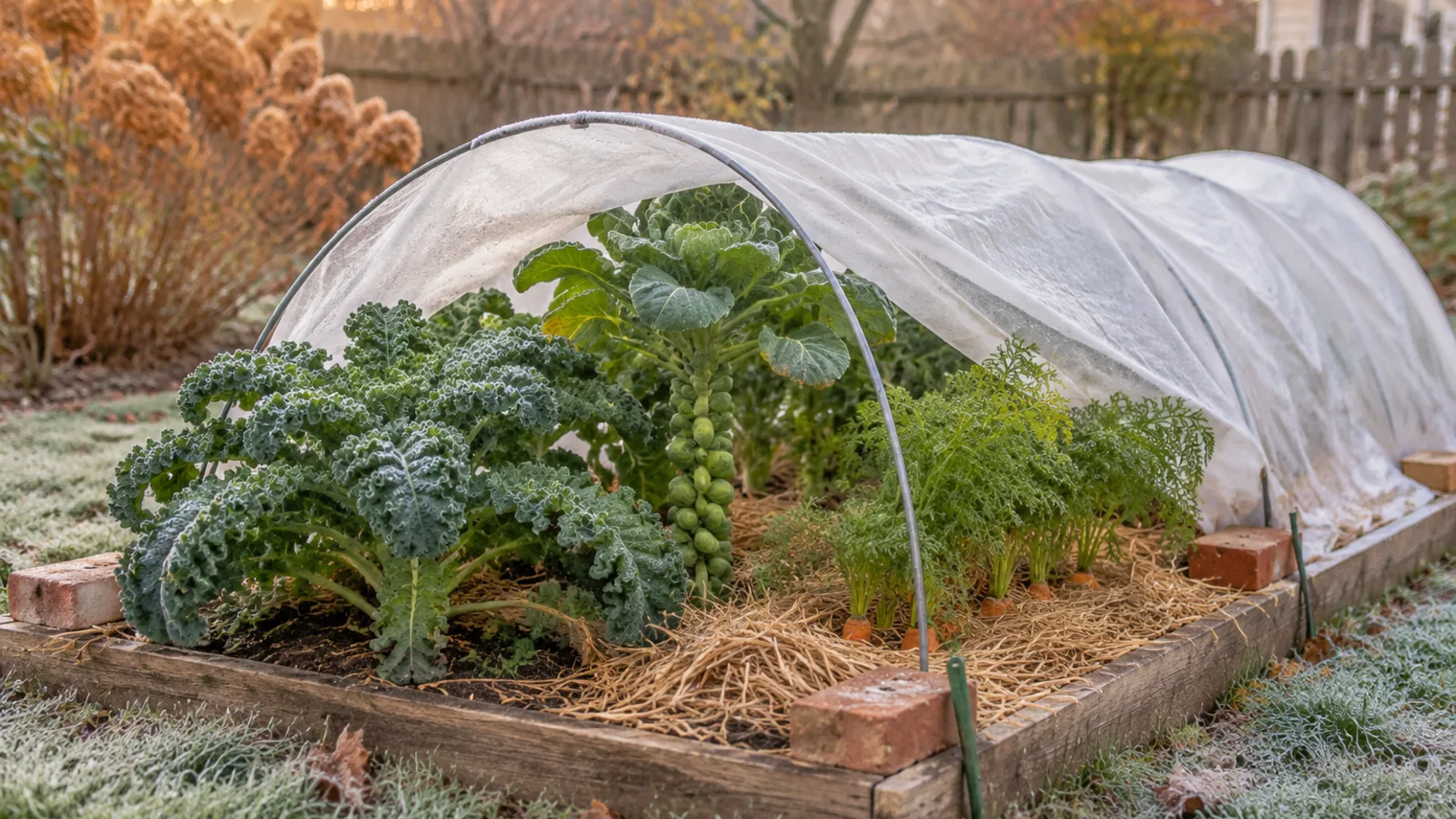
A hard-freeze warning lands on your phone at nine in the evening. Your kale is still in the ground, your half-grown carrots are right where you left them, and the nearest greenhouse belongs to your neighbour. Here is the thing: you do not need their greenhouse. Knowing how to protect your vegetable garden from frost is mostly a matter of understanding which plants need help, which ones actually benefit from cold, and which simple, low-cost methods work reliably in a home garden. This guide gives you a clear temperature reference, a method for every situation, and a checklist you can use on the evening of a frost warning — no permanent structures required.
What frost actually means — and why it is not one thing
A forecast that says “frost tonight” is not specific enough to act on. The difference between a light frost and a hard freeze can mean the difference between a slightly nipped lettuce and a dead one.
Three thresholds matter to home gardeners. A light frost sits roughly between 28 and 32°F (-2 to 0°C): delicate leaves may show some damage, but most hardy crops come through fine. A hard frost falls below 28°F (-2°C) and poses a serious risk to any exposed foliage. A sustained killing freeze — several consecutive nights well below that mark — ends the season for anything left unprotected.
What actually kills a plant is ice forming inside the cells and rupturing them. Cold air itself is not the direct mechanism; the destruction is cellular. Wind speeds up the process by stripping the thin layer of still air that naturally sits against a leaf surface, and clear, still nights are when radiation frost strikes hardest, because there is no cloud cover to trap warmth.
Reading your forecast correctly
Forecasting services use specific terms worth knowing. A frost advisory means temperatures are expected to fall to around 33–36°F (1–2°C): a risk for tender plants, but most hardy crops need no cover. A freeze warning means 28–32°F (-2 to 0°C): cover brassicas and salad crops. A hard freeze warning means below 28°F (-2°C): act immediately on anything you have not already harvested or protected.
What to cover, harvest, or leave well alone
Not every plant in your garden has the same relationship with cold. Getting this right saves unnecessary work and, in several cases, actively improves the harvest.
- 28 to 32°F (-2 to 0°C): cover tender salad crops and brassicas that are close to harvest.
- Below 28°F (-2°C): cover exposed broccoli side-shoots, cauliflower heads, and cabbage hearts; move or harvest anything tender.
- Below 32°F (0°C) for several hours: harvest tomatoes, peppers, courgettes (zucchini), climbing beans, and basil before damage sets in.
- After the first light frost: leave parsnips, carrots, kale, Brussels sprouts, leeks, and swede (rutabaga) in place if you want sweeter flavour and the weather is not severe.
Crops that taste better after a light frost
Parsnips, carrots, kale, Brussels sprouts, leeks, and swede (rutabaga) convert starches to sugars when their internal temperatures dip just below freezing. This is straightforward flavour chemistry, not gardening folklore. Leave these in the ground deliberately and harvest them after the first frost rather than rushing to dig them beforehand. A parsnip lifted in winter after several frosts will usually be noticeably sweeter than one pulled in autumn.
Crops that tolerate hard frost with minimal help
Garlic, overwintering onion sets, spinach, chard, and winter-variety lettuces handle temperatures well below freezing once established. They may look completely collapsed on a cold morning — leaves lying flat, stems down — and recover fully by mid-afternoon as the soil warms. Do not pull them unless the plant itself has turned mushy.
Crops that need cover below 28°F
Broccoli side-shoots, heading cauliflower, and cabbage hearts are worth protecting at this threshold. The plants themselves are quite tough; the edible part is more vulnerable. A layer of fleece over the worst of a hard-frost night is usually enough.
Tender crops: why you must harvest before the first frost
Tomatoes, peppers, courgettes (zucchini), climbing beans, and basil will not survive once temperatures consistently fall below 32°F (0°C). Pick everything usable before the first forecast frost. Green tomatoes ripen well on a windowsill or in a drawer alongside an apple; they do not need sunlight to do it.
Work with your garden’s microclimates before you spend anything
The most reliable frost protection costs nothing: it is the placement of your plants relative to walls, structures, and the natural movement of cold air through your garden.
South-facing walls in the Northern Hemisphere, or north-facing walls in Australia and the Southern Hemisphere, absorb heat during the day and radiate it overnight, keeping nearby air several degrees warmer than an open bed. A row of Brussels sprouts planted along a brick wall can survive a night that damages identical plants just a few feet away in an exposed spot. Raised beds drain cold air away from roots and warm up faster in the morning sun.
Low-lying areas are the opposite: cold air is denser than warm air and flows downhill, pooling in dips and hollows. These are genuine frost pockets. If one corner of your garden always freezes first and hardest, that is the reason — and moving sensitive crops away from it costs nothing.
Windbreaks help too. A hedge, fence, or even a temporary screen can reduce the drying effect of wind on leaves and fleece. Just avoid creating a fully enclosed space that traps damp air around plants for days on end.
Deep mulching — the method most guides underestimate
Mulch does not warm the air above your plants. What it does is stabilise the soil temperature below them, and that distinction matters. A thick layer prevents the freeze-thaw cycling that physically heaves plants out of the ground by repeatedly expanding and contracting the soil around their roots.
Apply straw, shredded dry leaves, or wood chip to a depth of 3 to 6 inches (8 to 15 cm), pulling the material back slightly from stems and crowns to avoid trapping moisture against the plant. A practical use: carrots left in the ground all winter under a straw mulch can be dug as needed in mild to moderate winters, with no storage required. In very cold regions, mulch still helps, but it will not keep the ground workable through deep, sustained freezes.
What not to use as autumn mulch
Fresh or partially composted manure introduces high nitrogen at the wrong time and can scorch roots going into dormancy. Impermeable materials — standard black plastic sheeting, for instance — trap moisture against crowns and create the conditions for rot. Breathable materials work; sealed ones do not.
How to protect your vegetable garden from frost with breathable row covers
Horticultural fleece — called floating row cover in North America — works by trapping a thin layer of still air between the fabric and the plant. It consistently outperforms plastic sheeting because plastic creates condensation, restricts gas exchange, and can raise temperatures inside the cover to damaging levels even on a cold but sunny day.
Weight matters when you are choosing fabric. Lightweight fleece, roughly 17 to 30 gsm, gives around 2 to 4°F (1 to 2°C) of protection and suits light-frost conditions. Heavier fabric, around 50 to 70 gsm, adds up to 6 to 8°F (3 to 4°C) for harder frosts. Secure the edges with tent pegs, stones, or by burying the hem in a shallow trench — a cover that blows off at midnight provides no protection at all.
If snow is part of your winter weather, keep the structure low enough to shed heavy wet snow. High, loose tunnels catch wind and can collapse onto the crop, which defeats the purpose.
The ventilation rule
On any day where the temperature climbs above around 50°F (10°C), open the ends of your tunnel or lift the fleece. Closed covers in mild spells trap humidity, encourage grey mould (botrytis), and can push brassicas to bolt prematurely. If you would open a window in the house, ventilate your covered beds.
DIY hoops and low tunnels: one afternoon’s work
Laying fleece directly onto plants works, but hoops are worth the small extra effort. A cover sitting above the foliage traps a larger volume of air, insulates more effectively, and does not physically damage leaves by pressing wet fabric against them overnight.
Useful materials include flexible alkathene water pipe or irrigation tubing pushed over short rebar stakes, lengths of heavy-gauge wire fencing bent into arches, or fresh-cut willow or hazel rods for a no-cost option. Space hoops roughly every 3 feet (90 cm), make them tall enough that a full-grown kale plant clears the fabric, and secure the ends by pegging or weighting the cover at both ends of the row.
For a low tunnel, keep the profile compact enough to stand up to wind and winter weather. A smaller tunnel is often more stable than a tall one, especially in an exposed garden.
Single-plant cloches: no construction needed
For an individual plant or small cluster, a cloche takes minutes to set up. A large clear plastic bottle with its base cut off works well; so does an inverted clear storage container weighted with a stone. Remove the bottle cap during the day — or the temperature inside will spike. Traditional glass bell cloches do the same job, though they tip in wind if not secured.
Cold frames: the middle ground
A cold frame is a bottomless box with a transparent lid, usually angled to catch low winter sun. It is not a greenhouse — there is no heating — but it extends the season reliably and can be built from reclaimed timber and a salvaged window for very little cost. Bought polycarbonate versions are more consistent in size and easier to ventilate, at a higher outlay.
Cold frames suit winter salad leaves, spinach, overwintering herbs, and spring seedlings being hardened off. Ventilate by propping the lid open on a stick when the internal temperature rises above around 45°F (7°C).
The Royal Horticultural Society has useful guidance on cold frames and their best uses.
A quick emergency kit for a frost warning
If you only have a few minutes before sunset, gather the simplest possible protection first. These are the items worth grabbing in order:
- Old fleece, horticultural fleece, or a clean bedsheet for a one-night emergency
- Bricks, stones, or pegs to hold fabric down
- Flexible tubing, wire, or branches for improvised hoops
- Straw or dry leaves for root crops and crown protection
- Clear bottles or containers for single-plant cloches
Use this kit to buy time, not perfection. A simple, secure cover that stays in place all night is far better than an elaborate tunnel that blows away.
A seasonal checklist: early autumn through late winter
First-frost dates vary by several weeks between climates — and sometimes between gardens. Use this as a loose sequence, not a rigid calendar. The Old Farmer’s Almanac frost date tool lets you look up average first and last frost dates by postcode or zip code.
- Early autumn: Harvest all tender crops before the first forecast frost. Plant garlic and overwintering onion sets. Sow spinach and winter lettuce under cover. Layer mulch over root crops you plan to leave in the ground through winter.
- First frost forecast: Cover brassicas and any remaining salad crops. Check that cloche and cold frame vents can close fully. Pull the last of the summer squash.
- During a sustained cold spell: Check that covers have not blown off or pooled with standing water. Avoid harvesting root crops while the ground is frozen solid — wait for a thaw. Note which plants show damage and which recover, as it will inform next year’s placement decisions.
- Late winter into early spring: Ventilate more aggressively as day length increases. Remove covers once overnight lows consistently stay above 28°F (-2°C). Begin hardening off any seedlings started indoors by leaving the cold frame lid open for progressively longer periods each day.
Frequently asked questions
Can I use ordinary plastic sheeting instead of horticultural fleece?
For an emergency overnight fix, plastic can work — but it comes with real drawbacks. It traps moisture against leaves, restricts gas exchange, and can raise temperatures inside the cover to damaging levels on a cold but sunny day. If you use it, remove it as soon as the temperature rises in the morning and never seal it tightly at the edges. For anything beyond a single-night emergency, breathable fleece is a better investment.
How long after a frost is it safe to uncover my plants?
Wait until the air temperature has clearly risen above freezing and any frost on the ground has melted — usually mid-morning for most hardy crops. Uncovering plants while they are still frozen and immediately exposing them to direct sun can cause cells to thaw too rapidly, which can damage tissue as much as the frost itself. When in doubt, leave the cover on until early afternoon.
My carrots have been in the ground since September — will they survive a hard freeze?
Maybe, but it depends on your climate and how deep the freeze goes. In mild to moderate winters, carrots often overwinter well under a generous mulch. In colder regions, especially where the soil freezes deeply, mulch will help but may not keep the roots fully thawed. If you garden in a northern climate or a very exposed site, harvest the best roots before the ground becomes solid, and treat mulch as insurance rather than a guarantee.
Do garlic and overwintering onions need frost protection?
Generally, no. Both are planted specifically to overwinter in the ground and actually need a period of cold to develop correctly. A hard frost on bare soil immediately after planting can occasionally lift small bulbs out of the ground, so a light straw mulch just after planting is worthwhile — not to protect from cold, but to stabilise the soil around them. Once they have established with visible shoot growth, they need no additional cover.
What is the difference between a “last frost date” and a “killing frost,” and which one should I be planning around?
A last frost date is a statistical average — the date after which frost is unlikely, based on historical records for your area. It is a spring planning tool, not a guarantee. A killing frost is a specific event: a temperature drop severe enough and prolonged enough to end the growing season for tender plants. For autumn and winter protection, the killing frost threshold is what matters. Your last frost date in spring tells you when to put tender plants out; your first killing frost in autumn tells you when to bring them in.
Knowing how to protect your vegetable garden from frost ultimately comes down to two habits: reading forecasts in terms of specific temperature thresholds rather than vague warnings, and matching your response to what each crop actually needs. Some of your best harvests will happen in January, pulled from under a layer of straw on a morning when the rest of the garden is frozen solid. No greenhouse required.




Join the conversation
Sign in — Sign in to join the conversation.