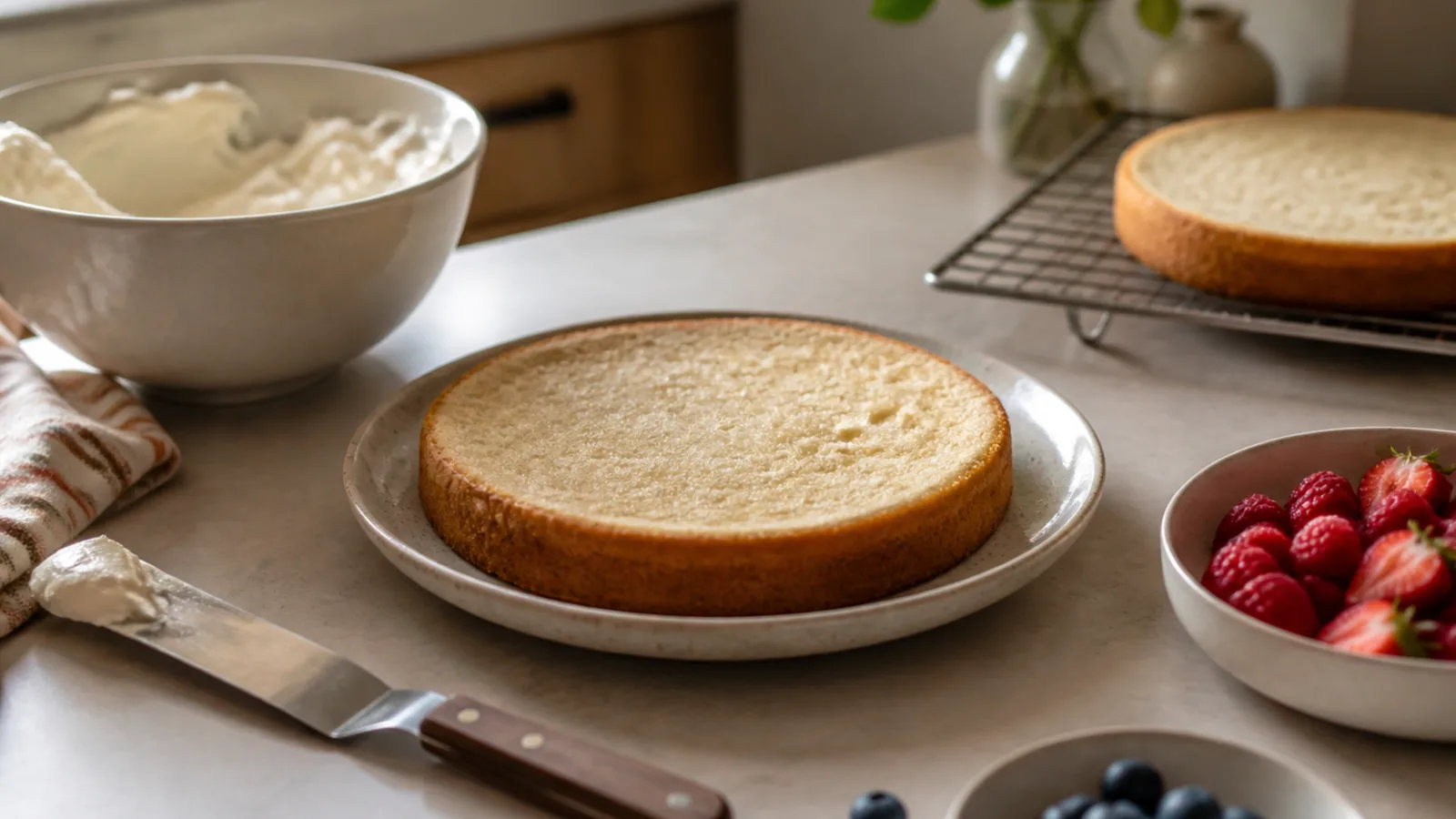
You pulled a cake from the oven, admired the rise, turned away for five minutes and came back to a crater. Or maybe it cracked across the top, baked up heavy, or tasted oddly dry despite following the recipe. If you have ever searched “why did my cake sink” while staring at a cooling rack, you are not alone.
Even skilled bakers have cakes collapse. The difference is that experienced bakers know how to read the clues: the crack pattern, the crumb, the pan, the oven temperature, the way the batter looked before it went in. Most cake failures are not mysterious. They usually come down to heat, measuring, mixing, leavening, pan size, bake time or altitude.
The calm baker’s rule: identify the symptom first, then change one likely cause at a time. Guessing wildly makes the next cake harder to fix.
Quick diagnosis: what went wrong with your cake?
If your cake sank in the middle
A sunken centre usually means the cake rose before its structure had time to set. Baking is a race between expanding gas bubbles and the egg, flour and starch framework firming up around them. If the bubbles grow too fast or too large, the cell walls stretch thin and collapse.
The most common causes are underbaking, too much baking powder or baking soda, opening the oven door too early, an oven that runs too hot or too cool, or a batter made too wet with extra milk, fruit puree, syrup, oil or melted chocolate.
A little sinking can be normal in rich cakes, cheesecakes and flourless chocolate cakes. A deep dip in a sponge, birthday cake or layer cake is a sign that something needs adjusting.
If your cake cracked on top
Cracking often happens when the outside of the cake sets before the centre has finished expanding. This can be caused by an oven that is too hot, a pan placed too high, too much flour, or a batter that is too stiff.
Not every crack is bad. Loaf cakes, pound cakes, banana bread and lemon drizzle cakes often split neatly down the middle. That can be part of their character. A delicate sponge with a hard crust and a dramatic peak, however, probably baked too aggressively.
If your cake turned out dry
Dry cake is usually the result of overbaking, too much flour, too much cocoa, too little fat or liquid, a pan that is too large, or poor storage. Even a cake that leaves the oven tender can dry out if it sits uncovered on the counter for hours.
Cakes continue to firm as they cool. If you bake until the skewer is completely dry and the edges are pulling firmly away from the tin, you may have taken it too far.
If your cake is dense, gummy or heavy
Dense cake can come from overmixing once flour is added, under-creaming butter and sugar, expired leavening, too much liquid, or underbaking. Gummy crumbs often point to excess moisture or a centre that did not bake through, while rubbery texture often suggests overmixing.
Why did my cake sink? The most common causes
The cake was underbaked
This is the most common reason a cake collapses after baking. The top may look golden and the edges may pull away slightly, but the middle still needs time for starches and proteins to set. Once the cake leaves the oven, that weak centre sinks.
The 5-point doneness test: the centre looks set, the top springs back lightly, a skewer shows moist crumbs rather than wet batter, the cake smells baked, and the edges are just beginning to release from the pan or cake tin.
Test in the centre, not just near the edge. If the recipe contains melted chocolate, fruit or jam, check in more than one spot because sticky ingredients can make a skewer look wetter than the crumb really is.
Your oven temperature was off
Home ovens often run hotter or cooler than the dial suggests. A hot oven can make a cake rise dramatically and then collapse because the structure cannot keep up. A cool oven can delay setting and leave the centre heavy.
A simple oven thermometer can be surprisingly useful. Place it in the centre of the oven and check it during a few bakes. You may discover that your oven runs hot, takes longer to preheat than it claims, or fluctuates more than expected.
You used fan or convection heat without adjusting
Fan and convection ovens circulate heat efficiently, so cakes may bake faster and brown more quickly. As a common rule of thumb, many bakers reduce a conventional oven temperature by about 20°C, or roughly 25°F to 30°F, when using fan or convection. Ovens vary, so your manual and your own notes matter, but that adjustment is a sensible place to start.
If a recipe gives both conventional and fan temperatures, use the one that matches your oven. If it does not, check the cake 5 to 10 minutes earlier than the recipe suggests, especially for cupcakes and shallow layers.
The oven door was opened too early
Cakes are fragile in the first stage of baking. Opening the oven door too soon can cause a rush of cooler air and a sudden temperature drop, especially in smaller ovens. If the cake has not set, the centre may sink.
Try not to open the door until the cake looks risen and set, and you can smell that baked-cake aroma. When you do check, open the door gently and close it promptly.
There was too much leavening
Baking powder and baking soda create the gas that helps cakes rise. More is not better. Too much leavening can produce large bubbles that inflate quickly, then collapse. It can also leave an unpleasant bitter or soapy taste, especially with baking soda.
Be careful with flour swaps. Self-raising or self-rising flour already contains a raising agent, and sometimes salt. If a recipe calls for plain flour or all-purpose flour plus baking powder, swapping in self-raising flour without adjusting the leavening may throw off the balance.
The batter had too much liquid, sugar or fat
Cakes depend on balance. Extra mashed banana, applesauce, yoghurt, milk, syrup, honey, oil or melted chocolate can all change the structure. The cake may taste lovely but lack the strength to hold its rise.
This is especially common when adapting recipes to be “moister” or less sweet. Reducing flour, cutting eggs, adding fruit puree or increasing liquid can work in a tested recipe, but casual changes often lead to sinking or gumminess.
The pan was the wrong size or material
A smaller, deeper pan makes the batter thicker and increases the time needed for the centre to bake. A larger pan spreads the batter thinly, so it bakes faster and may dry out. Dark metal pans can brown edges quickly; glass and ceramic hold heat differently from metal.
If you change the baking pan or cake tin, expect the timing to change too. A batter that works in two shallow sandwich tins may not behave the same way in one deep tin or a loaf pan.
Cracked cakes: when to worry and when to relax
Normal cracks versus problem cracks
A central split in a banana bread, lemon loaf or pound cake is often normal. These batters are dense, and the top sets as the centre continues to rise. A rustic crack can be exactly what you want.
Cracking is more concerning when a delicate layer cake forms a sharp peak, a thick crust or a dry canyon. That usually points to too much heat from above, too much flour, or batter that is too stiff.
Rack position matters
The middle rack is usually the safest place for cakes unless the recipe says otherwise. If a cake sits too high, the top may set and brown before the centre can rise evenly.
If your cupcakes dome sharply and crack, try baking the next batch slightly lower in the oven or reducing the temperature a little. Make one change at a time so you know what helped.
Too much flour can cause cracking
A stiff batter has to push harder as it expands, which can split the surface. This often happens when flour is measured by scooping straight from the bag with a measuring cup. The flour compacts, and you can add more than the recipe intended.
If you use cups, stir or fluff the flour first, spoon it into the cup, then level it with a straight edge. Do not tap or shake the cup. For the most consistent results, weigh flour with a kitchen scale.
Dry cakes: why they happen and how to prevent them
Overbaking is the usual suspect
Small cakes and cupcakes can go from tender to dry in just a few minutes. Start checking at the lower end of the recipe’s time range. If the cake springs back and the skewer shows a few moist crumbs, it is usually ready.
Carryover heat matters too. A cake continues to cook for a short time after it leaves the oven, especially in a heavy pan. Follow the recipe’s cooling instructions: some cakes need to sit briefly in the pan, while delicate ones may need turning out sooner.
Too much flour or cocoa absorbs moisture
Flour and cocoa are thirsty ingredients. Accidentally adding too much can create a dry, tight crumb. Cocoa-heavy cakes often need enough fat, sugar and liquid to stay soft.
Be cautious with swaps such as wholemeal flour, almond flour, coconut flour, protein powder or extra cocoa. These ingredients do not absorb liquid in the same way, and they may need a recipe designed for them.
Cutting sugar or fat changes texture
Sugar does more than sweeten. It helps hold moisture and tenderise the crumb. Fat also keeps cake soft. If you significantly reduce sugar, butter or oil, the cake may become drier, firmer or more bread-like.
Small reductions may be fine in some recipes, but larger changes are best tested before an important birthday, dinner party or bake sale.
Measuring: why weight beats volume for cakes
Measuring by weight is one of the easiest ways to improve your cakes. A cup of flour can vary depending on who scoops it, how compacted the bag is, and even the cup size used in different countries. Grams remove much of that guesswork.
If you do not have scales, improve your volume measuring with these habits:
- Use dry measuring cups for dry ingredients and liquid jugs for liquids.
- Fluff flour before measuring.
- Spoon flour into the cup rather than scooping with the cup.
- Level with a knife or straight edge.
- Pack brown sugar only if the recipe tells you to.
- Measure baking powder and baking soda with level spoons, not heaped ones.
Regional terms can also trip you up. Powdered sugar and icing sugar are broadly the same category. Plain flour in the UK and Australia is similar in use to all-purpose flour in North America, though brands vary. Heavy cream and double cream are not identical, so use the cream specified in the recipe when texture matters.
Mixing mistakes that ruin cake texture
Overmixing after adding flour
Once flour meets liquid, gluten begins to develop. Some gluten is useful, but too much can make cake tough, rubbery or dense. After adding flour, mix only until the dry streaks disappear unless the recipe gives different instructions.
A good habit is to stop the mixer just before the batter looks perfect, scrape the bowl, and finish gently with a spatula.
Undermixing during creaming
In butter cakes, creaming butter and sugar is not just combining ingredients. It beats in tiny air pockets that help the cake rise. If you rush this step, the cake may bake up squat and heavy.
Properly creamed butter and sugar usually looks lighter, fluffier and slightly increased in volume. Scrape the bowl so dense butter does not hide at the bottom.
Folding too aggressively
Foam-based cakes, such as genoise, chiffon and some sponge cakes, rely on whipped eggs or egg whites. Stirring too firmly knocks out the air. Fold slowly and deliberately, turning the bowl and lifting batter from the bottom rather than beating it.
Leavening: baking powder, baking soda and self-raising flour
Baking powder contains both an acid and a base, while baking soda needs acidity in the batter to react properly. Recipes use one or both for a reason. Buttermilk, yoghurt, lemon juice, brown sugar and some cocoa powders can affect which leavening is needed.
Old leavening may also fail. If baking powder or baking soda has been sitting open for a long time, especially in a humid kitchen, replace it before a special bake. Store it sealed and dry.
Avoid casual swaps between plain flour, all-purpose flour, cake flour, self-raising flour and wholemeal flour. They differ in protein, texture and, in the case of self-raising flour, added leavening.
High-altitude baking: why cakes sink, dry out or overflow
At higher altitude, air pressure is lower and moisture evaporates faster. Cakes may rise quickly, overflow, dry out, or sink before they set. This is common in places such as Denver, Calgary, mountain towns and alpine regions.
There is no single fix for every cake, but common adjustments include slightly reducing leavening, increasing liquid, making small changes to sugar, and sometimes using a slightly higher oven temperature with a shorter bake time. The right adjustment depends on your elevation, recipe, pan and oven.
If you bake at altitude often, keep notes and use local resources where possible. University extension services, such as Colorado State University Extension, offer practical high-altitude baking guidance.
How to rescue a cake that sank, cracked or dried out
If the cake sank but is fully baked
Do not throw it away. Level the top and frost it, or turn the dip into a feature. Fill a shallow sunken centre with lemon curd, whipped cream or double cream, ganache, berries or roasted fruit. Dust the rim with powdered sugar or icing sugar.
For a deeper sink, cube the fully baked cake and make trifle, parfaits, cake cups or layered desserts. A sunken vanilla cake with custard and berries can still be wonderful.
If the centre is underbaked
If the cake has just come out and is still hot, return it to the oven straight away. Cover the top loosely with foil if needed. If it has cooled and the middle is raw, it usually will not bake evenly as a whole cake.
Be firm about safety here: do not turn raw or partly raw batter into cake pops or trifles. Raw flour and raw eggs can carry harmful bacteria, and a cooled cake with a raw centre is not something to casually rescue hours later. If the edges are fully baked, you may be able to cut them away and use only those baked portions, but discard any raw or doubtful centre. For broader food safety guidance, see FoodSafety.gov.
If the cake is dry
Brush it with syrup. A simple ratio is equal parts water and granulated sugar, heated until the sugar dissolves. For an 8-inch or 20cm cake layer, start with 2 to 3 tablespoons of syrup; you can add more, but you cannot easily remove it. Try warm syrup on a cool cake or cool syrup on a warm cake so it absorbs evenly without turning soggy.
Flavour the syrup with citrus zest, coffee, vanilla, fruit juice or, for adult desserts, a little liqueur. Dry chocolate cake can be brushed with coffee syrup and layered with whipped cream. Dry sponge can become trifle. Dry loaf cake can be toasted and served with fruit and cream.
If the cake cracked badly
Trim the top if you need a flat layer, then flip the cake so the neat base becomes the top. Frosting, ganache, glaze and crumble toppings hide many sins. If you are stacking layers, put the roughest layer in the middle and save the smoothest for the top.
The cake rescue hierarchy: syrup for dryness, filling for dips, frosting for cracks, trifle for anything fully baked but too messy to slice.
The next-bake checklist
Before you start
- Read the recipe all the way through.
- Check the pan size and oven setting.
- Bring ingredients to the temperature listed.
- Check that baking powder or baking soda is fresh.
- Preheat the oven properly.
- Prepare the pan before mixing the batter.
While mixing
- Measure by weight when possible.
- Cream butter and sugar properly if the recipe requires it.
- Mix gently once flour is added.
- Scrape the bowl so ingredients combine evenly.
- Avoid untested substitutions for important bakes.
While baking
- Use the recommended rack, usually the centre.
- Do not open the oven door too early.
- Start checking at the low end of the time range.
- Use several doneness cues, not just colour.
- Cool the cake as directed.
Keep a simple cake log
If a recipe matters to you, write down what happened. This is especially useful if your oven runs hot, you bake at altitude, or you often adapt recipes.
- Recipe:
- Pan or cake tin:
- Oven setting:
- Bake time:
- Texture:
- What I will change next time:
Common cake problems and likely fixes at a glance
- Sunken centre: Underbaked, too much leavening, oven door opened early, oven temperature off, too much liquid, high altitude.
- Cracked top: Oven too hot, rack too high, too much flour, batter too stiff.
- Dry crumb: Overbaked, too much flour or cocoa, pan too large, too little fat or sugar, poor storage.
- Dense or heavy cake: Overmixed batter, under-creamed butter and sugar, expired leavening, too much liquid.
- Sticky top: Trapped steam, humid storage, high sugar, or slight underbaking.
- Burnt edges and raw middle: Oven too hot, pan too dark, pan too deep, cake placed too high.
- Cake stuck in pan: Pan not greased or lined well, cake too delicate, or cake left too long before turning out.
FAQ
Why did my cake sink after I took it out of the oven?
The structure probably had not fully set, even if the top looked done. Other likely causes include too much baking powder or baking soda, excess liquid, opening the oven door early, or an oven temperature problem.
Can I put a sunken cake back in the oven?
If it has just come out and is still hot, yes, you can often return it to the oven right away. If it has cooled and the centre is raw or gummy, it usually will not bake evenly as a whole cake. Discard any raw centre rather than using it in another dessert.
Is a cracked cake ruined?
Usually not. Cracks are normal in many loaf cakes and pound cakes. For layer cakes, trim the top, flip the cake, or cover it with frosting, ganache or glaze.
Why is my cake dry even though I followed the recipe?
The most common reasons are overbaking, too much flour from volume measuring, a pan that made the batter too shallow, or an oven running hot. Storage can also dry out a cake after it bakes.
Should I measure cake ingredients in grams or cups?
Grams are more consistent, especially for flour, cocoa and sugar. Cups can work, but use the spoon-and-level method for dry ingredients and avoid packing unless the recipe specifically says to.
Conclusion
The next time you wonder “why did my cake sink,” start with the basics: was it fully baked, was the oven accurate, did you measure carefully, and did the batter have the right balance of lift and structure? Cake troubleshooting is not about perfection. It is about building the kind of kitchen intuition that lets you spot a problem early, save what you can, and bake with more confidence next time.




Join the conversation
Sign in — Sign in to join the conversation.