
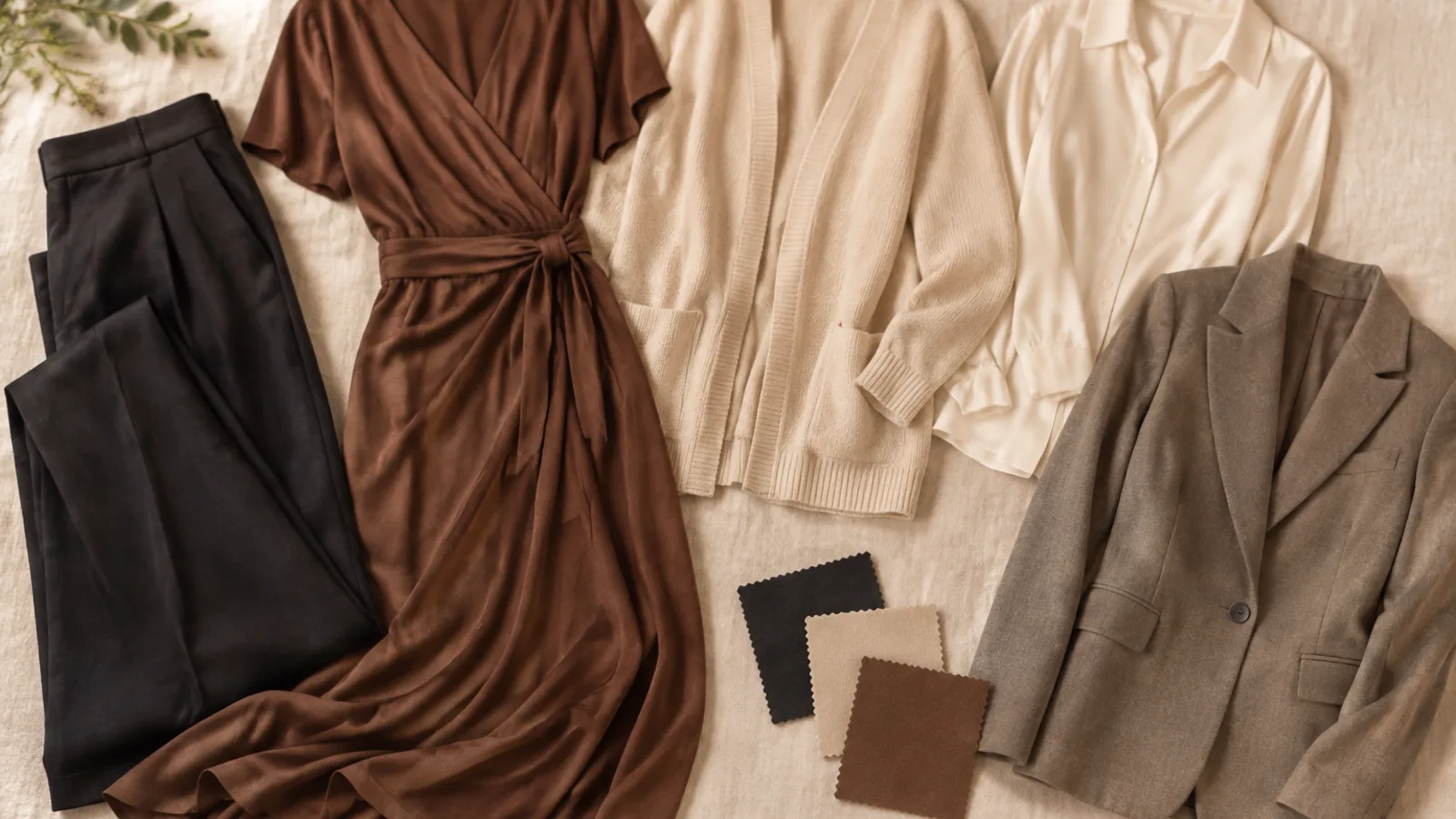
Every capsule wardrobe guide eventually tells you to invest in well-fitting basics. It is advice that sounds sensible right up until your body stops cooperating with the concept of a fixed fit. For many women in their forties and fifties, that moment arrives quietly — a waistband that worked last spring feels constricting by autumn, a beloved blazer sits differently after a stressful few months, and the size on the label becomes an increasingly unreliable narrator. Building a midlife capsule wardrobe — one that feels genuinely flattering and comfortable — is not about finding better basics. It is about using different criteria altogether: ones built for a body that moves, shifts, and refuses to stay still.
This is not a problem with your body. It is a flaw in the original framework.
Why Standard Capsule Rules Break Down in Midlife
The classic capsule wardrobe model was designed around the assumption of a stable body: buy twelve pieces in your size, wear them indefinitely, replace as needed. That logic works when your size is consistent. Hormonal fluctuation, water retention, and the gradual redistribution of fat that accompanies perimenopause and menopause mean that your size may span a range of two to three sizes across any given month, and shift further over a few years.
Body-shape frameworks — the apple, pear, hourglass system — compound the problem. They treat your silhouette as fixed and assign rules accordingly. A body that changes does not fit neatly into one category, and rules built for a static shape offer nothing useful when that shape is in motion.
The more productive question is not what shape am I but what does this fabric do, and what does this cut allow. Those are questions you can answer standing in a fitting room, and the answers stay useful no matter where your body is on a given day.
The Three Fabric Principles That Do the Work
Fabric choice does more work than cut in a variable body. A technically well-cut garment in the wrong material becomes uncomfortable the moment your body changes slightly; the right fabric handles that change without registering it.
Structured Stretch: Shape with Give
Structured stretch means a fabric with enough body to hold a recognisable line but enough give to move with you. Ponte, wool-blend ponte, thick modal jersey, and crepe-back satin all sit in this category. They spring back when gathered, do not crinkle permanently, and hold their shape through a full day of wear.
A purely stiff fabric punishes fluctuation — it fits at one point and protests at any other. A purely soft fabric collapses and clings. Structured stretch sits between those extremes. The practical test: gather a handful of the fabric, hold it for a few seconds, release it. If it springs back without permanent creasing, it has enough structure. If it clings to your hand, it is too soft.
This principle matters most in trousers, fitted tops, and blazers — the pieces that have to follow your body through a full day of movement.
Fluid Drape: Movement Over Mapping
Drape fabrics — viscose, cupro, Tencel, silk, and quality silk-look weaves — fall away from the body rather than clinging or standing stiff. They follow gravity, not your waistline, which means they accommodate change without reading as deliberately oversized.
The distinction between drape and volume matters here. A draped garment looks intentional; a voluminous one can look like a cover-up. Drape comes from how a fabric behaves, not how much of it there is. When you hold a drape fabric up by the shoulder seam, it falls cleanly and holds its hang. That hanging quality is what does the work on a fluctuating body.
Drape fabrics are best used in blouses, shirt-dresses, wrap styles, and wide-leg trousers. They are less useful in structured pieces like blazers or coats, where you want the garment to hold its own shape independently of yours.
Breathable Structure: Warmth Without Compression
Temperature regulation becomes more complicated in midlife, and synthetic fabrics that trap heat — polyester lining, tight nylon blends — can make a previously wearable garment unwearable. Medium-weight cotton, linen-blend, and wool crepe offer structure without compression and allow air to move.
When evaluating a coat or jacket, check the lining as well as the outer fabric. A beautiful wool coat with a thick polyester lining defeats itself. Breathable lining fabrics include cupro, viscose, and thin cotton twill. If you run warm, it is worth looking for these by name rather than accepting whatever is standard.
Cut Principles for a Variable Body
Once fabric is settled, cut is where you gain the most control. A few consistent principles apply across body types and fluctuations.
Waistbands: Engineering, Not Compromise
Elasticated waistbands have an undeserved reputation as a concession. They are, in fact, a more intelligent design for a body that changes. Full-elastic waistbands can look gathered and shapeless; side-elastic — elastic at the sides of the waistband only, with a flat front panel — gives a cleaner front line while still accommodating fluctuation throughout the day.
Adjustable waist ties on wrap dresses and belted coats give you active control over where the waist sits and how firmly. The pieces worth avoiding: rigid woven waistbands that sit at the natural waist with no give, and low-rise cuts that cut across a lower belly rather than sitting above it.
Shoulder Fit: The Fixed Point
In any top, jacket, or coat, the shoulder seam is the one measurement that is genuinely difficult and expensive to alter — adjusting it requires detaching the collar, recutting the armhole, resetting the sleeve head, and reworking the lining. Everything below — the torso width, the hem length, the sleeve length — can accommodate more variation or be tailored relatively easily. The shoulder cannot.
When trying on, fit to the shoulder first. If the shoulder seam sits cleanly at the edge of your shoulder, the rest of the garment becomes workable. If it droops or pulls, no other quality will compensate. This single habit makes shopping considerably more efficient.
Hemlines and Proportions
The old hemline rules — skirt to the knee, jacket hem covering the hip — were silhouette rules built for a narrower range of body proportions. What actually matters is simpler: a hemline that does not cut across the widest point of whatever it falls near. A skirt hem that bisects the widest part of the hip draws the eye to that measurement; one that falls above or below it does not.
Midi and maxi lengths offer more flexibility than strict knee-length for most bodies in midlife. For trousers, a wide or straight leg in a full length reads as more intentional and more comfortable than a tapered or cropped cut, both of which tend to foreshorten the leg.
Necklines: Drawing the Eye Up
V-necks and scoop necks direct attention toward the face regardless of what is happening below. High, tight necklines work for many bodies but need a longer vertical line below them — a longer cardigan, a longer torso — to avoid reading as compressed. For anyone who runs warm, a very close mock-neck adds discomfort without adding much aesthetically.
Building a Flattering, Comfortable Midlife Capsule Wardrobe: Twelve Core Pieces
This is not a shopping list of brands. It is a criteria list — the qualities to look for in each category, which apply regardless of price point or where you shop.
- Wide-leg trousers in ponte or crepe: mid-rise, full length, side or back elastic at the waistband
- Straight-leg jeans in stretch denim: mid-rise, full length, not cropped — look for denim containing 1% to 2% elastane (also labelled spandex or Lycra) combined with a high cotton percentage; 100% rigid denim offers no forgiveness on difficult days, while high-polyester stretch denim sags and loses its shape by midday
- Fluid shirt-dress or wrap dress: viscose or Tencel, adjustable tie waist, midi length
- Tailored blazer in wool-blend or ponte: fit to the shoulder first; a slightly longer body than average is more versatile
- Structured jersey top in modal or ponte blend: avoid single-layer cotton jersey, which loses shape quickly; look for a fabric with recovery
- Silk or silk-look blouse: should drape off the shoulder rather than mapping the torso; avoid anything cut close to the body
- Midi skirt, A-line or bias-cut: elasticated waist, mid-calf length, in a fabric with enough weight to hang rather than puff
- Trench coat or unstructured coat: belt loops with a loose self-tie, breathable lining, shoulder seam that fits cleanly
- Open-front knit cardigan: mid-weight, not oversized, hitting at the hip or just below — this length works as a layering piece across most proportions
- Jumpsuit or one-piece in ponte or crepe: wide leg, V or wrap neckline, mid-rise — a useful single-piece option that sidesteps the question of waistbands entirely
- Breathable base-layer tank: cotton-modal blend, longer hem length for tucking or layering, not skin-tight
- One elevated flat or low block-heel: comfort in shoes affects how every piece above reads and how long you will actually wear the outfit
Three Reliable Outfit Formulas for Fluctuating Days
Pieces earn their place when they work together. These three combinations cover most occasions without requiring everything to fit perfectly at once.
- The Drape and Structure Equation: Fluid shirt-dress worn open over a fitted modal tank and stretch straight-leg jeans — the drape layer travels over the structure layer without adding bulk.
- The Zero-Pressure Day: Wide-leg ponte trousers, a structured jersey tee, a relaxed tailored blazer, and a smart flat — four pieces that need no particular fit except at the shoulder of the blazer.
- The Elevated Event: Bias-cut midi skirt, a silk-look blouse tucked loosely at the front only, and an unstructured trench worn open — the asymmetric tuck creates a waistline without a waistband.
Shopping for a Body That Changes
A few adjustments to how you shop make the difference between a wardrobe that works and one that only works sometimes.
Shop on your more difficult physical days rather than your easiest ones. If you experience bloating, a heavier cycle day, or water retention, those are the conditions your clothes need to handle. Buying on a good day means returning to bad days in clothes that do not fit them.
Try on sitting down. Trousers that feel fine standing but cut across the belly when seated are not working. A test drive in the fitting room chair takes thirty seconds and saves significant frustration later.
If your budget allows and the retailer offers free or low-cost returns, ordering two adjacent sizes can eliminate the guesswork — especially across brands whose sizing fluctuates. If that is not feasible, take flat measurements of your favourite, best-fitting trousers (rise, waist laid flat, hip) and compare them directly against the garment-specific size chart before you buy.
Know which alterations are worth the cost: hemming trousers and skirts, shortening sleeves, taking in a waistband that has gaped at the small of the back, adjusting a hem. Not worth the cost: altering shoulder width, restructuring an armhole, or resizing a rigid waistband that is several inches too small. Those alterations typically cost more than a replacement and rarely produce a cleaner result.
Caring for What You Build
The right care extends the life of the pieces that do the most work.
Stretch fabrics — ponte, jersey blends — last longer cold-washed and air-dried. Heat degrades the elastic fibres that give them recovery. Fluid fabrics like viscose and Tencel need a gentle or hand-wash cycle; a hot tumble dry permanently alters their drape and can cause significant shrinkage. Steam rather than iron drape fabrics — a steamer restores their fall without the pressure that can flatten the texture and distort the weave.
Store structured pieces on hangers. Fold knits flat rather than hanging them; gravity stretches a hanging knit out of shape over time, particularly around the shoulders and hem.
Frequently Asked Questions
How many pieces does a midlife capsule wardrobe actually need?
There is no fixed number. The working principle is enough pieces to cover your real week — including the parts that require smart-casual rather than office formal — without repeating, plus two or three options for occasions that come up less often. For most people that lands between twelve and eighteen garments, excluding shoes and accessories. Fewer high-quality pieces that you wear consistently will serve you better than a larger wardrobe full of compromises.
I fluctuate between two sizes regularly. Should I keep clothes in both?
Keep one size range: the one that fits your body at its most frequent point and covers its upper end comfortably, with fabric and cut doing the work of accommodation. A wardrobe that only fits at a specific lower weight is a wardrobe you cannot use most of the time, and it creates a low-level pressure that is not worth carrying.
Can I build this wardrobe without spending everything at once?
Start with whatever you wear most often — typically trousers and a top or two — and replace items as they wear out or as budget allows, applying the fabric and cut criteria to each new purchase. One considered piece per season builds a coherent wardrobe faster than a wholesale overhaul, and it gives you time to learn what actually works for you rather than committing to a full collection at once.
Are there cuts to avoid entirely?
Very low-rise cuts and very tight tapered trousers are the two that work for the fewest midlife bodies — not because of a style rule, but because both tend to sit at or below a shifted waistline and restrict movement through the core. Everything else is situational: the specific garment, the specific fabric, your body on that particular day.
A piece I love no longer fits the same way. Is it worth altering?
Depends on the garment. A well-made blazer with a shoulder seam that already fits you correctly is worth taking to a tailor for smaller adjustments — shortening the sleeves, taking in the side seams, adjusting the hem length. A pair of trousers with a rigid waistband that is now several inches too small is usually not worth restructuring; the alteration typically costs more than a replacement and the result is rarely as clean as a garment cut to fit from the start.
Dressing a Body That Moves
The goal of a midlife capsule wardrobe that is flattering and comfortable is not to manage your body or accommodate its failures. It is to stop asking clothes to do the wrong job. When you choose fabric for what it does rather than what it looks like on a hanger, fit to the shoulder rather than the label size, and design for the body you have on the most days rather than the easiest ones, the wardrobe stops being a source of friction and starts being a genuinely useful tool. That is a different kind of investment — not in more pieces, but in better criteria.



Join the conversation
Sign in — Sign in to join the conversation.