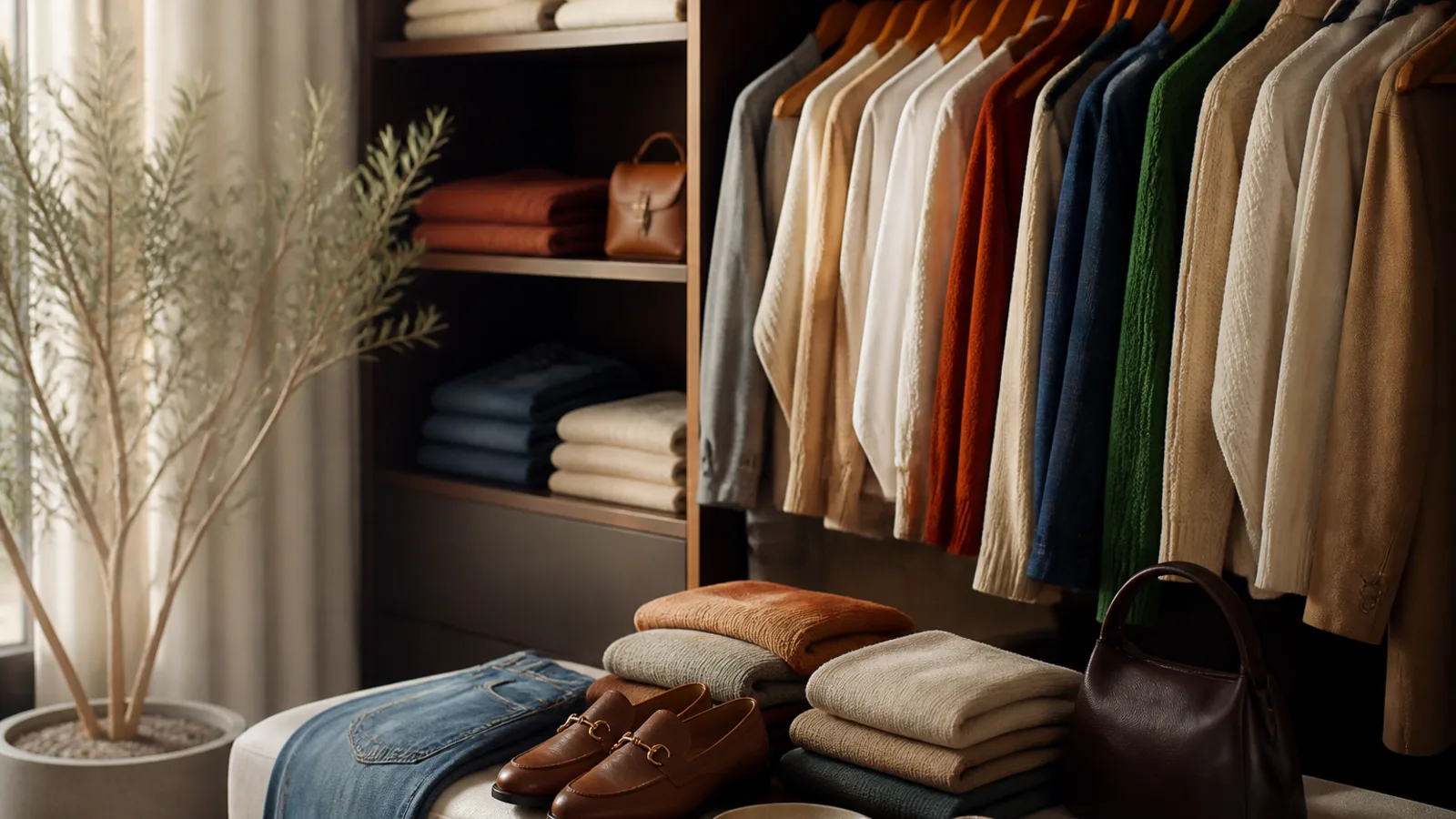
You probably do not need to buy a capsule wardrobe. You may already own most of one. It is simply hidden between the dress you keep for someday, the jeans that pinch by lunchtime, and the tops that only work with one very specific bra.
If you are wondering how to build a capsule wardrobe, start with your own closet, not a shopping list. A good capsule should make mornings easier, help your clothes work harder, and reflect the life you actually live: your job, your climate, your body, your laundry routine and your weekends.
This is a practical closet-first method. You will audit what you own, choose a colour palette from your real favourites, build outfit formulas for work and off-duty life, then shop only when you have found a genuine gap.
What a capsule wardrobe is, and what it is not
A capsule wardrobe is a smaller, more intentional collection of clothes that mix and match easily. It usually includes pieces you wear often, feel good in, and can style in several ways.
It does not have to be beige. It does not have to be expensive. It does not have to fit into exactly 30 pieces. And it definitely does not have to look like someone else’s rail of perfect white shirts, trench coats and black loafers.
The point is not to own as little as possible. The point is to reduce the daily feeling of having a full closet and nothing to wear.
A useful capsule wardrobe is built around your real body, real climate, real laundry routine and real calendar.
That means a lawyer in London, a stay-at-home parent in Toronto, a freelance designer in Sydney and a teacher in Chicago will not need the same capsule. Different lives require different clothes.
How to build a capsule wardrobe from the clothes you already own
The easiest way to make a capsule wardrobe feel personal is to begin with an edit. Before you buy anything, you need to know what you already have, what you actually wear, and what is making your closet harder to use.
Pull everything out by category
Do not empty your entire wardrobe onto the bed unless you genuinely enjoy a dramatic before-and-after. For most people, one category at a time is more realistic.
Start with one of these:
- Trousers, jeans and skirts
- Tops and T-shirts
- Shirts and blouses
- Knitwear and cardigans
- Dresses and jumpsuits
- Jackets, blazers and coats
- Shoes
Put the category somewhere you can see it clearly. You are looking for patterns: duplicates, neglected pieces, colours you never reach for, fabrics you avoid, and the items you wear again and again.
Use the five-pile closet audit
Sort each piece into one of these groups:
- Love and wear often: the reliable pieces you reach for without overthinking.
- Like but do not know how to style: good pieces that need outfit testing.
- Needs repair, tailoring or cleaning: items that could work if you take action.
- Wrong for now but worth storing: seasonal, sentimental, maternity, occasion or body-change pieces.
- Let go: items that do not fit, suit your life, feel good, or earn their space.
Be honest, but not cruel. A pair of goal jeans does not need to be punished out of existence, but it also does not need to take up the same prime space as the jeans you can comfortably wear today.
Ask better questions
Instead of asking, could I wear this someday, ask questions that reflect your life now:
- Does this fit my body today?
- Do I feel like myself in it?
- Have I worn it in the past year, excluding special occasions?
- Can I style it with at least three other pieces I own?
- Is the care routine realistic for my life?
- Does it suit the weather where I live?
- Would I choose this over something similar I already prefer?
A silk blouse may be beautiful, but if it needs delicate cleaning and you have a toddler, a coffee-heavy commute or no patience for fussy laundry, it may not deserve everyday closet space. It can still be kept for certain occasions, but it should not be mistaken for a core capsule piece.
Notice what you already wear on repeat
Your most-worn clothes are giving you valuable information. They show you what feels comfortable, what suits your schedule, and what you choose when you have five minutes to get dressed.
Pull out 10 to 15 items you wear constantly. Then write down why each one works. Is it the cut? The colour? The fabric? The waist height? The sleeve length? The fact that it goes in the washing machine and dries quickly?
Your list might look like this:
- Straight-leg jeans because they work with trainers, boots and loafers
- A navy crew-neck jumper because it looks polished but feels relaxed
- A striped long-sleeve tee because it makes plain outfits more interesting
- Black wide-leg trousers because they work for office days and dinners
- White trainers because they are comfortable enough for errands and school runs
This is your real style talking. If your most-worn clothes are jeans, soft knitwear, striped tees and loafers, your capsule should probably lean classic-casual, even if your saved images are full of satin skirts and stilettos.
Choose a colour palette from your actual favourites
A capsule wardrobe becomes much easier when the colours work together. But that does not mean you have to start wearing only black, white and camel.
Use this simple palette blueprint:
- Base neutrals: choose two or three colours you already wear for trousers, skirts, jackets, coats, shoes or bags. Examples include black, navy, grey, cream, camel, chocolate, olive and denim blue.
- Supporting neutrals: add one or two softer bridge colours if you use them often, such as ivory, taupe, stone, charcoal or light denim.
- Accent colours: choose two to four colours that already appear in your tops, dresses, knitwear, scarves, jewellery or prints.
A realistic palette might be navy, cream and denim as the base, with burgundy, soft blue and olive as accents. Another might be black, grey and white with cobalt, blush and silver. If you love colour, use it. The trick is repetition. When the same colours appear across several pieces, outfits become easier to build.
What about prints?
Prints can absolutely belong in a capsule wardrobe. Stripes, checks, florals, polka dots and animal print can all work if they repeat colours from your palette.
For example, a navy-and-cream striped top will work easily in a wardrobe built around denim, navy, cream and tan. A floral skirt with six unrelated colours may be harder to style, unless several of those colours already appear in your tops and shoes.
Build outfit formulas for your real life
Outfit formulas are repeatable combinations. They are not uniforms, and they do not have to be boring. They simply reduce decision fatigue.
Start by dividing your week into real-life categories:
- Office or work meetings
- Work from home
- School run or parenting days
- Errands and casual weekends
- Exercise or walking
- Evenings out
- Travel
- Special occasions
Then be honest about how much of your week each category takes up. If you work from home four days a week and go into the office once, your capsule should not be mostly blazers and pencil skirts. If your weekends involve sports sidelines, food shopping and muddy dog walks, you need practical layers and shoes, not just elevated basics.
Work outfit formulas
- Tailored trousers + knit top + blazer + loafers
- Dark jeans + blouse + cardigan or jacket + ankle boots
- Wide-leg trousers + fitted tee + statement jacket + flats
- Midi dress + blazer + knee-high boots
Parenting or busy home-life outfit formulas
- Washable trousers or jeans + comfortable tee + cardigan + trainers
- Leggings or ponte trousers + oversized shirt + practical coat
- Easy dress + denim jacket + flat sandals or boots
- Structured joggers + fine knit + long coat + trainers
Weekend outfit formulas
- Jeans + striped top + trench or leather jacket
- Midi skirt + knit + trainers
- Linen trousers + tank + relaxed shirt
- Denim shorts or skirt + cotton shirt + sandals
Decide what stays in your active capsule
Your active capsule is the set of clothes you keep visible and easy to access for the current season and stage of life. It does not need to include every item you own.
Start with the obvious yes pieces: the clothes you love, wear and can style multiple ways. These are your foundation.
Next, bring in the pieces from your like-but-hard-to-style pile. Try them with your favourites before you give up on them.
Use the 3-minute styling diagnostic
For any item you like but rarely wear, test it quickly:
- Check proportions: is the top too long for wide trousers, or does it need a tuck, belt or different waistline?
- Check the shoes: is the hem hitting an awkward spot with trainers, flats or ankle boots?
- Check the connector: does it need a base layer, open shirt, cardigan, blazer or different jacket to make it feel balanced?
If two styling attempts fail, move it to storage or the let-go pile. The aim is not to force every piece to work. It is to learn which clothes make dressing easier.
Be especially gentle if your body is changing because of pregnancy, postpartum recovery, illness, stress, medication, menopause, training, injury or any other life shift. A capsule wardrobe should support you, not turn your closet into a judgement zone.
Find the real gaps before you buy
A true wardrobe gap is not that you do not own the perfect white shirt. A true gap is an item that would unlock several outfits with clothes you already wear.
Before shopping, style what you have. Put together outfits for your main weekly needs and write down what is missing. You may discover that you do not need more tops at all. You might need one reliable pair of trousers, a weather-appropriate coat, a comfortable shoe, or a layering piece that makes your dresses wearable in cooler months.
Use the three-outfit test
Before buying anything, ask whether the item would work with at least three outfits using clothes you already own.
For example, a camel cardigan might work with:
- Straight-leg jeans + white tee + loafers
- Black trousers + striped top + ankle boots
- Midi dress + belt + trainers
That is a useful gap. But if a sequinned skirt only works with a fantasy party calendar you do not actually have, it may be better to admire it and move on.
Common true gaps
- A layering piece for unpredictable weather
- Comfortable shoes that suit your commute
- A jacket that works over your everyday tops
- A neutral bottom that goes with several favourite tops
- A top that makes existing trousers or skirts wearable
- Underlayers that make sheer, low-cut or itchy items practical
- A coat that suits both your climate and your usual outfits
If you own five lovely blouses but only one pair of trousers that fits, your gap is probably a reliable bottom, not another blouse.
Create a flexible capsule wardrobe checklist
Use this as a framework, not a rule. Your numbers will vary depending on climate, laundry, dress code, storage space and how often you like to repeat outfits.
A realistic 35 to 40 piece baseline
If you want a starting point, try this broad ratio for one season:
- 8 to 10 everyday tops
- 3 to 5 smart tops or blouses
- 4 to 6 knits, sweatshirts or layering pieces
- 5 to 7 bottoms, such as jeans, trousers, skirts or shorts
- 1 to 3 dresses or jumpsuits, if you wear them
- 2 to 4 jackets, blazers or overshirts
- 1 to 3 coats, depending on climate
- 3 to 5 pairs of shoes
- A small set of accessories that finish outfits
This is not a target to hit perfectly. It is a reality check. If you need fresh tops for messy work, frequent laundry gaps or parenting, you may need more. If you wear a uniform, you may need fewer.
Two examples of how the same framework changes
The hybrid professional: may need tailored trousers, polished knitwear, one or two blazers, smart flats or loafers, dark denim and a coat that works over office outfits.
The active casual parent or caregiver: may need more washable tops, practical trousers, comfortable trainers, weatherproof layers and a smaller number of dressy pieces for work, dinners or events.
Popular capsule challenges, including Project 333’s 33-item guideline for three months, can be useful if you enjoy structure. But rigid numbers rarely suit every climate, body, dress code or laundry routine. Someone in Melbourne may need fewer heavy layers than someone in Montreal. Someone in Manchester may prioritise rain-friendly shoes and coats. A good capsule bends to your life.
Test your capsule for two weeks
Once you have chosen your active pieces, test them for 10 to 14 days. Wear only those items if you can, but do not turn it into a punishment. If something important is missing, note it.
During the test, pay attention to:
- Which pieces you reach for first
- Which items you avoid
- Whether you are doing laundry too often
- Whether you have enough shoes for your week
- Whether your layers suit the weather
- Whether your outfits feel too plain, too formal or too casual
- Whether anything needs tailoring or repair
Quick mirror photos can help if you like visual tracking. You do not need to post them anywhere. They simply show what outfits worked and what felt off.
If every outfit feels too simple, your capsule may not need more clothes. It may need stronger accessories, a print, a better jacket, a more interesting shoe or a colour that feels more like you.
Maintain your capsule without starting over
A capsule wardrobe is not a one-time project. It is a system you adjust as life changes.
Do a quick review at the start of each season. Bring forward the clothes that suit the weather, store what is not needed, and check for repairs before you desperately need the item.
Keep a running gap list on your phone. This helps you shop more calmly because you already know what you are looking for. You can also use a one-in, one-out guideline if it helps keep your closet manageable, but do not treat it as a moral rule. Sometimes life requires more clothes for a while.
Update your capsule when there is a real shift, such as:
- A new job or dress code
- Pregnancy, postpartum or body changes
- Moving to a different climate
- Returning to commuting after working from home
- A new exercise routine
- Clothes wearing out
- A style shift that feels genuine and lasting
Care matters too. Repair buttons, clean shoes, de-pill knitwear and tailor pieces when it is worth the cost and effort. Often, the most stylish choice is not buying more. It is making your best clothes easier to wear.
Common capsule wardrobe mistakes to avoid
- Buying a full set of essentials before auditing your closet. You may already own your essentials, and they may not look like anyone else’s.
- Copying someone else’s palette. Beige, white and black are not mandatory. Choose colours you actually wear.
- Keeping clothes for an imagined lifestyle. A capsule should serve your real calendar.
- Making it too small. If you are constantly doing laundry, the capsule is not practical.
- Ignoring shoes and coats. These often decide whether an outfit works in real life.
- Removing all personality. Simpler does not have to mean bland.
- Decluttering too aggressively during stress. If life feels unstable, store uncertain pieces before making final decisions.
Quick-start weekend plan
If you want to make progress quickly, use this simple weekend plan.
- Friday evening: choose one category, such as jeans or tops, and sort it into the five piles.
- Saturday morning: pull out your 10 to 15 most-worn pieces and identify your base colours and accents.
- Saturday afternoon: build 8 to 10 outfits for your real week. Take photos or make notes.
- Sunday morning: choose your active capsule pieces and move maybes, repairs and off-season items out of the main space.
- Sunday afternoon: write a short gap list. Do not shop yet unless the need is clear and immediate.
- Next two weeks: wear, test and adjust.
FAQ
How many clothes should be in a capsule wardrobe?
There is no perfect number. Some people like a small capsule of around 30 to 40 pieces, while others need more because of climate, work, laundry, parenting, exercise or frequent outfit changes. The better question is whether your clothes mix well and support your actual week.
Do shoes, coats and accessories count in a capsule wardrobe?
They can, but they do not have to. Counting matters less than making sure these pieces work with your outfits. Shoes and outerwear often make or break a capsule because they affect comfort, weather and polish.
Can I build a capsule wardrobe if I love colour and prints?
Yes. A capsule wardrobe does not have to be plain. Choose a consistent palette and repeat colours across prints, tops, shoes or accessories so your pieces still mix easily. A colourful capsule can be just as streamlined as a neutral one.
What should I do with clothes I like but do not wear?
Try styling them with your favourite pieces first. If they still feel wrong, work out why. The issue may be fit, fabric, colour, missing layers or the wrong shoes. If the fix is realistic, keep and action it. If not, store it temporarily or let it go.
How often should I update my capsule wardrobe?
Review it seasonally or when your life changes. You do not need to rebuild from scratch unless your climate, job, body, style or daily routine has shifted significantly.
Conclusion: how to build a capsule wardrobe that lasts
Building a capsule wardrobe that actually lasts is an exercise in editing, not consumption. Your closet’s highest-performing pieces are likely already hanging there: the jeans that always work, the jumper you reach for twice a week, the jacket that makes simple outfits feel finished.
The most realistic answer to how to build a capsule wardrobe is to start with what you own. Keep what fits your body and your life. Choose colours from your real favourites. Build outfit formulas for the week you actually have. Then fill only the gaps that will make your existing clothes work harder.
A good capsule wardrobe should not make you feel restricted. It should make getting dressed feel calmer, clearer and more like you.



Join the conversation
Sign in — Sign in to join the conversation.