
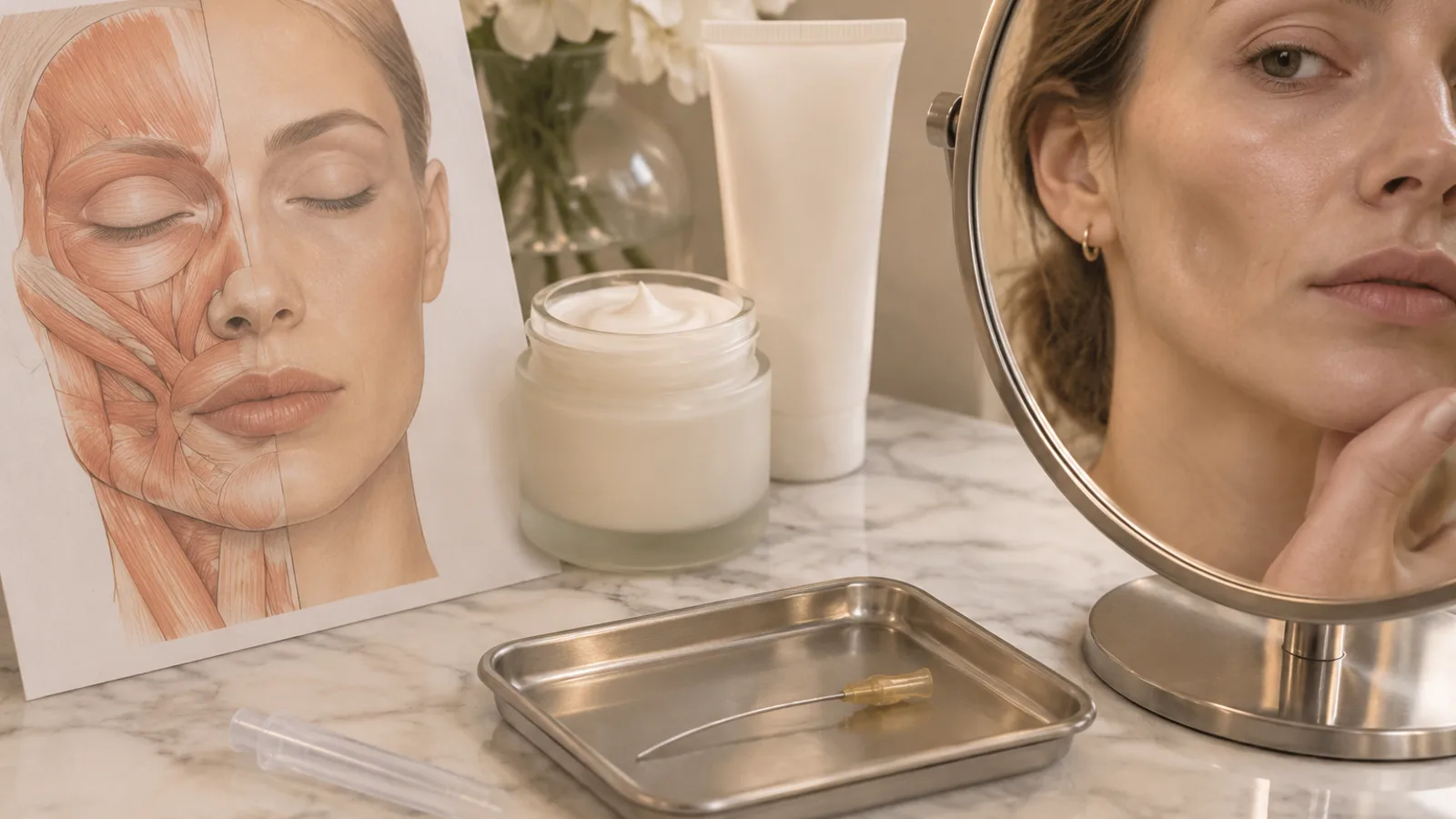
There is a particular moment many women describe the same way: good light, a mirror, and a face that looks subtly different from the one they remember. Not older in a dramatic sense. Just flatter. The under-eye area seems deeper, the cheeks less lifted, the temples less full. This is loss of facial volume over 40, and it is not just a skincare issue. It is a structural one.
That distinction matters. If the problem is mostly dehydration, a richer cream may help. If the problem is hollowing from bone remodeling, fat pad changes, and collagen loss, no moisturizer can rebuild the framework. The right response depends on knowing what changed and where.
Why the Face Changes in Your 40s
The skeleton beneath the skin is not static
Facial aging is not only about wrinkles. The bones of the face continue to remodel over time, and those changes can affect projection. The orbital rim can become less prominent. The midface can lose support. The jawline may look softer because the underlying structure has changed shape.
When people say their face looks tired, they are often noticing the effect of a slightly smaller scaffold underneath the skin. The skin may still be healthy. The architecture has simply shifted.
Fat pads don’t just disappear — they move differently
The face contains separate fat compartments, not one uniform layer. With age, some of these fat pads shrink. Others descend. Some do both. That is why a face can look hollow in one area and heavier in another at the same time.
The classic example is the midface. It may look flatter and less lifted, while the lower face seems slightly heavier. If treatment only adds volume where the face looks empty, without respecting where tissue has shifted, the result can be puffy rather than refreshed.
Collagen loss is part of the picture, but not the whole story
Collagen and elastin decline affects the skin itself. Texture changes. Skin can feel thinner, less springy, and more crepey. This is real, and it matters. But collagen loss is not the same thing as losing cheek projection or under-eye support. It is one layer of aging, not the entire explanation.
That is why so many women improve their skin quality with topical care and still feel that something is missing. They are treating one layer of the problem while the structural layer remains untouched.
What Skincare Can Realistically Do
The products that earn their place
Skincare should not be dismissed. It just needs to be assigned the right job.
- Retinoids are still the most useful topical category for improving skin texture and supporting collagen over time. They do not replace lost structure, but they can improve the surface quality that makes hollowing look worse.
- Hyaluronic acid and ceramides help with hydration and barrier support. Better hydration can soften the look of fine lines and crepiness, even though it does not create true volume.
- Peptides and growth-factor products may offer modest improvement in skin quality for some people. The effects are subtle, not dramatic.
- Daily broad-spectrum SPF remains the most important long-term step for preventing further damage. The Skin Cancer Foundation offers clear guidance on sunscreen use.
What no cream can do
No topical product can rebuild bone. No serum can move fat pads back to where they started. And no moisturizer can restore the projection that structural aging has removed. The word “plumping” in skincare usually refers to surface hydration, not the kind of volume loss that changes the contours of the face.
This is not a failure of skincare. It is simply a matter of using it for the right problem.
In-Office Options: What Actually Restores Volume
Hyaluronic acid fillers: immediate, targeted, and reversible
Hyaluronic acid fillers add volume directly. They are useful when the goal is to restore a specific hollow or support a feature that has lost projection. Results are visible immediately, which is part of their appeal.
They are also reversible. If the result is not right, hyaluronidase can dissolve the product. That does not make fillers risk-free, but it does make them a more forgiving option than permanent treatments.
The downside is well known: overuse can create a heavy or overfilled look. That usually happens when filler is used to compensate for several different changes at once, rather than with careful attention to anatomy.
Biostimulators: gradual support through your own collagen
Biostimulators work differently. Instead of adding obvious volume right away, they stimulate your body to make more collagen over time. Common categories include poly-L-lactic acid and calcium hydroxylapatite formulations.
These treatments are usually done in a series rather than as a single appointment, and improvement develops gradually over months. That slower pace is part of the appeal for women who want natural-looking change.
Important trade-off: biostimulators are not reversible in the way hyaluronic acid fillers are. If they are placed incorrectly or if a complication occurs, they cannot simply be dissolved. For that reason, experience and judgment matter a great deal.
Biostimulators can be a good fit for people who want subtle restoration without obvious added volume, but they are not the best choice for major hollowing that needs direct structural replacement.
Nanofat: not a filler, not traditional fat transfer
Nanofat is often misunderstood because the name sounds like it should behave like filler. It does not. Nanofat is processed, emulsified fat tissue that has been refined so much that it cannot provide meaningful structural volume. It is not a substitute for a filler, and it is not the same as traditional fat grafting.
Its value is regenerative. Nanofat is used to improve skin quality — texture, tone, fine lines, and crepiness — especially in delicate areas where the skin is thin. It may be helpful around the eyes or on the surface of the cheeks when the goal is better skin quality, not added projection.
It is important to be precise here: nanofat may help the look of under-eye skin, but it does not correct true tear trough hollowing on its own. If the problem is structural depth, a different approach is needed.
Because nanofat is a procedure that uses your own tissue, it is biologically appealing. But it is still a procedure, usually performed by an experienced clinician with local anesthesia and some downtime. It should be discussed as a real intervention, not a trendy add-on.
Traditional fat grafting: the more structural option
When volume loss is more significant, traditional fat grafting can make more sense. In this procedure, fat is taken from another area of the body, processed, and placed into the face to restore projection in a more substantial way.
This is closer to rebuilding structure than simply camouflaging it. It may be especially relevant for temple hollowing, midface flattening, or deeper under-eye loss where the goal is meaningful restoration rather than a small cosmetic tweak.
The trade-off is that it is more involved than injectables, involves recovery, and results can vary depending on how much of the transferred fat survives. It is usually the right conversation for someone with clear structural loss who is ready for a bigger procedure.
Energy-based devices and thread lifts: useful, but not volume treatments
Radiofrequency and ultrasound-based devices may help with mild laxity and skin tightening. Thread lifts may offer some repositioning of tissue. Neither one replaces lost volume.
They can still play a supporting role when the issue is a mix of mild looseness and hollowing, but they should not be mistaken for solutions to structural volume loss.
How to Avoid the Overfilled Look
The overfilled look usually starts with a bad plan, not a bad product. A thoughtful provider does not look at the face and immediately decide how much filler to inject. They assess the face in layers.
- Bone structure: Is there true loss of support?
- Fat pad position: Has tissue moved downward rather than simply disappeared?
- Skin quality: Is the surface thin, crepey, dehydrated, or lax?
When those layers are evaluated separately, treatment becomes more precise. That is what creates a refreshed result instead of a swollen one.
If you are booking a consultation, it helps to ask direct questions:
- Are you treating bone loss, fat pad changes, or skin quality?
- What would happen if we did a smaller amount first and reassessed later?
- If this doesn’t look right, what is the plan to correct it?
These questions do not make you difficult. They make you informed.
How to Build a Smart Plan in Your 40s
For many women, the best starting point is not a treatment package. It is a careful consultation with a board-certified dermatologist or plastic surgeon who regularly treats faces, not just bodies. The goal of that visit should be assessment first, treatment second.
In many cases, a balanced plan may include:
- a steady skincare routine with retinoids, sunscreen, and barrier support;
- a modest in-office option such as a filler in a precise area or a staged biostimulator plan;
- or, when the change is more structural, a discussion about fat grafting or another procedure that addresses the deeper cause.
The right choice depends on how your face has changed, how much you want to change it, how quickly you want results, and how much maintenance you are comfortable with. There is no single correct answer for everyone.
It is also worth being honest about cost and upkeep. Injectable and regenerative treatments often require maintenance over time. That is not a reason to avoid them. It is simply part of the decision.
The goal is not to look younger at any cost. It is to look rested, like yourself, and to choose treatments that respect your facial structure instead of fighting it.
When you understand the biology behind loss of facial volume over 40, the options become easier to compare. Skincare can improve the surface. In-office treatments can restore what the surface cannot. The best results usually come from using each tool for the job it was designed to do.
FAQ
Can skincare reverse facial volume loss?
No. Skincare can improve hydration, texture, and overall skin quality, which may make the face look healthier and less tired. But it cannot rebuild bone, replace lost fat pads, or restore the structural projection that has changed with age.
What is the difference between filler and a biostimulator?
Filler adds volume directly and gives immediate results. A biostimulator works more slowly by encouraging your body to produce collagen over time. Fillers are reversible when they are hyaluronic acid-based; biostimulators are not dissolved in the same way, so provider skill matters even more.
Is nanofat the same thing as fat transfer?
No. Nanofat is processed so finely that it cannot provide structural volume. It is used mainly for skin quality improvement. Traditional fat transfer places larger volumes of fat to restore actual projection and contour.
Will fillers always make me look overdone?
No. When placed conservatively and with an understanding of facial anatomy, fillers can look very natural. The overfilled look usually happens when too much is used, or when filler is placed without considering bone loss, fat pad movement, and skin quality separately.
How do I know which treatment is right for me?
Start with a consultation focused on anatomy, not sales. Ask what is causing the change you see, what the treatment is meant to correct, how long results last, and what the correction plan would be if you do not like the result. The right treatment depends on whether your main issue is surface texture, mild volume loss, or deeper structural hollowing.

Join the conversation
Sign in — Sign in to join the conversation.