
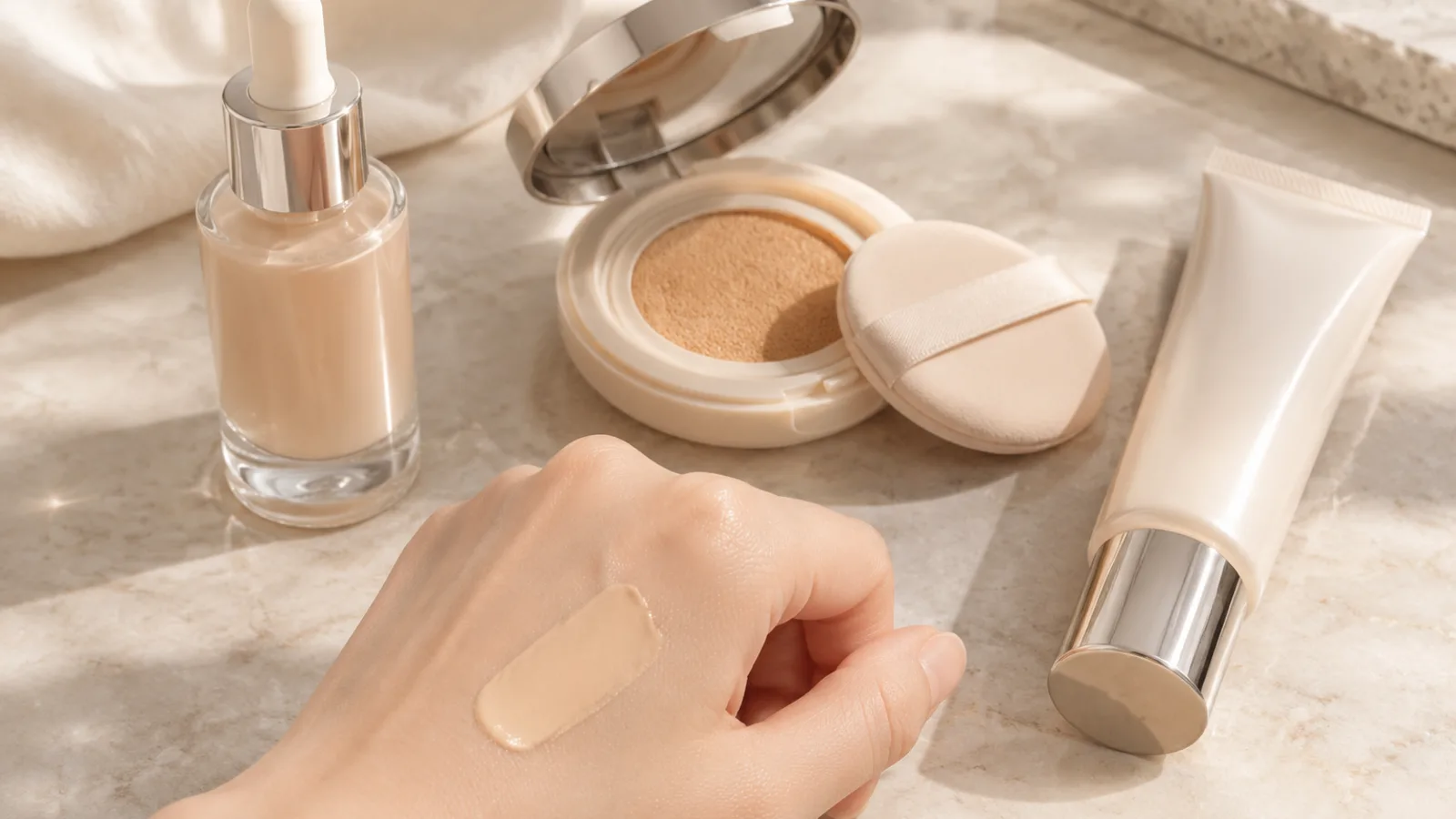
You have been applying foundation the same way for years. Same brush, same technique, roughly the same amount of product. But somewhere in your early forties, something shifted. The formula that used to smooth everything over now settles into the lines around your mouth by mid-morning, sits in your pores by noon, and reads as a mask by the time you catch your reflection in a shop window. The frustrating part is that nothing you are doing is wrong. The skin you are working with has changed, and the formula built for a different version of your face simply has not kept up.
Finding the best foundation for women over 40 is less about tracking down a miracle product and more about understanding why the mismatch is happening — and making two or three deliberate shifts that work with your skin rather than against it. This is that framework.
What changes about your skin after 40 (and why your old foundation no longer cooperates)
The most useful thing to understand is that mature skin does not need less foundation. It needs foundation delivered differently. The changes driving the problem are specific.
Oil production tends to drop with age, particularly after perimenopause. Skin that once had some natural slip now has less, which means heavy formulas have fewer opportunities to blend out smoothly. Instead of gliding over the surface, they grip onto dry patches and look uneven within hours. The American Academy of Dermatology notes that skin barrier function changes over time, which is part of why moisture retention becomes a more active concern.
The character of fine lines changes too. They become more defined and have more depth, so thick, pigment-dense products fill and settle into them the way water finds a groove. The foundation is not covering the lines — it is tracing their shape.
Skin also loses some density gradually, which affects how the face moves. There is less of the natural rebound that used to push product off creases as you talk, eat, or smile. Product that lands in a crease tends to stay there.
None of this is a reason to avoid foundation. It is a reason to change which kind you reach for, and how you use it.
The formula shift that changes everything
From matte and full-coverage to hydrating and buildable
The single most effective change is separating coverage level from formula weight. These are two different things, and conflating them causes most of the frustration.
Coverage level refers to how much pigment a product contains and how well it evens out the skin tone. Formula weight is about what carries that pigment — the base, the texture, how it behaves over time. A hydrating, medium-coverage foundation can conceal uneven tone, dark spots, and redness effectively. A heavy full-coverage matte sometimes covers less, visually, because the texture itself draws the eye rather than neutralizing imperfections.
When scanning ingredient lists or product descriptions, look for humectants like hyaluronic acid and glycerin, skin-conditioning ingredients like squalane or jojoba oil, and any mention of light-diffusing or blurring particles. These keep the product mobile and help it sit on the surface rather than sinking. What to approach with more caution: formulas where dense cross-polymer silicones are paired with high powder loads — a combination common in extreme-matte and very long-wear products — which causes pigment to cake and settle into lines. This is distinct from the flexible, serum-grade silicone emulsions that give many hydrating foundations their slip and are genuinely well-suited to mature skin. Products described primarily as "24-hour transfer-proof" or "completely matte" lean toward the former and are worth testing carefully before committing.
In terms of what to reach for on a shelf, three formula types consistently perform well on mature skin. Serum-drop foundations — thin, water-based, often in a dropper bottle — offer buildable coverage with a skin-like finish and blend easily without force. Cushion compacts with a hydrating sponge formula deliver light-to-medium coverage and are designed to be pressed on rather than dragged, which suits mature skin well. Tinted fluid emulsions, often labeled as skin tints or radiant fluid foundations, give an even, hydrated base in one step and work particularly well alongside a targeted concealer. All three are available across a wide price range.
Skin tints and lighter formulas — when they work and when they fall short
There is a persistent assumption that moving toward lighter formulas means accepting less coverage as a concession. It is not. Many women find that a skin tint over well-prepped skin, combined with a small amount of concealer applied precisely to dark spots or broken capillaries, gives more overall coverage than a full face of heavy foundation. The light-reflecting quality of the thinner formula makes skin look even and alive, while targeted concealer handles specific areas without loading the whole face.
That said, skin tints are not the right answer for everyone. If you have significant pigmentation or simply prefer more coverage, a hydrating medium-to-full foundation is the better starting point. Build in thin layers rather than committing to one heavy application.
Full coverage without the mask effect
Full coverage is not off the table. What creates the mask effect is not a formula's coverage potential — it is a heavy application, the wrong tools, and unprepped skin. A full-coverage foundation applied in a thin layer, pressed rather than dragged, over a well-moisturized base reads as skin. The same product applied in a thick pass with a dense brush, buffed across a dry face, reads as a mask. The formula is identical. The technique is not.
Prep is half the application
Moisturizer is non-negotiable. A hydrated surface gives foundation somewhere to move and blend. Without it, even a good formula grips unevenly and starts to look patchy within an hour.
If you use a daily SPF — which most dermatologists recommend for this age group — your sunscreen may be doing double duty as your moisturizer, depending on its texture. Either way, the wait time before applying foundation is doubly important when sunscreen is in the mix. Applying foundation directly over a freshly applied sunscreen or moisturizer, before it has absorbed, creates a slick surface where everything migrates and pills. Two to three minutes of absorption time makes a visible difference in how foundation sits and lasts.
Primer is worth thinking about deliberately rather than reaching for automatically. A hydrating primer over very dry patches or a smoothing formula over particularly textured areas can genuinely help. But adding a primer layer without a clear purpose adds another surface for products to interact with and can contribute to slipping rather than fixing it. If your foundation behaves well on a moisturized face, an extra layer may not be improving anything.
Application technique matters as much as the formula you choose
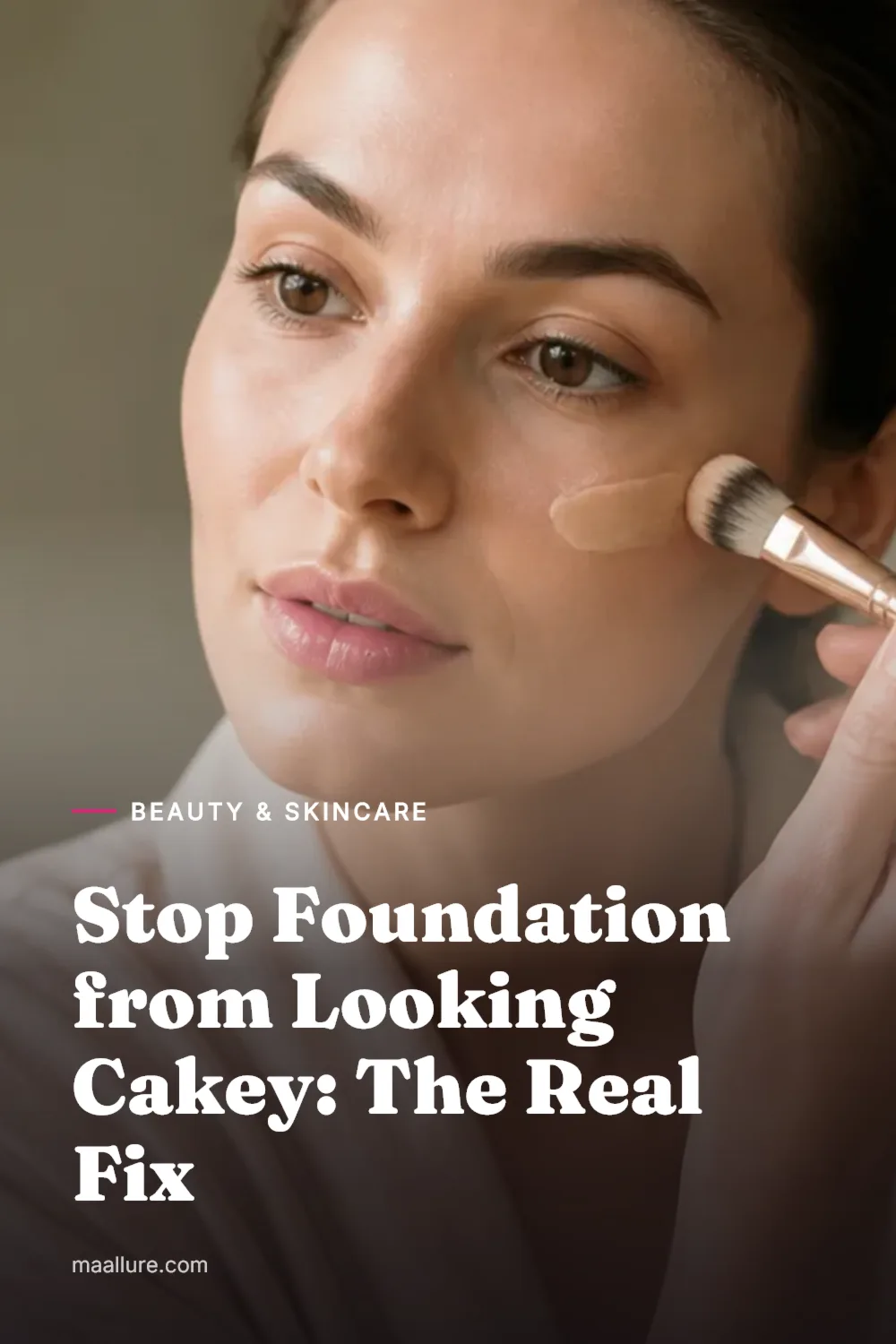
A damp sponge and a brush do different things to foundation. A dense brush used in buffing or circular motions tends to drag product across the skin — exactly the action that pushes it into lines and pores. A damp sponge used with a pressing and stippling motion sits product on the surface instead of dragging it, and blends without force. For most skin over 40, stippling with a damp sponge is the most consistently reliable approach. If you prefer a brush, the technique needs to shift to short pressing strokes rather than buffing.
Use less product, more deliberately. Apply one thin pass, step back, assess what actually needs more, and add only there. The instinct to load a brush and work quickly is what causes most creasing. Around the eyes and mouth — the highest-movement zones on the face — use the smallest amount of product possible and always press it in rather than rubbing. These areas crease most because they move most.
Start at the center of the face, where coverage is usually most needed, let that layer settle for a moment, then work outward with a progressively lighter hand. The result is more coverage where you need it and a natural fade toward the hairline and jaw.
How to choose the best foundation for women over 40 — in a shop or online
Three questions cut through most of the noise when you are evaluating a foundation.
- How does the product describe itself? Words like "matte," "transfer-proof," "long-wear," and "24-hour" are flags, not deal-breakers, but they warrant careful testing. These formulas prioritize staying power through a dry-down chemistry that can settle visibly on mature skin.
- How does the texture feel without moisturizer? Try a small amount on the back of your hand without any prep. If it feels tight, powdery, or stiff within a minute or two, it will feel worse on your face over the course of a day.
- What does it look like after 15 minutes? The in-store swatch on your jaw is the most underused tool in foundation shopping. Apply a small amount, do not touch it, and return to it in natural light after fifteen minutes. If it has separated, gone patchy, or settled into any lines, that is what it will do on your face by mid-morning.
Understanding finish — a quick-reference guide
Finish is one of the most useful things on a foundation label once you know how to read it. Here is what each term actually means for skin over 40.
- Flat matte: Absorbs all light, no shine. Tends to emphasize texture and fine lines because there is no surface reflection to soften them. Best approached cautiously on mature skin, or reserved for very specific zones.
- Natural / skin-like: Minimal shine, some quiet reflection. Sits on the skin rather than flattening it. Generally the most forgiving finish across a range of skin types and tones.
- Satin: A step toward luminosity. Reflects light softly and evenly, which helps blur the look of texture without looking glassy. A reliable starting point for most skin over 40.
- Dewy / radiant: Visible luminosity. Works well on drier or more sallow skin. Can look oily on combination or oily skin types unless set selectively with a light powder.
If your skin runs oily in your forties — which is entirely possible — the solution is not an all-over mattifying formula. Use a natural or satin foundation and dust a very light translucent powder only over the zones that get shiny: typically the nose, center of the forehead, and inner corners of the eyes. A full-face powder set tends to age a look by deadening the finish and settling into every line.
The takeaway: match the formula to the face you have today
The best foundation for women over 40 is not a single product — it is the right combination of formula, finish, and technique for the skin you have now. A hydrating, buildable formula applied with a pressing rather than dragging motion, over well-prepped skin, in a satin or natural finish works across a wide range of skin types, preferences, and budgets. Start there, adjust based on what you actually observe, and remember that your skin is not the problem the formula has been trying to solve — it was just waiting for the right one.
Frequently asked questions
Should I be wearing less foundation now that I am older?
No. There is no reason age should mean less coverage if coverage is what you want. The goal is to shift the type of foundation and the method of application so the result looks like skin rather than a product. How much coverage you wear is entirely your preference.
How do I cover dark spots and uneven tone without it looking heavy or cakey?
Use a lightweight or medium-coverage hydrating foundation across the whole face, then apply a small amount of concealer only on the specific spots that need more. Pressing it in with a fingertip or the pointed end of a damp sponge blends it without disturbing the layer underneath. This targeted approach gives more coverage than loading the whole face and looks significantly more natural.
My foundation looks fine when I first apply it but is creased by noon — what is going wrong?
Usually one of three things, or a combination: not enough time between applying moisturizer or sunscreen and foundation, too much product in a single layer, or a formula that is too heavy or matte for your current skin. Try waiting three minutes after your base layer, using noticeably less product, and pressing rather than dragging. If the creasing persists after those changes, the formula itself is likely the issue.
Can I still use the same foundation I have been wearing for years?
Possibly — test it honestly against the criteria above: finish, dry texture, and fifteen-minute behavior. If it still looks good on your skin as it is now, there is no reason to change it. If it has started to settle or look mask-like, the formula is probably no longer a good fit. That is not a reflection on the product; it is a reflection of the fact that your skin has changed and the formula has not.
Is concealer better applied under or over foundation for skin over 40?
For most purposes, over. Applying concealer under foundation means the foundation goes on top and can dilute or shift it, requiring more product overall to get the same result. Applying a small amount of concealer over your foundation base, precisely where it is needed, uses less and gives you more control. The exception is very dark under-eye circles, where a color-correcting concealer applied under foundation can be more effective — but use the thinnest layer you can manage.
Join the conversation
Sign in — Sign in to join the conversation.