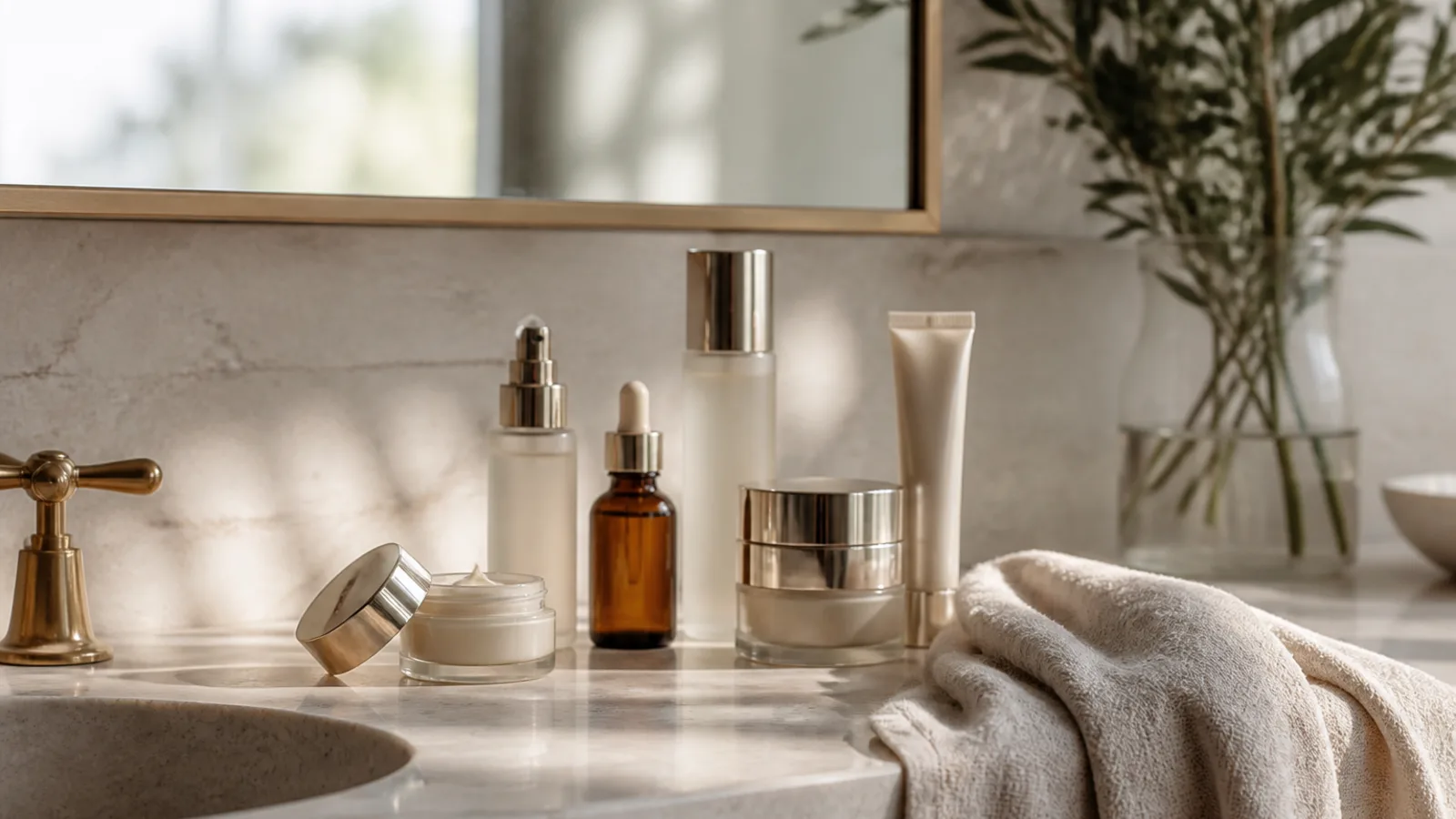
Skincare labels can make anti-aging sound far more complicated than it needs to be. One serum promises “collagen support,” another claims to “resurface,” and a third suggests it can “firm” your face in days. The truth is simpler: the best anti-aging ingredients are the ones with a clear job, realistic evidence behind them and a place in a routine your skin can actually tolerate.
This guide compares retinoids, vitamin C, niacinamide, AHAs, peptides and bakuchiol in plain English: what they can do, how strong the evidence is, how long results usually take, what pairs well and what combinations deserve caution.
The most effective anti-aging routine is rarely the most complicated one. It is the one you can use consistently without irritating your skin barrier.
The short answer: which ingredients are worth it?
If you want the clearest hierarchy, here it is:
- Best overall evidence for fine lines, texture and photoaging: retinoids.
- Best for brightness and antioxidant support: vitamin C.
- Best low-drama support ingredient: niacinamide.
- Best for quick surface smoothness and glow: AHAs.
- Useful but often overstated: peptides.
- Promising gentler alternative: bakuchiol.
And one essential point: sunscreen is not optional if your goal is to reduce visible aging. UV exposure is a major driver of lines, uneven tone and loss of firmness. A beautifully chosen night routine will underperform if your skin is unprotected during the day. For general guidance, the American Academy of Dermatology explains what to look for in a broad-spectrum sunscreen.
Quick comparison: the best anti-aging ingredients at a glance
- Retinoids: best for fine lines, wrinkles and texture. Irritation risk can be moderate to high at first. Expect several months for meaningful visible change.
- Vitamin C: best for brightness, uneven tone and antioxidant support. Irritation risk varies by formula. Glow may appear within weeks; pigmentation takes longer.
- Niacinamide: best for barrier support, pores, blotchiness and comfort. Usually lower irritation risk. Skin may feel calmer within weeks.
- AHAs: best for glow, roughness and surface texture. Irritation risk rises with strength and frequency. Smoothness can appear quickly, but tone changes take longer.
- Peptides: best for hydration, softness and subtle plumping. Usually low irritation. Results are often modest and formula-dependent.
- Bakuchiol: best for people who want a gentler retinoid-like option. Usually lower irritation than retinoids, but evidence is less established.
The best anti-aging ingredients, ranked by evidence and usefulness
1. Retinoids: strongest for wrinkles, texture and long-term change
Retinoids are vitamin A derivatives. This family includes over-the-counter retinol and retinaldehyde, as well as prescription options such as tretinoin or adapalene, depending on your country and skin concern.
They are among the best-supported skincare ingredients for visible signs of photoaging. In practical terms, they can help improve the look of fine lines, uneven texture, roughness and sun-related discoloration over time. They work gradually, not overnight.
Best for: fine lines, rough texture, enlarged-looking pores, uneven tone, early wrinkles and long-term maintenance.
Evidence strength: strong, especially for prescription retinoids and well-formulated retinol products.
Timeline: your skin may feel smoother after several weeks, but more visible changes often take several months of consistent use.
How to use:
- Use at night.
- Start two or three nights a week.
- Apply a pea-sized amount for the whole face.
- Use moisturiser before or after if you are prone to dryness.
- Do not introduce strong acids in the same week if you are new to retinoids.
Availability varies by country. For example, adapalene is available over the counter in the US, while it generally requires a prescription in the UK, Canada and Australia. Cosmetic retinol rules and permitted strengths also vary, especially between the US, UK, EU, Canada and Australia, so check local labels and follow pharmacist or prescriber advice.
Retinoids can cause dryness, flaking, stinging or a “purging” phase for some people. That does not mean you should push through severe irritation. If your skin burns, cracks or becomes increasingly sensitive, scale back and simplify.
Topical retinoids are usually advised against during pregnancy or while trying to conceive, and prescription retinoids require particular caution. If you are pregnant or breastfeeding, pause retinoids and ask your doctor, midwife or dermatologist about suitable alternatives, which may include ingredients such as azelaic acid depending on your skin and medical history.
2. Vitamin C: best for brightness and antioxidant support
Vitamin C is an antioxidant used to help brighten dull skin and support a more even-looking tone. It is especially popular in morning routines because it pairs well with sunscreen. Think of vitamin C as support against environmental stress, while sunscreen is the actual UV protection.
The classic form is L-ascorbic acid. It is well known and widely used, but it can be unstable and may irritate sensitive skin. Pure L-ascorbic acid formulas often need a low pH to perform well, and many of the best-known formulas combine vitamin C with vitamin E and ferulic acid for added stability and antioxidant support. If your skin is easily irritated, derivatives such as tetrahexyldecyl ascorbate, often called THD ascorbate, or sodium ascorbyl phosphate may feel gentler, though results vary by formula.
Best for: dullness, uneven tone, early dark spots, antioxidant support and glow.
Evidence strength: good, especially for well-formulated products, but formula stability matters a great deal.
Timeline: glow may appear within a few weeks if the product suits your skin. Uneven tone and pigmentation usually take longer and depend heavily on daily sunscreen.
How to use:
- Use in the morning after cleansing or rinsing.
- Follow with moisturiser if needed.
- Finish with broad-spectrum sunscreen.
- Choose opaque or air-restrictive packaging where possible.
If your vitamin C serum turns dark orange or brown, smells odd or suddenly stings more than usual, it may have oxidised or become less suitable for your skin. With vitamin C, packaging and storage are not small details.
3. Niacinamide: the quiet overachiever
Niacinamide, a form of vitamin B3, is one of the easiest ingredients to fit into a routine. It is not as dramatic as a retinoid for wrinkles, but it is useful because it supports the skin barrier, helps improve the look of uneven tone and can make pores appear less noticeable.
It is also a good companion ingredient if your routine includes retinoids or acids. When the skin barrier is calmer, your more active products are often easier to tolerate.
Best for: sensitivity, blotchiness, uneven tone, visible pores, barrier support and combination skin.
Evidence strength: good for barrier support and tone-related concerns, with strong practical usefulness.
Timeline: comfort and hydration may improve fairly quickly. Tone and texture changes usually need several weeks or more.
Many modern formulas combine niacinamide with vitamin C without issue. The old idea that they must never be used together is too simplistic. Your skin’s response matters more than a rigid rule.
4. AHAs: best for surface smoothness and glow
AHAs, or alpha hydroxy acids, exfoliate the surface of the skin. Common examples include glycolic acid, lactic acid and mandelic acid. They can make skin look smoother and brighter because they help remove dull, built-up surface cells.
AHAs are excellent for glow, but they are not a replacement for retinoids if your main goal is deeper wrinkle improvement. They are more about surface polish than long-term structural change.
Best for: dullness, rough patches, uneven surface texture and mild discoloration.
Evidence strength: good for exfoliation, brightness and texture, with results depending on strength, pH and formulation.
Timeline: smoother-feeling skin can appear quickly. More even tone takes longer.
How to use:
- Start once weekly if you are new to acids.
- Use at night unless the product directs otherwise.
- Follow with a simple moisturiser.
- Skip retinoids on the same night at first.
- Use sunscreen consistently, as exfoliation can make skin more sun-sensitive.
Glycolic acid often feels stronger and may suit more resilient skin. Lactic acid is often better tolerated and can feel more hydrating. Mandelic acid is commonly chosen by people who want a gentler approach. The percentage alone does not tell the whole story; the full formula matters.
5. Peptides: helpful support, not magic collagen
Peptides are short chains of amino acids used in skincare for smoothing, hydrating and firming claims. The category is broad, and not all peptides do the same thing. Some are more promising than others, but “contains peptides” does not automatically mean a product will visibly firm your face.
Peptides can still be useful, especially in moisturisers or serums designed to support hydration and skin comfort. They are usually easier to tolerate than retinoids and acids.
Best for: dry skin, sensitive skin, recovery nights and subtle plumping from hydration.
Evidence strength: mixed to promising, depending on the specific peptide and the formula.
Timeline: hydration and plumping may be noticeable quickly. Firming, if it happens, is usually subtle and gradual.
The key is not to overpay for vague “collagen” language. Topical collagen and peptide products can help skin feel moisturised and smoother, but they do not simply replace lost collagen in the deeper layers of skin.
6. Bakuchiol: a gentler option if retinoids are too much
Bakuchiol is a plant-derived ingredient often marketed as a retinol alternative. It is not the same as retinol and should not be described as identical. The evidence is encouraging, but retinoids remain better established for photoaging.
That said, bakuchiol may be worth considering if you find retinoids too irritating or you want a gentler night active. It can be a sensible compromise for sensitive skin, provided the full formula is also gentle.
Best for: sensitive skin, retinoid beginners and people who want a lower-irritation active.
Evidence strength: emerging and promising, but not as strong as retinoids.
Timeline: expect gradual changes over weeks to months, with radiance or texture changes appearing before deeper lines.
Even if a product is marketed as “natural,” that does not automatically make it suitable for pregnancy, breastfeeding, rosacea-prone skin or eczema-prone skin. If you are unsure, ask a qualified healthcare professional.
The anti-aging ingredients you can genuinely skip
Not every luxurious-sounding ingredient is useless, but some claims are poor value if your goal is visible anti-aging. Be especially cautious with products that lead with glamour rather than meaningful actives.
- Topical collagen creams that imply they rebuild collagen: collagen in a cream can help skin feel hydrated and temporarily plumper, but it does not simply travel into the dermis and replace lost collagen.
- Plant stem cell claims: apple, grape or botanical “stem cells” may sound scientific, but they are not living human skin cells and should not be treated as a proven substitute for retinoids, sunscreen or professional care.
- Gold, diamond or pearl anti-aging claims: these may create a luxury feel or shimmer, but they are not the reason a formula improves wrinkles or tone.
- Vague proprietary complexes: “miracle broth,” “youth complex” or “lifting technology” can be fine if the formula also contains proven ingredients, but the name alone tells you almost nothing.
- Too many exfoliants: an acid cleanser, acid toner, peel pads and retinoid do not create a more advanced routine. They often create irritation.
Which ingredients pair well together?
Vitamin C + sunscreen
This is one of the most useful morning pairings. Vitamin C supports brightness and antioxidant defence, while sunscreen protects against UV damage. Vitamin C does not replace SPF.
Retinoid + moisturiser
A moisturiser can make retinoids much easier to tolerate. If your skin is sensitive, try the “sandwich” method: moisturiser, retinoid, then moisturiser again.
Niacinamide + retinoid
This is a smart pairing for people who want retinoid benefits but struggle with dryness or redness. Niacinamide can help support the barrier, making the routine feel less harsh.
AHA + moisturiser
Acid nights should be simple. Cleanse, apply the AHA product, then moisturise. Avoid layering multiple exfoliants just because your skin feels smooth the next morning.
Peptides + recovery nights
Peptides fit well into gentle, hydrating routines. They are especially useful on nights when you are not using retinoids or acids.
Which combinations need caution?
Retinoids + strong AHAs
This combination is not forbidden forever, but it is a common route to irritation. If you are new to either ingredient, alternate nights rather than layering them.
Vitamin C + strong exfoliating acids
Some people tolerate this well, but others find it stingy or drying. A simple solution is vitamin C in the morning and acids at night, or using them on different days.
Multiple exfoliants at once
An exfoliating cleanser, acid toner, peel pads and retinoid do not create a more advanced routine. They often create a damaged barrier. Warning signs include burning, tightness, flaking, shiny-looking skin, sudden sensitivity or breakouts that feel different from your usual pattern.
Retinoids during pregnancy or breastfeeding
Do not self-prescribe retinoids during pregnancy or breastfeeding. Prescription retinoids are generally avoided, and it is best to ask a doctor, midwife or dermatologist about suitable alternatives. The NHS offers general guidance on checking medicines and treatments during pregnancy, but personalised advice is important.
Realistic timelines: when will you see results?
First few days
Hydrating products, peptide moisturisers and niacinamide formulas may make skin feel softer or more comfortable quickly. This is usually hydration and barrier support, not a structural anti-aging change.
Two to six weeks
AHAs may improve glow and smoothness. Vitamin C may make skin look brighter if the formula suits you. Niacinamide may help the skin feel calmer and look more even.
Eight to twelve weeks and beyond
Retinoids often need this longer window before visible changes in fine lines, tone and texture become more meaningful. Deeper wrinkles, pigmentation and sun damage typically require patience, and some concerns may need professional treatments for more noticeable improvement.
If you are treating melasma, persistent pigmentation, acne scarring or significant sun damage, consider seeing a dermatologist or qualified skin professional. Skincare can help, but it has limits.
Simple anti-aging routines by goal
If your main concern is fine lines and texture
Morning:
- Gentle cleanse or rinse.
- Vitamin C if tolerated.
- Moisturiser if needed.
- Broad-spectrum sunscreen.
Night:
- Gentle cleanser.
- Retinoid two or three nights weekly to start.
- Moisturiser.
If your main concern is dullness or dark spots
Morning:
- Vitamin C or niacinamide.
- Moisturiser if needed.
- Broad-spectrum sunscreen.
Night:
- Retinoid on some nights.
- AHA on one separate night weekly.
- Moisturiser every night.
If your skin is sensitive
Morning:
- Gentle cleanser or rinse.
- Niacinamide or a simple hydrating serum.
- Moisturiser.
- Broad-spectrum sunscreen.
Night:
- Gentle cleanser.
- Bakuchiol or a low-strength retinoid only if tolerated.
- Moisturiser.
For sensitive skin, the best routine is often the one with the fewest moving parts. Add one active at a time and give your skin several weeks before judging.
If you want the most minimalist routine
Morning: sunscreen.
Night: cleanser, retinoid if tolerated, moisturiser.
That is enough for many people. You can add vitamin C, niacinamide or an AHA later if there is a clear reason.
How to decode product labels
Look for the actual active
Marketing words such as “renewing,” “lifting,” “youth activating” and “collagen boosting” do not tell you much. Look for the ingredient doing the work: retinol, retinal, ascorbic acid, niacinamide, glycolic acid, lactic acid, mandelic acid, peptides or bakuchiol.
Do not buy by percentage alone
A stronger percentage can mean more irritation, not better results. Formulation, pH, packaging and your skin tolerance all matter. A lower-strength product used consistently often beats a strong product you can only tolerate once before your skin peels.
Packaging matters
Retinoids and vitamin C can be sensitive to light and air. Opaque pumps or air-restrictive packaging are often preferable. Jars can be fine for basic moisturisers, but they are less ideal for fragile actives.
Be careful with dramatic before-and-afters
Lighting, facial expression, angle and hydration can make skin look very different. Look for realistic claims, transparent ingredient information and a routine that fits your actual life.
FAQ
What is the single best anti-aging ingredient?
For visible signs such as fine lines, wrinkles and uneven texture, retinoids have the strongest overall evidence. But sunscreen is equally important because UV exposure is a major cause of visible skin aging and can undermine your results.
Can I use retinol and vitamin C together?
Yes, many people use both successfully. The easiest approach is vitamin C in the morning and retinol at night. If your skin is sensitive, introduce one first, wait a few weeks, then add the other.
Are peptides better than retinol?
Usually, no. Peptides can support hydration and subtle smoothing, but retinoids are better established for fine lines, wrinkles and photoaging. Peptides are best viewed as supportive, not as a replacement for retinoids.
Is bakuchiol the same as retinol?
No. Bakuchiol is often marketed as a gentler retinol alternative, but it is not a retinoid. It may be useful if you cannot tolerate retinol, but the evidence for retinoids is stronger.
How many anti-aging ingredients should I use at once?
Most people do best with a few well-chosen products: sunscreen, a retinoid if tolerated and one support active such as vitamin C or niacinamide. Add AHAs, peptides or bakuchiol only if they match your skin goals and your skin barrier feels comfortable.
Conclusion: choose evidence, not hype
The best anti-aging ingredients are not the newest or most expensive ones. They are the ingredients that match your goal and that your skin can tolerate consistently. For most people, that means daily sunscreen, a retinoid at night if suitable, vitamin C or niacinamide for tone and support, and occasional AHAs if texture or dullness is a concern.
Peptides and bakuchiol can have a place, especially for sensitive or dry skin, but they should not distract from the basics. Skip products that rely on luxury language without meaningful actives, start simple, introduce one active at a time and pay attention to your skin barrier. A calm, consistent routine will always age better than an aggressive one your skin is trying to survive.

Join the conversation
Sign in — Sign in to join the conversation.