
It is 6:47 on a Tuesday morning. The crew arrives forty minutes early. There is nowhere to make coffee, a fine grey film has settled on your bedroom mirror overnight, and your dog is barking at a stranger in steel-toe boots standing in what used to be your kitchen. No article you read during the planning phase prepared you for this. Living through a renovation is a different discipline from planning one — less about spreadsheets and more about surviving Tuesday. This guide focuses on the part most renovation advice skips entirely: the day-to-day logistics of staying functional while your home is taken apart around you.
Set Up Your Base Before Day One
The decisions you make in the 48 hours before work starts will shape the weeks ahead more than almost anything else. Creating a stable, protected zone before the chaos begins is far easier than improvising one once it has arrived.
Choose and Fortify Your Sanctuary Room
Pick one room and commit to it. This space will function as your living room, retreat and, on the worst days, the place that reminds you life is still normal. Size matters less than proximity to a bathroom — a main bedroom with an en suite is ideal. What matters most is that it can be properly sealed.
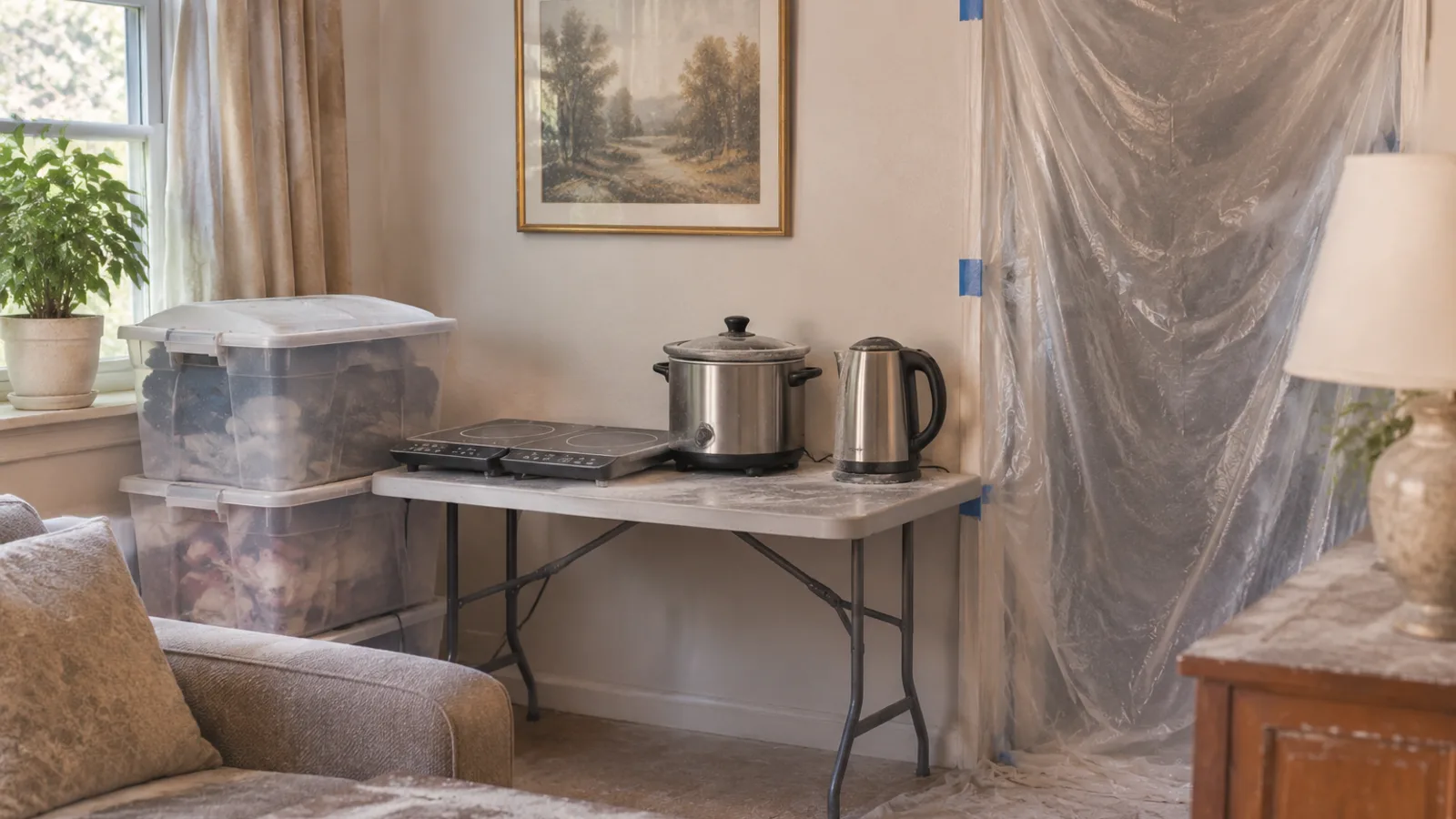
A draped sheet over a doorway does almost nothing. Dust from plaster cutting, sanding and demolition is fine enough to drift straight through fabric. Use heavy plastic sheeting taped firmly to the door frame on all four sides, with a zip or overlapping flap for entry. It takes twenty minutes and costs very little.
Stock the room with what you will actually use:
- A kettle and a small selection of mugs, tea and coffee
- A power board with enough sockets for devices and a lamp
- A folding table or sturdy tray for eating and working
- Clean clothes stored in sealed bags or a closed wardrobe
- Bedding kept in a zip-up storage bag when not in use
Keep it simple. The sanctuary room works because it is protected and consistent, not because it is comfortable in the way your home normally is.
Move Everything Worth Protecting Before You Think You Need To
Dust travels further and faster than contractors tend to warn. Soft furnishings, rugs, cushions and curtains in adjacent rooms should be packed away before work begins — not on day two when you notice the problem.
Use clear plastic storage bins rather than cardboard boxes, which absorb dust and cannot be wiped clean. Label everything clearly with tape and a permanent marker. When you are exhausted in week three, you will not remember which unlabelled box holds the good knives.
Managing Dust Every Day
Barrier Systems That Actually Work
For any work involving cutting concrete, tile or plasterboard, a dropcloths-only approach falls short. A proper dust containment setup uses plastic sheeting sealed to walls and ceilings, combined with a negative-pressure system — a fan unit that exhausts air outward through a filtered vent — to prevent fine particles from migrating through the rest of the house. This is standard practice for major renovation work, and something to confirm with your contractor before day one, not discover is missing on day three.
Fine dust from tile and concrete cutting contains respirable silica particles, which carry real health risks with repeated exposure. The UK Health and Safety Executive and the US Centers for Disease Control and Prevention both publish guidance on silica dust in construction. Asking your contractor what dust controls they are using is entirely reasonable.
A Daily Dust Routine
Cleaning once a week produces a situation that feels impossible to recover from. A short daily routine keeps it manageable. At the end of each working day, before the crew leaves:
- Run a damp microfibre cloth over hard surfaces in work-adjacent rooms
- Damp-mop hard floors in those areas
- Vacuum carpets and soft furnishings with a HEPA-filter vacuum
A contractor-grade shop vacuum is worth having on site — a standard household vacuum can recirculate fine dust rather than capturing it. Fifteen to twenty minutes at the end of each day keeps the problem from compounding into a weekend-consuming job.
Prioritise rooms where you sleep and eat. The hallway can wait until Friday; the bedroom and temporary kitchen cannot.
Protecting Food, Clothes and Electronics
Three areas people consistently underestimate: open food in pantries next to work zones should be moved to sealed airtight containers; wardrobe contents in adjacent rooms benefit from garment bags or a large sealed bin bag over hanging clothes; and air vents can carry fine particles across an entire floor. Cover vents in unaffected rooms with plastic sheeting taped lightly over the opening — cheap, easy to remove, and genuinely effective.
Keep laptops and open-vent electronics inside your sanctuary room, or in a sealed bag when not in use. A fine layer of concrete dust inside a keyboard is not immediately catastrophic, but it accumulates.
The Temporary Kitchen
What Equipment Is Worth Setting Up
Four pieces of equipment cover the vast majority of home cooking needs during a renovation:
- A two-burner induction hob — for frying, boiling pasta and stir-fries
- A microwave with a grill function — for reheating, jacket potatoes and simple roasting
- A slow cooker — for soups, stews and batch cooking with almost no active attention
- An electric kettle — non-negotiable
Set the temporary kitchen up in a utility room or a corner of the dining room rather than a garage — temperature, ease of access and proximity to water all matter when you are already tired. If water access is disrupted, a plastic washing-up basin handles most tasks adequately.
Meal Planning for a No-Kitchen Period
Batch cook on the last evening before demo day. A slow cooker running overnight gives you two or three days of meals at the start — the period when adjustment is hardest and your energy is lowest. A practical week might look like this:
- Monday and Tuesday: slow-cooker chicken and vegetable stew from the batch cook
- Wednesday: pasta with a jarred sauce, finished with cheese under the microwave grill
- Thursday: stir-fry on the induction hob — fifteen minutes, minimal washing up
- Friday: takeaway, planned and budgeted for in advance
Keep a written meal plan on the fridge so decisions are made once a week, not at 6:30 in the evening while standing in a room that smells of plaster. Budget honestly for takeaway from the start. There will be evenings where it is simply the right call, and treating it as a failure makes the whole period harder than it needs to be.
The Fridge and Pantry Situation
Move the fridge to wherever it stays accessible and can be kept reasonably clean. Before demo day, pare down pantry stock so you are not managing a large quantity of dry goods with nowhere sensible to put them. Sealed plastic bins stacked in the sanctuary room or a hallway work better than trying to keep an open pantry functional next to a work zone.
Noise, Hours and Contractor Schedules
Setting Ground Rules From the Start
Give the site lead a brief written house-rules sheet on day one. It does not need to be formal — a printed half-page covering start and end times, which rooms are off-limits without asking, how much notice you need before an early start, and how you prefer to be contacted for questions is enough. This prevents the small boundary negotiations that would otherwise play out across the first week.
Working From Home During a Renovation
Demolition and cutting are the noisiest phases. Grouting, painting and finishing work are significantly quieter. Ask your site lead at the start of each week what the loudest work is scheduled for, and block your most critical calls and focused work around it.
Some phases will simply be unworkable from home. A library, café or co-working space for two or three days during peak noise is not a retreat — it is a practical decision that protects your work and your composure. Plan for it rather than trying to push through and failing.
Protecting Sleep
If work has disrupted or exposed your bedroom in any way, re-seal it properly before the crew leaves for the day. Even in a well-protected sanctuary room, the ambient stress of a renovation disrupts sleep for most people. Keep the room as dark, quiet and consistent as possible — this is not the time to tolerate the curtain rail being down for a week because it felt too minor to raise.
Children During a Renovation
Safety That Goes Beyond the Obvious
Beyond the clear rule of keeping children out of the work zone, the less-visible risks are worth naming: adhesives, primers and solvents left near a work area; uneven or unfinished floors in transition zones; and the habitual quick look that becomes a habit. Set a physical boundary — a closed door with a latch, not an open archway — and explain the rule once, clearly, in terms your child understands. For younger children, the explanation is simple: the people building our house need that space to be safe.
Keeping Routines Intact Where It Matters
Bedtime, mealtimes and homework routines are worth protecting at almost any cost during a renovation. Everything else can flex. Recreate the consistent elements in whatever space you have: a specific chair for homework, a consistent snack spot, the same bedtime sequence even if the room looks different than usual. Children adapt to disrupted spaces more readily when the routine inside that space stays the same.
Making It Interesting Instead of Stressful
A progress photo taken from the same spot every few days gives children a concrete, visual sense of change over time rather than just an indefinite period of inconvenience. If the project allows it, let them choose something small and low-stakes — a tile colour, a drawer handle. This shifts the emotional framing from something being done to them to something they are part of.
Pets
Where the Pet Goes During Active Work
For dogs, the practical options in rough order are: a closed room with an owner present, a trusted neighbour or family member, day care for the noisiest phases, and boarding for extended high-disruption periods such as a full demolition week. For cats, boarding is often more stressful than the renovation itself; a cat contained in a quiet, closed room with familiar bedding and a litter tray usually copes better than one moved to a stranger's home.
Stress Signals to Watch For
Behavioural changes in pets during renovations are common and often dismissed as minor. In cats, watch for hiding for extended periods, reduced appetite and over-grooming. In dogs, watch for persistent barking beyond the first few days, destructive behaviour or a significant change in appetite. Some level of unsettled behaviour is normal and temporary. If it persists or escalates, speak to a vet. There are calming aids available for both cats and dogs — their efficacy varies considerably by animal, and a vet is the right starting point for advice specific to your pet.
Your Own Mental Health: The Part Everyone Skips
Renovation fatigue is real, it compounds quickly, and it is worth taking seriously before it takes hold.
Decision Fatigue and How to Cut It Down
A live renovation generates a near-daily stream of small decisions: substitute materials because the original is out of stock, finish options the contractor needs an answer on, questions that feel urgent but mostly are not. Batch these by designating a single thirty-minute window each day as your renovation contact time. Outside that window, questions go to a shared note or message thread and wait. This one change reduces the cognitive drain significantly.
Decide in advance which decisions one person can own independently and which ones require both partners. Most substitution decisions — a slightly different tile size, a grout colour in the same family — do not need a joint meeting. Keep a simple decision log so neither person has to remember what was agreed.
When to Leave the House
Plan at least one weekend away during the worst phases before the renovation starts, not mid-project when it feels too complicated to arrange. Demolition week and floor sanding are reliable candidates. This is a recovery window that makes the following weeks more sustainable, not an indulgence.
The Last 20 Percent Problem
The final phase of almost every renovation drags. The big, visible work is done, motivation has drained, and a snagging list of small unfinished items grows without obvious resolution. This is nearly universal, and it costs real money and time to let it drift.
Close it out deliberately: produce a written snagging list shared with the contractor, with a named completion date beside each item and a clear shared definition of what finished means for each one. Review it weekly. This is unglamorous, but it is the difference between a project that closes and one that is almost done for another six months.
Frequently Asked Questions
How do I stop dust from reaching rooms that are not being worked on?
Sealed plastic sheeting taped to door frames is significantly more effective than draped fabric. For major work, ask your contractor to use a negative-pressure containment system that exhausts air outward. Cover air vents in unaffected rooms and do a fifteen-minute damp clean of adjacent areas at the end of each working day.
We are losing our kitchen for six weeks — is a temporary kitchen really liveable that long?
Yes, with the right setup. A two-burner induction hob, a microwave with a grill function, a slow cooker and an electric kettle cover a wide range of cooking. The harder part is psychological: build in a realistic budget for occasional takeaway from the start, batch cook before demo day, and keep a weekly meal plan visible so you are not making decisions at the end of a tiring day.
What should I do with my dog during the renovation?
During the noisiest and most disruptive phases, the most practical options are day care or a trusted person outside the house. For quieter phases, a closed room with familiar bedding, water and a chew toy works for most dogs. Watch for behavioural changes beyond the first week and speak to a vet if anxiety seems persistent.
How do I work from home when there are tradespeople in the house all day?
Ask your site lead at the start of each week when the loudest work — cutting, drilling, demolition — is scheduled, and protect those windows for lower-focus tasks. Reserve your most critical calls and deep-work blocks for quieter phases. For the noisiest days, working from a library or café for a few hours is a practical solution, not a defeat.
I am three months in and completely over it — is renovation fatigue normal?
Entirely normal, and it compounds quickly when daily domestic life is disrupted for an extended period. The most effective responses are concrete rather than motivational: take a weekend away from the house if you have not done so recently, reduce the daily decision load with a batched contact window, and push hard to close the snagging list with named dates rather than leaving the finish line vague. The end of a renovation often needs to be engineered deliberately rather than waited for.
The practical reality of living through a renovation is that it is a temporary logistics problem, not a character test. The families who come through it well are not the ones with the highest tolerance for chaos — they are the ones who sealed a sanctuary room before day one, managed dust daily rather than weekly, handed the site lead a written house-rules sheet on the first morning, and kept their own decision-making lean. None of it is complicated. All of it makes a genuine difference.






Join the conversation
Sign in — Sign in to join the conversation.