
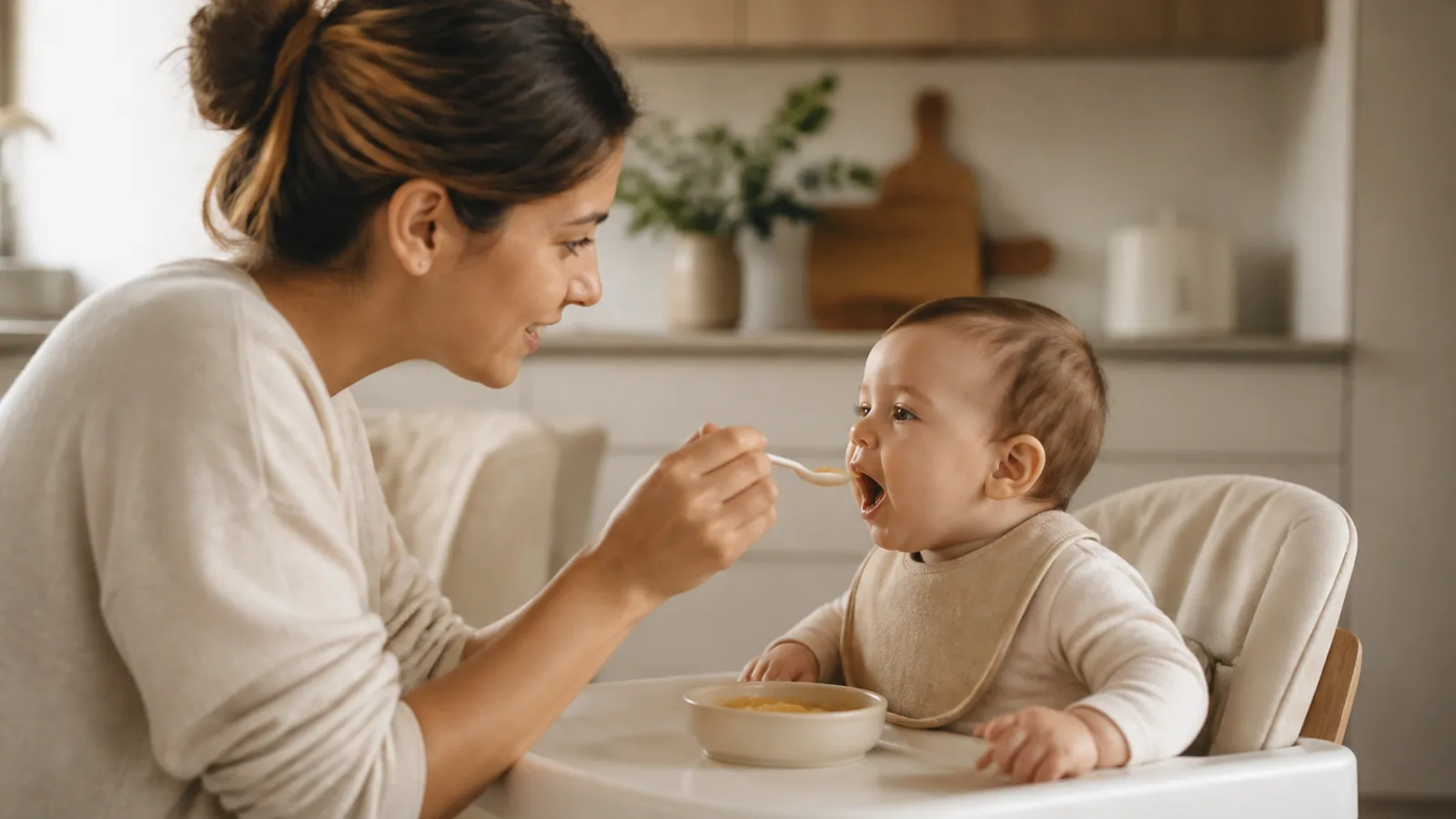
Starting solids baby decisions can feel strangely high-stakes for something that begins with a spoonful of mashed banana. One parent is told to wait until six months, another says “as soon as they seem interested,” and a third swears by purées while a friend insists on baby-led weaning. The truth is usually less dramatic: most babies do best when solids are introduced gradually, when they show readiness, and when families choose an approach that feels safe and sustainable.
This guide is here to make the first steps clearer. It covers when babies are usually ready, what to offer first, how purées and baby-led weaning compare, how to introduce common allergens, what gagging looks like versus choking, and a simple first-month plan. Advice varies a little between countries, so if you are unsure, check with your paediatrician, health visitor, family doctor, or local public health guidance.
When to start solids
In many places, the general recommendation is to begin solids around six months, but readiness matters more than the date on the calendar. Some babies are ready a little before or after that point. The key is whether your baby can handle food safely and has the motor skills to manage it.
It is also important to remember that solids are called complementary foods for a reason. Breast milk or formula still does most of the nutritional work at first. The goal in the beginning is not to “replace” milk feeds, but to let your baby learn how to eat.
Because guidance differs slightly across the US, UK, Canada, Australia, and Europe, it is sensible to follow the advice of your local health authority and your baby’s own clinician. If your baby was born early or has any feeding, growth, or medical concerns, personalised advice matters even more.
Signs your baby may be ready
- They can hold their head steady and have good neck control.
- They can sit with support and stay fairly upright.
- They show interest in food, such as watching you eat or reaching for your plate.
- They open their mouth when food comes near.
- They are less likely to push food straight back out with their tongue.
You do not need every sign to be perfect, but you do want several of them. One sign on its own is not enough.
When to pause and check in first
If your baby cannot sit with support, has very poor head control, or seems to push everything out with the tongue, it may be too soon. If your baby has reflux, swallowing problems, constipation, poor weight gain, significant eczema, or other health concerns, ask your paediatrician or health visitor before starting.
When in doubt, ask. There is no prize for starting early, and no harm in waiting a little if your baby is not quite ready yet.
What to offer first
There is no single “best” first food. What matters most is that it is soft, safe, and rich in nutrients. Many parents start with a simple single food and then build from there.
One helpful priority is iron. By around six months, babies’ iron needs rise, and milk alone may no longer cover everything. That is why many clinicians suggest including iron-rich foods early rather than focusing only on fruit.
Good first foods can include:
- Iron-fortified infant cereal mixed with breast milk or formula
- Very soft cooked vegetables such as sweet potato, squash, carrot, or broccoli
- Mashed avocado, banana, pear, or steamed apple
- Plain full-fat yoghurt, if it fits your local guidance and your family’s approach
- Smooth lentil purée or well-mashed beans
- Soft, flaky fish or very finely shredded meat, when appropriate
The best first foods are often the ones your family already eats, prepared in a baby-friendly texture. That can make the transition easier and more affordable.
Texture matters from the beginning
At the start, food should be soft enough to mash easily between your fingers. That does not mean it needs to be watery or completely smooth. Babies learn from texture, and a little thickness is often helpful.
A useful rule of thumb: if you can squash it easily between your fingers, it may be soft enough. But shape still matters. A soft grape is still not safe if it is served whole.
As your baby gains skill, you can move from smooth purées to thicker mashed foods, soft lumps, and then small pieces or finger foods. Think gradual progression, not a sudden jump.
Starting solids baby: purées versus baby-led weaning
Parents often feel pressured to choose one feeding style and stick to it. In reality, many families use a mix of approaches. You do not have to be “for” one method and “against” the other.
Both purées and baby-led weaning can work well when they are done safely and with attention to a baby’s cues. The better question is often: what suits your baby, your confidence level, and your daily life?
Purées: the pros and cons
Purées can be a gentle place to begin. They are often easier to spoon-feed, simpler to portion, and useful when you want to focus on iron-rich foods or introduce a new food in a controlled way. For some parents, they feel less stressful than finger foods at first.
The trade-off is that some babies may stay on very smooth textures for too long if parents do not gradually move them on. If you choose purées, aim to thicken them over time and introduce mashed textures and soft lumps as your baby becomes more confident.
Purées can also become a parent-led experience if the adult is doing all the feeding and the baby has little chance to explore. A spoon-fed start is not a problem in itself; just try to keep the experience responsive and low-pressure.
Baby-led weaning: the pros and cons
Baby-led weaning usually means offering soft finger foods from the start and allowing the baby to feed themselves. Many families like it because it encourages independence, gives babies a chance to explore texture, and fits naturally into family meals.
The downside is that it requires extra attention to food shape and safety. It can also be messier and more mentally demanding for parents, especially if you are nervous about choking or worried your baby is not eating much.
That said, “not eating much” is often normal in the beginning. Early solids are mostly practice. If you choose baby-led weaning, the food needs to be soft, appropriately shaped, and offered while your baby is sitting upright and supervised.
A hybrid approach is completely fine
Many families use both. You might offer oatmeal by spoon one day, avocado sticks the next, and a mixed meal later in the week. That is not inconsistent; it is practical.
A hybrid approach can help if your baby likes self-feeding but also needs help getting enough iron-rich food early on. It can also make family meals easier because you are not tied to one method.
How to introduce common allergens
Many current recommendations support introducing common allergens early, once solids are underway, rather than delaying them for months. The aim is not to provoke reactions, but to help your baby become familiar with these foods in a safe, age-appropriate way.
Common allergens include peanut, egg, cow’s milk in foods, wheat, sesame, fish, shellfish, soy, and tree nuts. The exact timing and approach can vary a little by country and by your baby’s risk factors, so if your baby has severe eczema, an existing food allergy, or a strong family history of allergy, speak to your clinician first.
For many babies, a simple approach works well: introduce one allergen in a small amount when your baby is healthy, offer it at home, and repeat it regularly if there is no reaction.
Safe ways to offer allergens
- Peanut: smooth peanut butter thinned with warm water, breast milk, formula, yoghurt, or purée. Never offer thick globs of nut butter.
- Egg: well-cooked scrambled egg, omelette strips, or hard-boiled egg mashed into another food.
- Milk: small amounts of yoghurt or cheese in foods, if appropriate. Cow’s milk should not replace breast milk or formula as a drink before one year.
- Wheat: soft toast soldiers, wheat cereal, or pasta well-cooked until very soft.
- Sesame: tahini thinned into yoghurt or purée.
- Fish: very soft, flaky fish with all bones removed.
- Tree nuts: nut butters thinned smooth, or finely ground nuts mixed into food.
Offer just a little at first, then a bit more if your baby tolerates it. If there is no reaction, keep offering the food now and then. Repeated exposure matters more than a one-time taste.
It is usually best to try new allergens earlier in the day and at home, so you can watch for a reaction. Possible signs include hives, swelling, vomiting, coughing, wheezing, or unusual sleepiness. If symptoms are severe or affect breathing, seek urgent medical help right away.
Gagging versus choking
This is one of the biggest sources of fear for parents, and it helps to know the difference.
Gagging is common when babies are learning to eat. It can look alarming: coughing, retching, spluttering, a red face, watery eyes, and a lot of noise. But gagging is often the body’s way of moving food forward safely.
Choking is different. A choking baby may be unable to cough or cry, may look panicked or silent, and may have trouble breathing. Skin may turn blue or grey. This is an emergency.
Because the difference can be hard to spot in the moment, it is a very good idea to take an infant first-aid course or learn your local choking response from a trusted health source. Helpful official resources include NHS, American Academy of Pediatrics, and CDC guidance pages, as well as local paediatric organisations in your country.
A few practical rules reduce risk:
- Always feed your baby sitting upright.
- Stay with your baby while they eat.
- Do not feed while lying down, in a car seat, or while being carried around.
- Keep portions small.
- Move slowly, especially with new textures.
Safe textures, shapes, and feeding habits
Starting solids is not only about what food you serve, but how you serve it. Shape and texture matter as much as ingredients.
Some foods are common choking hazards for babies unless they are prepared carefully. These include whole grapes, nuts, popcorn, chunks of raw apple or carrot, hard crusts, sticky spoonfuls of nut butter, and sausage rounds. Cherry tomatoes and blueberries also need special preparation because of their size and shape.
A safer approach is to think in terms of age-appropriate prep:
- Cut round foods lengthwise into strips or quarters, not circles.
- Cook firm vegetables until very soft.
- Remove bones, pits, and tough skins when needed.
- Spread nut butter thinly or mix it into other foods.
- Keep food soft, moist, and easy to gum.
It also helps to keep mealtimes calm. Babies do not need to finish a serving. They may play with food, spit it out, or eat a few spoonfuls and stop. That is normal.
At first, solids are about practice and exposure, not volume. Milk feeds still matter a great deal, and your baby may only eat tiny amounts for weeks. That does not mean you are doing anything wrong.
If your baby is interested, you can also offer a few sips of water from an open cup or straw cup with meals, depending on local guidance. The point is simply to help them learn the skill, not to replace milk.
A simple first-month approach
If you want a low-pressure plan, keep it simple. You do not need an elaborate menu or a new recipe every day. A calm, repeatable routine is often easier for both baby and parent.
- Week 1: Offer one or two small tastes a day. Focus on one or two iron-rich foods plus one fruit or vegetable. Keep the texture soft and familiar.
- Week 2: Repeat foods your baby tolerated and introduce a few new ones if you want to. There is no need to rush.
- Week 3: Start moving toward thicker textures and more variety. You can combine foods, such as mashed vegetables with lentils or cereal with fruit.
- Week 4: Add more family foods in safe forms, including soft finger foods and common allergens if that fits your plan and your clinician’s advice.
Examples of simple meals might include oatmeal with mashed banana, lentil purée with soft sweet potato, scrambled egg strips, avocado on soft toast fingers, or yoghurt mixed with thinned peanut butter. The exact combinations matter less than the fact that they are soft, safe, and repeated often enough for your baby to get comfortable.
Try not to measure success by how much ends up eaten. In the first month, the real progress is learning to tolerate a spoon, explore texture, and practise moving food around the mouth.
When to call your clinician
Check in with your paediatrician, health visitor, or doctor if:
- Your baby cannot manage even very soft textures.
- Feeding causes persistent coughing, choking, or distress.
- Your baby vomits often or seems to struggle after most meals.
- You suspect a food allergy or your baby has a reaction.
- Your baby has eczema, reflux, constipation, prematurity, or growth concerns that make feeding feel complicated.
- You feel overwhelmed and want a plan that suits your baby specifically.
It is always better to ask early than to second-guess yourself for weeks. A quick conversation can save a lot of anxiety.
FAQ
What is the best age to start solids baby feeding?
Many babies start around six months, but readiness matters more than the exact age. Look for good head control, the ability to sit with support, interest in food, and less tongue-thrusting. If your baby was premature or has any health concerns, ask your clinician before starting.
Should I start with purées or baby-led weaning?
Either can work. Purées may feel easier at first and can be helpful for iron-rich foods. Baby-led weaning lets babies self-feed and explore textures earlier. Many families use a mix of both, and that is completely fine.
How do I know if my baby is gagging or choking?
Gagging usually looks noisy and dramatic: coughing, retching, or a red face, but the baby is still moving air. Choking is more serious and may involve silence, trouble breathing, or a blue or grey colour. If you are unsure, seek emergency help and learn infant first aid in advance.
When should I introduce peanut, egg, and other allergens?
General guidance in many places now supports introducing common allergens early, once solids have started, rather than delaying them. Offer them in safe forms, at home, and watch for a reaction. If your baby has severe eczema or a known allergy, ask your paediatrician first.
What are the safest first foods for a baby?
Soft foods that can be mashed easily are usually a good place to start: iron-fortified cereal, mashed avocado, soft-cooked vegetables, banana, pear, yoghurt, lentils, and other smooth or very soft foods. The safest food is always one that is soft, appropriately shaped, and served while your baby is upright and supervised.
Starting solids is rarely neat, and it does not need to be. The starting solids baby stage is about learning, not perfection. If you keep the food soft, the pace gentle, and the approach flexible, you are already doing a lot right. And if anything feels off, trust yourself and ask your child’s clinician for guidance.






Join the conversation
Sign in — Sign in to join the conversation.