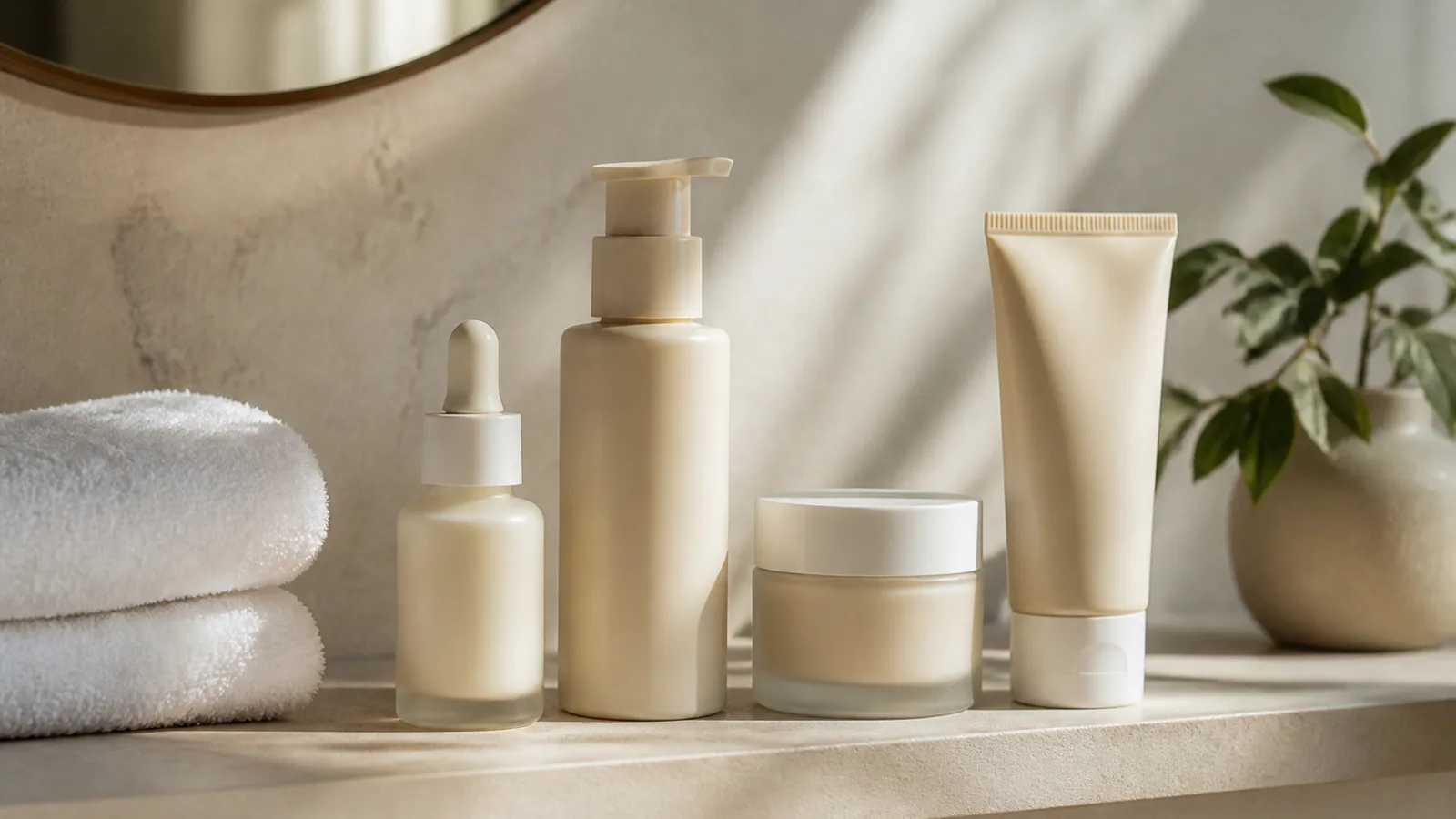
You are at the sink with a serum in one hand and a moisturiser in the other, wondering which goes first and whether it even matters. It does, a little, but far less than the ten-step routines online suggest. The right skincare routine order comes down to a simple principle you can apply to any product you own.
In the morning: cleanse, treat, moisturise, protect. At night: cleanse, treat, moisturise. Within that, layer from thinnest to thickest, keep treatments close to clean skin, and make sunscreen your last skincare step every morning.
Below you will find a quick-reference order, the logic behind it, three routines from minimal to advanced, which ingredients to keep apart at first, and how to add new products without upsetting your skin.
Skincare Routine Order at a Glance
Steps marked optional really are optional.
Morning
- Cleanse, or simply rinse with water if your skin is dry or sensitive.
- Toner or essence (optional).
- Treatment serum, such as vitamin C or another antioxidant.
- Eye cream (optional).
- Moisturiser.
- Sunscreen, always the last skincare step.
- Makeup, if you wear it.
Night
- Remove makeup and sunscreen, if you wore them.
- Cleanse.
- Toner or essence (optional).
- One treatment, such as a retinoid, an exfoliating acid or a targeted serum.
- Eye cream (optional).
- Moisturiser.
- Face oil or balm (optional).
The one rule to remember: watery textures first, creamy textures next, oils and balms last. In the morning, sunscreen goes on top of everything.
The Logic Behind Layering
Thinnest to thickest
Toners and essences go first, then serums and gels, then lotions and creams, then oils and balms. Lighter formulas get to reach your skin before richer products form a heavier layer over the top. It is a guideline, not a law, but it works for most products.
Treatments go close to clean skin
Products with a specific job, such as vitamin C, retinoids, exfoliating acids or azelaic acid, usually go on early so they are not working through layers of cream. The exception is prescription treatments: if your doctor, dermatologist or pharmacist gives you instructions, those always win.
Moisturiser supports the skin barrier
Moisturiser helps keep skin comfortable and reduces the dryness that can come with active ingredients. For sensitive skin, it can also act as a buffer: some people apply moisturiser, then a retinoid, then another thin layer of moisturiser. This “sandwich” method may make strong products easier to tolerate, though not everyone needs it.
Sunscreen goes last in the morning
Sunscreen needs to form an even, undisturbed film to protect as labelled, so it is your final skincare step before makeup. Do not mix it into moisturiser or foundation, which makes an even layer harder to achieve.
Many dermatology bodies recommend a broad-spectrum sunscreen with SPF 30 or higher for daily use. Labelling rules differ by country, so check the directions where you live. The American Academy of Dermatology and the NHS both offer practical guidance.
Amount matters. A commonly cited rule of thumb for face and neck is two finger-lengths of sunscreen squeezed along your index and middle fingers. Many people apply far less than the amount used in testing, which means they may get less protection than the label suggests. Reapply when you are outdoors for long periods, sweating or swimming. SPF in makeup is a nice bonus, but few people wear enough foundation for it to replace sunscreen.
Do you need to wait between layers?
No stopwatch required. Apply the next product once the previous one no longer feels wet, usually within a minute. If a label or prescription specifies a waiting time, follow it.
Putting the logic to work
Just bought a vitamin C serum? Run through the questions: it is a watery texture, so it goes before moisturiser. It is a treatment, so it goes on clean skin. It is an antioxidant, so it is a natural fit for mornings. Answer: after cleansing (and toner, if you use one), before moisturiser and sunscreen.
Your Morning Routine, Step by Step
Cleanse or rinse. Oily skin may prefer a gentle cleanser; dry or sensitive skin is often happy with water. Skin should feel clean, never tight or squeaky.
Toner or essence. Most modern toners are hydrating liquids rather than harsh astringents. Pleasant, but skippable.
Treatment serum. Vitamin C is a popular morning choice because antioxidants pair well with a protective routine. Some formulas tingle at first, so reactive skin may start with a few mornings a week or choose a gentler serum.
Eye cream. Optional. Your regular moisturiser often works around the eyes if it does not sting. If you use one, pat a small amount along the orbital bone.
Moisturiser. Gel-creams suit oily skin; richer creams suit dry skin. If your sunscreen feels hydrating enough on its own, it can double as your morning moisturiser, which often suits oily or combination skin. Dry skin usually prefers both.
Sunscreen. The step to keep even when you skip everything else. Mineral and chemical filters both have a place; the best sunscreen is the one you enjoy enough to apply generously every day.
A three-minute weekday morning can be as simple as rinse, moisturiser, sunscreen. Add a serum when you have a little more time.
Your Evening Routine, Step by Step
Remove makeup and sunscreen. A cleansing balm, oil or micellar water breaks down long-wear products, followed by a gentle cleanser. If you wore very little and your skin is dry, double cleansing every night may be unnecessary.
Cleanse. If your face feels tight straight afterwards, switch to something gentler before adding more serums.
Choose one main treatment. At first, stick to one active per night:
- A retinoid for texture, fine lines or breakouts.
- An AHA, such as glycolic or lactic acid, for dullness and roughness.
- A BHA, such as salicylic acid, often favoured by oily, breakout-prone skin.
- Azelaic acid, often used for uneven tone or blemishes.
- A hydrating serum if your skin is dry or recovering.
Moisturise. Especially useful at night, since many actives can be drying.
Face oil or balm. These usually go last because they are the richest layer. Prefer a lighter feel? Mix a drop into your moisturiser. Breakout-prone skin should introduce oils slowly.
On nights your skin feels irritated, skip the active entirely. A rest night of cleanser and moisturiser is not lazy; it is what keeps a routine sustainable.
Three Routines: Minimal, Standard and Advanced
Minimal
Morning: rinse or cleanse, moisturise, sunscreen. Night: cleanse, moisturise.
Ideal for beginners, sensitive skin, busy weeks or recovering from irritation. This is a complete routine, not a starter version you have to graduate from.
Standard
Morning: cleanse or rinse, vitamin C or another serum, moisturiser, sunscreen. Night: cleanse, one treatment (for example, a retinoid two or three nights a week to start), moisturiser.
Suits most people with one or two goals, such as dullness, occasional breakouts or early fine lines.
Advanced
Morning: cleanse, hydrating toner or essence, vitamin C, eye cream, moisturiser, sunscreen. Night: rotate actives across the week rather than stacking them:
- Monday: retinoid
- Tuesday: rest night
- Wednesday: exfoliating acid
- Thursday: retinoid
- Friday: rest night
- Saturday: retinoid, if tolerated
- Sunday: rest night or hydrating mask
Best for skin that already tolerates actives. More steps do not guarantee better results; if you are stinging, flaking or constantly red, simplify.
Three real-life examples
- Oily, breakout-prone skin: morning gentle cleanser, lightweight gel moisturiser (or a hydrating sunscreen alone), fluid sunscreen. Night cleanser, BHA two or three nights a week, gel moisturiser. Once that feels easy, a retinoid can be added on the non-BHA nights.
- Dry, sensitive skin: morning water rinse, rich moisturiser, sunscreen. Night cream cleanser and moisturiser. If you want a retinoid, try a gentle one once a week using the sandwich method, building up slowly.
- 40s or 50s, focused on texture and fine lines: the standard routine, with vitamin C in the morning, a retinoid a few nights a week and rest nights in between. Daily sunscreen is the foundation everything else builds on.
Ingredients Not to Stack at First
Experienced users sometimes combine these, but stacking them early is a common route to irritation. Start by keeping them apart.
Retinoids and exfoliating acids
Both can be useful; together they are often too much at first. Use them on different nights.
Retinoids and benzoyl peroxide
This pairing can be irritating, and benzoyl peroxide may affect some retinoid formulas. A common approach is one in the morning and one at night, or alternate days. If either is prescribed, ask your prescriber or pharmacist.
Vitamin C with strong acids or retinoids
Not unsafe, but potentially uncomfortable for sensitive skin. Simplest fix: vitamin C in the morning, other actives at night.
Multiple exfoliants
An acid toner, acid serum and scrub do not belong in the same routine when you are starting. Over-exfoliation shows up as stinging, tightness, a tight shine that is not oil, flaking or sudden sensitivity.
Vitamin C and niacinamide
The old warning against combining these is widely considered overstated for modern formulas. If the pairing feels fine, it probably is. If it stings or flushes, use them at different times.
Get personalised advice first if you are pregnant, trying to conceive or breastfeeding. Retinoids are generally advised against during pregnancy, and prescription oral retinoids carry strict pregnancy warnings, so ask your doctor, midwife or pharmacist which actives are suitable for you. The same applies if you use prescription skincare, take medication that affects your skin, or have rosacea, eczema or persistent acne.
How to Introduce New Products Without Upsetting Your Skin
One new product at a time. Give each a few weeks before adding another, so you know what is helping and what is causing trouble. A note on your phone with the product, start date and any reaction is enough.
Patch test. Apply a little to a discreet area, such as along the jaw or behind the ear, for a few days. It is not foolproof, but it can catch obvious problems.
Start low and slow with actives. Begin retinoids, acids and benzoyl peroxide a few nights a week, at lower strengths, and increase only if your skin stays comfortable.
Be realistic about timing. Hydration can feel better quickly. Changes in tone, texture or breakouts usually take weeks to months, and results vary.
Know when to stop. Mild, brief tingling or dryness when starting a retinoid can be expected. Burning, swelling, hives, a rash or redness that does not fade is not. Stop the new product, return to the minimal routine and seek medical advice if symptoms are severe or do not settle.
Where Does This Product Go?
- Hyaluronic acid serum: on slightly damp skin after cleansing or toner, before heavier serums and moisturiser.
- Eye cream: after serum, before moisturiser.
- Spot treatment: follow the label; usually on clean skin or after serum, on the spot only.
- Face mist: after cleansing, between layers or over makeup.
- Sheet mask: after cleansing and toner; pat in the excess, then moisturise.
- Wash-off mask: after cleansing, before the rest of your routine.
- Face oil: last at night, or mixed into moisturiser.
- Prescription treatment: exactly as your prescriber instructs.
- Neck and chest: extend moisturiser and sunscreen here too.
- Lip balm: last.
Common Layering Mistakes and Easy Fixes
- Too many actives at once. One main treatment per routine.
- Oil before serum. Watery products first, oils last.
- Mixing sunscreen into other products. Apply it as its own layer.
- Skimping on sunscreen. Use the two-finger guide and wear it on cloudy days too.
- Switching products constantly. Give each a fair trial.
- Rubbing hard. Smooth or press products on gently.
- Ignoring irritation. Go back to cleanser, moisturiser and sunscreen until skin calms down.
FAQ
Does the order of skincare products really matter?
Yes, mainly so treatments reach clean skin and sunscreen sits undisturbed on top. Small variations, such as toner before or after a very watery serum, are rarely worth worrying about.
Should moisturiser go before or after sunscreen?
Before. Sunscreen is the final skincare step in the morning. If your sunscreen is hydrating enough, it can replace moisturiser altogether, which many oily and combination skin types prefer. A moisturiser with SPF can also cover both steps, but only if you apply it generously, which many people find hard to do.
Can I use retinol and vitamin C in the same routine?
Some people can, but the simpler, often gentler approach is vitamin C in the morning and retinol or another retinoid at night. It lowers the chance of irritation and keeps your routine easy to follow.
How long before I see results from a new routine?
Comfort and hydration can improve within days. Changes in texture, tone, fine lines or breakouts usually take several weeks to a few months, depending on the product and your skin. If things get worse, or nothing changes after a fair trial, consider seeing a dermatologist.
Do I need a different routine for morning and night?
Ideally, yes. Mornings focus on protection, nights on cleansing and treatments. At the minimal level they overlap almost completely: moisturiser and sunscreen in the morning, cleanser and moisturiser at night.
Start Simple, Then Build
The best skincare routine order is the one that lets each product do its job without overwhelming your skin. Cleanse, treat, moisturise and protect in the morning. At night, cleanse, choose one treatment if you need it, then moisturise.
If you are unsure where to begin, spend a few weeks on cleanser, moisturiser and sunscreen. Once that feels effortless and your skin is calm, add one product at a time. Your routine should feel supportive, not like a nightly chemistry exam.






Join the conversation
Sign in — Sign in to join the conversation.