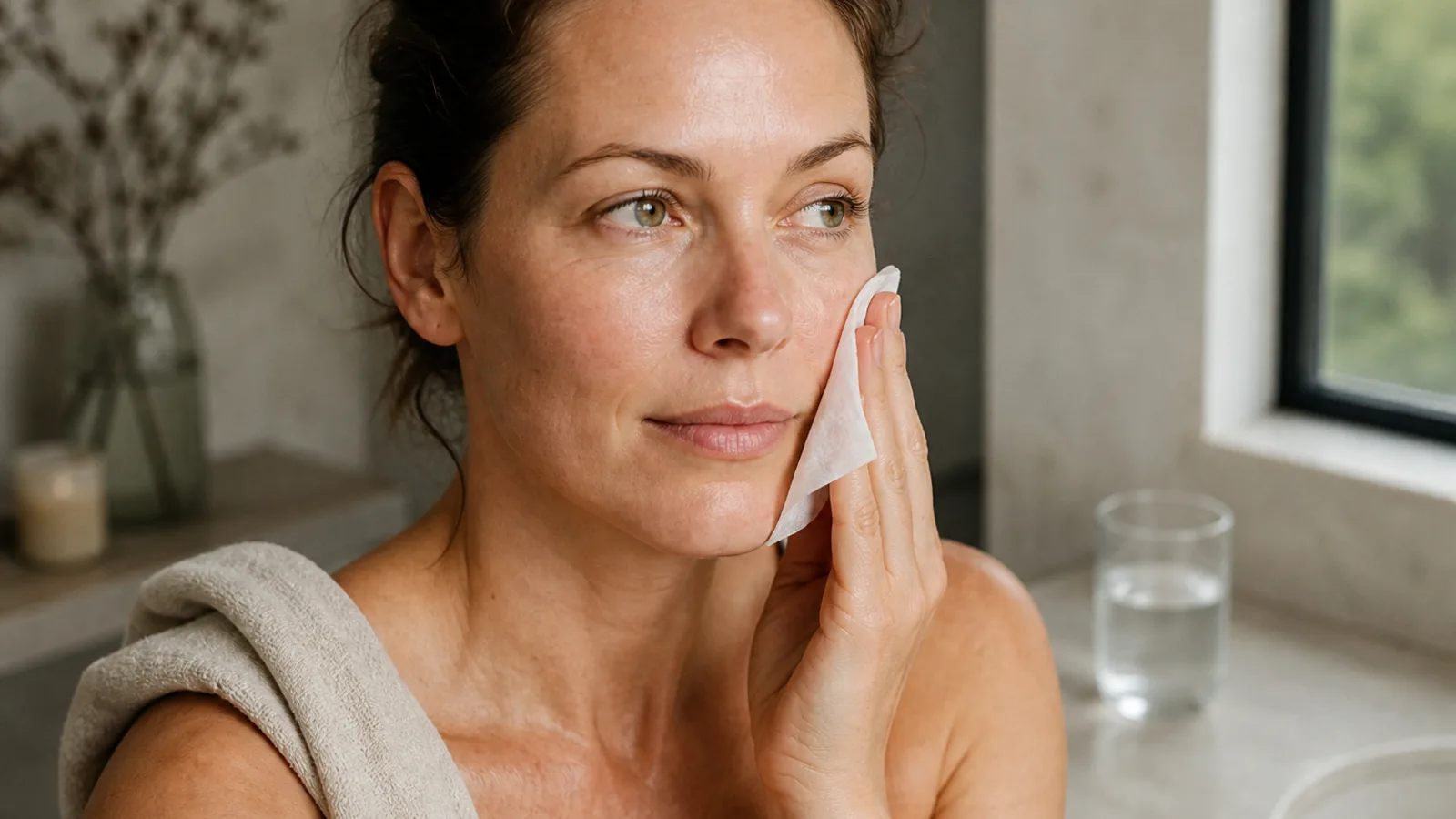
You may have been “oily” at 25, but now your cheeks feel tight by lunch. Or you bought a rich cream for “dry skin” and woke up shiny, congested and confused. Skin is more changeable than most labels suggest, which is why learning how to find your skin type is less about choosing a label for life and more about reading what your skin is doing right now.
The good news: you do not need a device or a drawer full of products to work it out. A clean face, a little patience and a few weeks of observation can tell you a lot.
Below, you will find two simple at-home tests, a clear way to separate skin type from skin conditions, an honest look at why skin shifts (including in perimenopause), and gentle routine adjustments for each result.
What “skin type” actually means
Your skin type is your skin’s baseline pattern: how much oil it tends to produce, where that oil shows up, and how comfortable your skin feels when you leave it alone.
The main skin types are usually described as:
- Dry: produces less oil and may feel tight, rough or flaky.
- Oily: produces more oil, often with visible shine across much of the face.
- Combination: oily in some areas, usually the forehead, nose and chin, while other areas feel normal or dry.
- Normal: generally comfortable, without strong oiliness or dryness.
You will often see sensitive listed as a fifth type. In practice, it is more useful to think of sensitivity as a tendency to react, which can sit alongside any of the four. You can have oily sensitive skin or dry sensitive skin, for example.
One more distinction: skin type is not the same as skin tone, or the way your skin responds to sun (dermatologists use a separate scale for that). Both matter, but for different decisions.
Before you test, set yourself up for a fair result
If your skin is inflamed, sunburned, windburned or recovering from a peel, the result will not reflect your true baseline. The same goes for the first few weeks after starting a strong active, such as a retinoid, exfoliating acid or prescription acne treatment.
Test when your skin is relatively calm. Avoid doing it straight after exercise, in a steamy bathroom or during a heatwave if you can.
You will need:
- A gentle cleanser, ideally fragrance-free
- Lukewarm water and a clean towel
- A mirror and natural light
- Blotting papers or a clean tissue, for the blotting method
If your menstrual cycle affects your skin, consider testing at two or three points across the month. Some people notice more oil or breakouts at certain times, and completely different skin at others.
How to find your skin type with the bare-face test
The bare-face test is the simplest place to start. Even the gentlest cleanser and tap water can have a mild, temporary effect, but this test gives you the clearest baseline you can get at home, without moisturiser, serum, sunscreen or makeup in the picture.
- Wash your face with a gentle cleanser and lukewarm water.
- Pat dry with a clean towel. Do not rub.
- Apply nothing else.
- Wait about 30 minutes to one hour, without touching your face.
- Look at your skin in natural light and notice how it feels.
A note on timing: if your indoor air is very dry, for example from central heating during a Canadian or northern UK winter, lean towards checking at the 30-minute mark. Waiting a full hour in low humidity can make even balanced skin feel artificially tight, nudging you towards a false “dry” result.
How to read the result
- Tight, rough or flaky, with little or no shine: your skin is likely dry.
- Shiny across the whole face, including the cheeks: your skin is likely oily.
- Shiny forehead, nose and chin, but cheeks normal or tight: your skin is likely combination.
- Comfortable, with minimal shine and no tightness: your skin is likely normal.
- Stinging, itching, burning or redness after a mild cleanse: your skin may be reactive, whatever your oil level.
A classic combination result is the “shiny nose, tight cheeks” pattern. That does not mean your skin is difficult; it means different areas need slightly different care.
The blotting approach
Blotting helps if you cannot tell whether you are seeing oil, natural glow or a trace of sweat. It is especially useful for confirming oily and combination patterns.
- Cleanse, pat dry and wait, just as you would for the bare-face test.
- Press a blotting paper gently onto your forehead, nose, chin and each cheek.
- Use a fresh sheet for each area if possible, and lay them out in order so you do not mix them up.
- Hold each sheet to the light and compare.
Little or no oil on any sheet suggests dry or normal skin. Use how your face feels to separate the two: dry skin usually feels tight, while normal skin feels balanced.
Oil on every sheet, including the cheeks, suggests oily skin. Oil mainly from the forehead, nose and chin suggests combination.
The limitation matters: blotting papers show oil, not hydration, irritation or barrier health. Oily skin can still be dehydrated, and dry skin can still break out. Treat blotting as one clue, not the whole story.
Watch your everyday clues
A single test is a snapshot. Your daily patterns are often more revealing. For one month, spend 30 seconds a day noting what your skin does; a note on your phone is enough.
- How your face feels 10 minutes after cleansing
- Whether you look shiny by midday
- Whether foundation clings to dry patches, separates or slides off
- Whether you reach for powder, moisturiser or nothing
- Any breakouts, redness, stinging or flaking
- Weather, travel, your cycle and any new products
You might discover you are normal-to-combination most of the month and oilier the week before your period. Or that you only feel dry when the heating is on. Patterns stop you overhauling your routine because of one bad skin day.
Your skin type is a baseline, not a permanent identity. You are looking for the pattern that shows up most often when your skin is calm.
Skin type vs skin condition: why the difference matters
A skin type is your baseline. A skin condition is something your skin is experiencing. Conditions can affect any type, and they can make your skin look like something it is not.
Dry vs dehydrated skin
Dry skin tends to produce less oil. It may feel rough, tight or flaky even with a simple routine.
Dehydrated skin lacks water, not necessarily oil, so it can happen to oily and combination skin too. The giveaway is skin that feels tight yet still looks shiny, sometimes with fine lines that look more noticeable than usual.
Common triggers include harsh cleansers, over-exfoliation, cold weather, central heating, air conditioning and long flights. Often the answer is not a heavier routine everywhere, but gentler cleansing, a hydrating layer and a moisturiser that supports the skin barrier.
Sensitive vs sensitised
Some people have naturally reactive skin, sometimes alongside a personal or family history of eczema or allergies. Others have sensitised skin: a temporary state caused by doing too much.
If your skin was comfortable until you started using three serums, an acid toner and a scrub, it is probably not a “sensitive type.” It is likely sensitised, and it often settles with a barrier-first pause: a gentle cleanser, a plain moisturiser, sunscreen, and nothing else for a few weeks. If it does not settle, get it checked.
Conditions that can be mistaken for a skin type
Acne, rosacea, eczema, seborrhoeic dermatitis, perioral dermatitis and pigmentation concerns such as melasma can all change how your skin looks and feels. They are not simply “oily” or “sensitive” skin.
Persistent redness and flushing may need a different approach from general sensitivity. Flaking around the nose and eyebrows does not necessarily mean your whole face is dry. Deep, painful spots are not a sign that you need a stronger cleanser.
If a concern persists, keeps returning or is painful, speak to a dermatologist or qualified healthcare professional. The American Academy of Dermatology and the NHS both offer clear patient information on common skin conditions.
Why mislabelling backfires
Treat dehydrated oily skin as “too oily” and reach for stripping products, and your face may feel tighter and more reactive while still getting shiny. Treat rosacea-type redness as a breakout problem and layer several acids, and irritation may get worse. The aim is not to diagnose yourself. It is to recognise when a simple adjustment is enough, and when something deserves professional eyes.
Why your skin type can change over time
Your body, environment and routine change, and your skin changes with them. Sometimes the shift is temporary; sometimes it becomes your new normal.
Hormones and your cycle
Many people notice changes in oiliness, breakouts or sensitivity at certain points in their cycle, though the pattern varies widely. Pregnancy, the postpartum months, and starting or stopping hormonal contraception can also shift how your skin behaves. If changes are sudden or severe, or come with other symptoms, talk to a doctor rather than trying to fix everything with skincare.
Perimenopause and menopause
This is often where women feel most confused, because skin can seem to do two opposite things at once: drier, thinner-feeling cheeks that are slower to recover, alongside breakouts along the jaw and chin, and sometimes new flushing or reactivity.
There is a reason. As oestrogen declines, the skin’s barrier lipids and moisture tend to drop, which can bring dryness and a crepier texture. At the same time, the relative influence of androgens is thought to increase for some women, which may contribute to adult breakouts. How strongly this shows up varies a great deal from person to person.
Picture someone who has been oily all her life and used a foaming cleanser and mattifying lotion for twenty years. In her late 40s, her cheeks feel tight and flaky, while spots appear along her jaw. Her skin has not failed, and she has not been doing anything wrong. Her skin has changed, and her routine is allowed to change with it: a creamier cleanser, a more cushioning moisturiser, less frequent exfoliation, and targeted spot care only where it is needed.
If midlife skin changes are significant, or arrive with other symptoms, it is worth raising them with your GP or doctor, who can look at the bigger picture.
Seasons and indoor climate
Cold air, wind and indoor heating often leave skin feeling drier and more sensitive. Heat and humidity make oil and sweat more noticeable. Someone in a Canadian winter may need a richer moisturiser than she uses in July, while someone in a humid Australian summer may prefer lighter layers. Seasonal adjustment is normal and does not necessarily mean your type has changed.
Moving, travel and flying
Moving from a humid climate to a dry one, or the reverse, can change how your usual products feel. Cabin air on long flights can also leave skin tight and dehydrated for a few days.
Age, medication and routine habits
Oil production often becomes less abundant with age, though the timing and degree vary. Some medications, including prescription acne treatments, can affect dryness, oiliness or sensitivity; ask the prescribing clinician what to expect and how to support your skin. And your own routine can change your “type” temporarily, as too many actives can make almost any face behave like sensitive skin.
A good rule: re-check your skin when seasons change, when life stages change, or whenever your usual products stop feeling right.
Gentle routine adjustments for each skin type
You do not need to replace everything overnight. Changing one thing at a time shows you what actually helps. Patch test if you are reactive, and give each change a few weeks.
Dry skin
- Choose a cream, milk or lotion cleanser rather than a harsh foaming wash.
- Use lukewarm water, never hot.
- Apply moisturiser to slightly damp skin.
- Look for hydrating and cushioning ingredients such as glycerin, hyaluronic acid, ceramides, shea butter or petrolatum, depending on what your skin tolerates.
- Keep exfoliation gentle and infrequent.
Oily skin
- Use a gentle gel or light foaming cleanser that does not leave skin squeaky.
- Do not skip moisturiser; choose a lightweight, non-comedogenic lotion or gel-cream.
- Niacinamide or salicylic acid may help some oily or congestion-prone skin, but introduce them slowly.
- Blot shine during the day rather than repeatedly washing.
Combination skin
- Zone your routine: a lighter moisturiser on the T-zone, more comfort on the cheeks.
- Apply oil-control or spot products only where you need them.
- Keep your cleanser gentle so drier areas do not become irritated.
Normal skin
- Keep it simple: cleanse, moisturise, protect from the sun.
- Avoid piling on strong actives just because your skin is calm.
- Adjust with the seasons, richer in winter and lighter in summer.
Sensitive or reactive skin
- Choose fragrance-free products with shorter ingredient lists.
- Introduce one new product at a time.
- Patch test on a small area, such as the jawline, before applying all over.
- Avoid layering multiple strong actives, especially when skin is already stinging or red.
For every type, daily broad-spectrum sunscreen is worth the habit. Choose a texture you will actually wear. If sunscreens often sting or break you out, look for formulas made for sensitive or acne-prone skin, or ask a dermatologist for guidance.
When to see a dermatologist instead of self-diagnosing
At-home observation is useful, but it has limits. Consider seeing a dermatologist, GP or qualified healthcare professional if you have:
- Persistent redness, flushing or burning
- Painful, deep or scarring acne
- Itching, scaling, cracking or rashes that do not settle
- Sudden changes in your skin without an obvious reason
- Skin that stays uncomfortable after several weeks of a simple, gentle routine
- A mole or spot that is changing, bleeding, itching or not healing
In the UK, Canada and Australia, many people start with a GP, who can refer to a dermatologist if needed. In the US, access often depends on insurance, and some plans let you book directly.
Before your appointment, take photos of flare-ups and list everything you use, including prescriptions, over-the-counter treatments and supplements. Your skin notes can help the clinician spot patterns you might forget in the moment.
FAQ
Can your skin type change permanently?
Yes. Hormonal life stages such as perimenopause, ageing, medication and moving to a different climate can all shift your baseline for the long term. Other changes, such as winter dryness or summer shine, come and go. Re-check whenever your routine stops feeling comfortable.
How long should I wait after washing my face to check my skin type?
About 30 minutes to one hour, without applying skincare or makeup. If your indoor air is very dry, check closer to 30 minutes so the room itself does not make your skin feel tighter than it really is.
Is sensitive skin a skin type?
It is often described that way, but it is better understood as a tendency to react, and it can occur with any type. Skin can also become temporarily sensitised from over-using actives. If stinging, redness or rashes persist, get professional advice.
How do I know if my skin is dry or dehydrated?
Dry skin lacks oil and often feels rough or flaky. Dehydrated skin lacks water and can feel tight while still looking shiny. Dehydration often improves with gentler cleansing and hydrating products, while true dryness tends to need richer, longer-term care.
Do online skin type quizzes work?
They can be a starting point, but they rely on your answers and sometimes on photos taken in variable lighting. Observing your bare skin over a few weeks is usually more reliable, and a dermatologist can assess anything that does not fit a clear pattern.
The takeaway: read your skin, not the label
The most reliable way to learn how to find your skin type is to observe your skin when it is calm, clean and product-free, then compare that with how it behaves across a normal month. The bare-face test and blotting method show your oil pattern; your daily notes reveal tightness, dehydration and reactivity.
Your skin type is a snapshot, not a life sentence. Hormones, seasons, climate, age and perimenopause can all change what your skin needs. Adjust gently, give yourself permission to retire routines that no longer fit, and get professional help for anything that persists.





Join the conversation
Sign in — Sign in to join the conversation.