
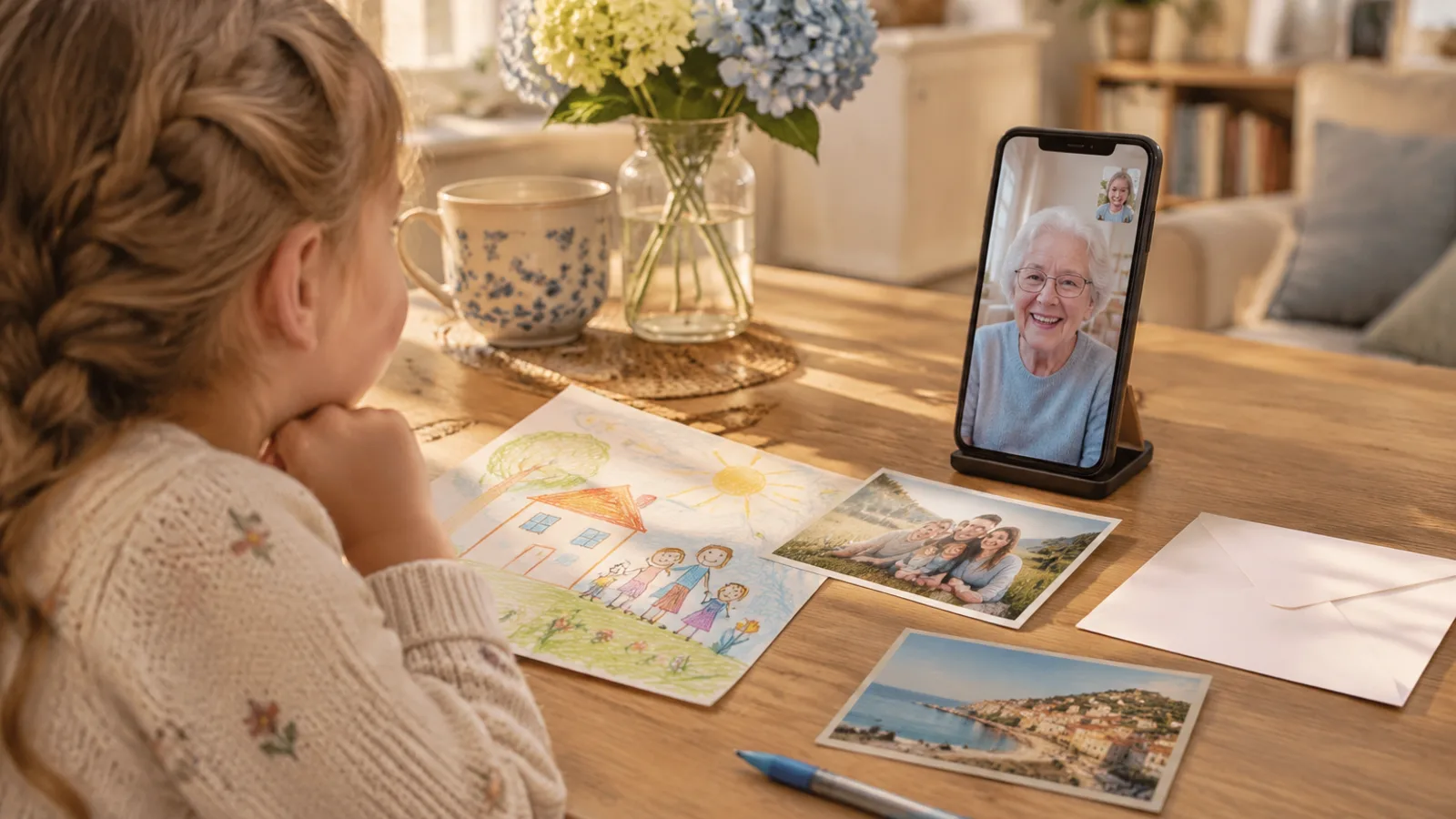
How to Keep Long-Distance Grandparents Connected Without Long Video Calls
When grandparents live several hours or several time zones away, staying close can quietly become another job for parents. A young child may lose interest after three minutes of a video call, a grandparent may ring during the school run, and everyone can finish feeling guilty rather than connected.
If you are wondering how to keep long distance grandparents connected, start with a small, repeatable mix of brief digital contact, offline rituals and ordinary glimpses of family life. A child does not need to sit still for a 40-minute conversation. Familiar voices, shared jokes, letters, photos and predictable moments can all make a distant grandparent part of everyday life.
What you'll need
- A phone or tablet with a camera and voice-message function.
- One private family messaging thread or photo-sharing space.
- A shared calendar showing the agreed call time in both time zones.
- A timer set for five to 10 minutes during early calls.
- Paper, envelopes, postcards, pens and stamps for monthly mail.
- One folder, notebook or box for letters, drawings and printed photos.
- Optional: a safe table space or stand for hands-free calls.
You do not need everything before you begin. A phone, one agreed contact method and a piece of paper are enough for the first week. Add printed photos, a keepsake folder or a more organised album only if they make contact easier rather than giving you another task.
How to keep long distance grandparents connected: a simple routine
Start with one brief live conversation each week, one message that can be opened later, and one physical exchange each month. If weekly calls are too difficult, make the live conversation fortnightly and keep the shorter message. The right schedule is the one both households can maintain without resentment.
Before setting anything up, ask what each person actually enjoys. A grandparent may prefer a phone call to video, a child may enjoy showing toys rather than answering questions, and a parent may have only one calm window on a Sunday. Consider hearing, vision, mobility, internet and time-zone needs as part of the plan.
Choose a default calling window instead of expecting everyone to be available whenever the phone rings. Check the exact date in a world clock, then put both local times in the invitation. Recheck recurring appointments when either country changes its clocks for daylight saving.
It can help to set a boundary in plain language: “We can usually do Sunday at 10 for eight minutes. Please message before calling at other times.” A predictable window protects the parent’s routine while giving the grandparent a clear way to participate.
A worked example for one month
Imagine a four-year-old whose grandparent lives in another country. On Tuesday, the parent sends one existing photo from the week with the caption, “Maya chose the yellow boots today and refused the red ones.” The grandparent replies with a 30-second voice note about a rainy walk and asks Maya whether she saw any puddles.
On Saturday, the grandparent initiates the agreed eight-minute call and has one picture book ready. Maya can show a drawing, listen to the story or wander away when she has had enough. The parent gives a one-minute warning before ending. The grandparent, rather than the parent, prepares the book and starts the call.
At the beginning of the month, the grandparent addresses a postcard. During an existing colouring session, the parent invites Maya to draw a reply. If Saturday falls apart, nobody needs to find a replacement appointment immediately: the grandparent sends the story as a recording and the weekly connection still happens.
This arrangement gives each person a role. The parent provides access and a small amount of context; the grandparent brings the activity and initiates some contact; the child chooses how to participate. It is a family rhythm, not a performance that the parent has to produce.
Make calls brief, purposeful and child-led
Video calls tend to go better when they resemble play rather than an interview. A child who cannot answer “What have you been doing?” may happily show a red fire engine, find three blue objects or help turn the pages of a familiar book.
Give the grandparent one prompt before the call. You might write, “Please ask her to show you the animal she chose at nursery,” or, “Can you tell him the short story about the time you got caught in the rain?” A specific invitation gives the child a starting point and prevents the adult from carrying the entire conversation.
Begin with five to 10 minutes for a young child. That is a starting arrangement, not a test or a limit that every child must meet. If the child remains interested, continue for a few more minutes. If they leave after two minutes, end warmly and try another format next time.
Let the child move. They may carry the device around, build blocks out of view or listen while colouring. If the device needs to remain still, place it safely on a table rather than asking a young child to hold it throughout the call.
Try a shared activity instead of forced conversation
- Read one short book: the grandparent reads slowly while the child turns pages or points to pictures.
- Show and tell: the child chooses one object before the call and explains one detail about it.
- Sing a familiar song: repetition gives the child a way to join without inventing conversation.
- Make the same snack: both households prepare something simple, with an adult handling hot or sharp equipment.
- Complete a small challenge: the grandparent asks the child to find something soft, round or green.
- Look at a family photograph: the grandparent tells one short story about a person, place or object in it.
Have an ending ready. Say, “One last wave, then we are putting the phone away,” and give the child a minute to finish. Use the same goodbye phrase or gesture each time, such as blowing a kiss, showing a hand-drawn star or saying a short family motto.
If a child refuses to join, do not force them to sit in front of the camera or say “I love you” on demand. They can wave from a distance, leave a toy beside the phone or send a voice note later. You could also say to the grandparent, “If she wanders away, we will let her go. You and I can finish talking, or you can send her a story for later.”
Use voice notes when live calls are inconvenient
Voice notes preserve a grandparent’s voice without requiring two households to be free at the same time. They are useful during school runs, shift work, travel or a week when the child is too tired for a call.
Ask grandparents to keep early messages between 20 and 45 seconds. A useful note contains a greeting, one detail from the grandparent’s day and one question the child can answer later: “Hello, Sam. I saw a robin in the garden this morning. Have you seen any birds this week?”
Children can respond in their own way. They might record one sentence, make a sound, sing a line or dictate a message while you hold the phone. Do not make them repeat it until it sounds polished. A genuine “I built a tower!” followed by background noise can be more inviting than a scripted update.
For grandparents with hearing difficulties, a written message or printed photograph may be more comfortable. If a grandparent finds smartphone recording confusing, show one method and write down the instructions in three steps. Avoid introducing several platforms when one dependable channel will do.
Share ordinary photos without creating more work
Grandparents often want to see the middle of family life, not only birthdays, first days of school and carefully composed portraits. A muddy pair of boots, a library book, a lopsided pancake or a cardboard creation can give them a clearer sense of the week.
Choose one private place for updates. It might be a family messaging thread, a private online album or another service everyone can use. Keeping photos in one location is easier than searching through several conversations later, and grandparents have a clear place to look when they miss the family.
Share one or two images rather than a large batch. Add a sentence that supplies context and invites an easy reply: “Leo built this garage from the delivery box and wants to know what you would park in it.” A caption turns a photo into a conversation.
For families who want private online albums for keeping full-quality photos and videos organised and sharing them with family and friends, Fayloo is one option alongside a private messaging thread or another photo-sharing service.
Before sharing, agree on basic privacy boundaries. Decide who may view, save or forward images, and avoid adding unnecessary details about a child’s location or routine. For older children, involve them in choosing photos and avoid sharing images they would find embarrassing. A private setting does not control what a recipient later saves or forwards, so family expectations still matter.
Make offline contact part of the month
Physical mail gives children something to hold, revisit and anticipate. It also lets a grandparent participate without a live conversation or another screen.
Start with one simple monthly mailer. A grandparent might send a postcard, a printed 4-by-6-inch photo (approximately 10 by 15 centimetres) and a short memory from childhood. The child can reply with a drawing, a sticker-covered card or a sentence dictated to an adult.
Use an envelope large enough for the photo and keep basic supplies together. A small folder, ordinary paper, a few postcards and stamps are enough. For very young children, avoid small loose items that could present a choking risk and check craft materials for age suitability.
A simple monthly mailer
When supplies are ready, assembling a mailer can take about 15 minutes. The grandparent chooses one postcard, adds one printed photo and writes a paragraph about something they remember. The child places the items in a labelled folder and is invited to reply during the next drawing session; the reply does not have to accompany every letter.
Use season-neutral prompts so the ritual works across countries and hemispheres:
- A childhood game the grandparent enjoyed.
- A favourite meal and the first time they learned to make it.
- A local walk, park or view from a window.
- A family celebration or tradition.
- A job, hobby or skill they learned as a child.
These prompts give a grandparent somewhere to begin while leaving room for their own stories. Over time, the folder becomes a record of both households, not simply a collection of updates sent in one direction.
Other screen-free ideas
- Send the same children’s book to both homes and read it during separate bedtime routines.
- Ask a grandparent to contribute one family recipe to a binder.
- Plant the same herb or flower and compare its progress with occasional photos.
- Keep a “grandparent box” for letters, cards and safe keepsakes.
- Start an annual handwritten birthday note that the child adds to each year.
- Ask for a short family story that can be retold at bedtime.
Choose rituals that fit something already happening. If Sunday breakfast is calm, read a postcard then. If weekday evenings are chaotic, do not add a scheduled craft session simply because it sounds meaningful.
Let grandparents participate without making parents manage everything
Parents may need to make the first connection easy, but grandparents can take responsibility for parts of the routine. They can keep the shared calendar, prepare call prompts, buy stamps, send the first message of the week or keep a list of the child’s current interests.
Give them useful information in small doses. A note such as “She is interested in insects this week” is enough to inspire a question or book. You do not need to write a full briefing before every call.
If the adults have different expectations, agree on the practical rules directly. A grandparent who wants long spontaneous calls may need to hear that the child’s bedtime is fixed. A parent who feels responsible for every reply can ask the grandparent to initiate the next postcard or voice note.
Choose a level of contact that fits your family’s relationships and boundaries. Distance does not remove the need for respectful timing, privacy or consent. A child should not be pressured to provide affection, and a parent should not be expected to keep a constant communication stream open.
Method: set up your routine today
- Choose the first contact method today. Ask the grandparent whether they prefer a phone call, video, voice note or photo. Choose one live option and one message option for the next seven days.
- Book the first call today. Use a world clock to check the exact date and both local times, then schedule a five- to 10-minute call outside meals, school preparation, naps and bedtime.
- Prepare one prompt today. Put a favourite book, toy, drawing or family photograph beside the device and tell the grandparent what the child might enjoy showing or hearing.
- Send the first update today. Choose one existing photo or record a 20- to 45-second voice note. Add one sentence of context and do not wait for a perfect image.
- Set the call ending today. Decide on a one-minute warning and a goodbye phrase. Tell the grandparent that the child may leave before the timer ends.
- Assemble the first mailer today. Put one postcard, one printed 4-by-6-inch photo or drawing and one short note into an addressed envelope. Keep paper ready for the child’s reply during the next natural drawing session.
- Choose the busy-week fallback today. Agree that one photo and one 30-second voice note will replace a missed call, with no immediate rescheduling required.
- Add a review reminder today. Put a 10-minute review in the calendar for four weeks from now. Keep the parts that feel warm and practical, and remove anything that creates more administration than connection.
Common mistakes
- Scheduling too much contact. Daily calls can turn a loving idea into an obligation. Begin with a rhythm that remains possible during a busy week.
- Expecting a child to perform. A child is not responsible for entertaining a grandparent or proving affection. Offer choices and accept brief participation.
- Calling at unsuitable times. Check time zones, school runs, meals and sleep before assuming a missed call means disinterest.
- Sharing only milestone photos. Ordinary moments give grandparents more openings to understand the child’s personality and ask natural questions.
- Giving grandparents too many apps. One clear channel is usually easier than several accounts, passwords and notification streams.
- Making one parent carry every interaction. Grandparents can prepare prompts, send postcards, label photos or maintain the calendar themselves where possible.
- Turning missed contact into guilt. A missed call is a scheduling problem, not evidence that the relationship matters less.
- Ignoring accessibility needs. Consider captions, larger print, slower speech, audio instead of video or a traditional phone call.
- Overlooking privacy. Agree on who may receive and forward children’s photos before creating a shared album or message thread.
Quick checklist
- We have one realistic weekly or fortnightly contact point.
- Our first calls are limited to about five to 10 minutes.
- We have a photo, voice-note or phone fallback for busy days.
- The grandparent has one simple prompt or activity.
- We share ordinary moments as well as milestones.
- A monthly postcard, letter or drawing is planned.
- The child can leave a call without pressure.
- We have discussed privacy and forwarding expectations.
Frequently asked questions
How often should children talk to long-distance grandparents?
There is no single schedule for every family. Try a weekly or fortnightly rhythm that fits the child’s age, temperament, school timetable, the grandparent’s availability and the organising required from the parent. One family may manage a 10-minute Sunday call; another may prefer a weekly voice note and a longer monthly call. Choose a frequency your household can maintain, then adjust it if contact repeatedly causes stress.
What if my child refuses to join a video call?
Do not force the child to sit in front of the camera or say affectionate words on demand. Offer a wave, a drawing, a toy left beside the phone or a voice note later. You can also change the format: try a phone call while the child plays, a grandparent reading aloud or a call built around one object. Pause and try again at a different time if the child continues to refuse.
Are voice notes better than video calls for young children?
Voice notes can be easier when a child will not sit still or when the two households are awake at different times. A child can listen while colouring and respond later. Video calls may suit children who enjoy showing objects or faces. Neither format is automatically better; use the one that produces relaxed, repeated contact for your family.
How can grandparents stay involved if they are not confident with technology?
Choose one simple channel and practise it once. Write the instructions in a few numbered steps, such as “Open the family thread, tap the microphone, hold while speaking, release to send.” Avoid adding platforms without a clear reason. Phone calls, postcards, printed photos, recipes and letters give grandparents other ways to participate when an app feels frustrating.
How can we share children’s photos safely?
Agree on who may view, save or forward images. Check the access settings on a private album or family thread, and avoid including location details or daily routines when they are not needed. Tell relatives whether photos should not be posted publicly, and involve older children in choosing images they are comfortable sharing. A private setting cannot control what a recipient later saves or forwards, so clear family expectations still matter.
Keep the relationship warm, not perfectly managed
When deciding how to keep long distance grandparents connected, choose a routine that both households can sustain. It may be a short greeting, a familiar story, a postcard on the fridge and a photo of something that would otherwise have been missed.
Start today with one brief call or voice note, then add a simple monthly mailer when the first habit feels manageable. Watch what your child enjoys, notice what the grandparent can sustain and adjust without guilt. When contact is easy enough to repeat, distance becomes a practical challenge rather than the centre of the relationship.
Disclosure: Fayloo is a sister brand of Maallure.


Join the conversation
Sign in — Sign in to join the conversation.