
You attend the event. You have good conversations, hand over your card, exchange a few LinkedIn requests on the way home, and then — nothing. No clients, no calls, no replies. The problem isn't your personality or even the room you chose. The problem is the absence of a system: a repeatable sequence that moves a casual conversation toward a paying engagement. Learning how to network for a new business isn't really about networking at all. It's about building a pipeline, one honest conversation at a time, and knowing exactly what to do at each stage so momentum doesn't die when you leave the room.
Lay the Groundwork Before You Walk in the Door
Sharpen your one-problem statement
Before attending any event, you need a single sentence that names the person you help and the specific result you produce. This is not an elevator pitch and it isn't a job title. A bookkeeper who says "I help service businesses stop overpaying their quarterly taxes" gets callbacks. One who says "I do bookkeeping and accounting" gets a polite nod and a forgotten card.
Test your statement on a friend who doesn't work in your industry. If they can explain what you do back to you in one sentence, it's working. If they look uncertain, keep simplifying.
Have somewhere to send people before you arrive
Nothing deflates a good conversation faster than someone asking "Where can I find out more?" and you having nothing to offer except a business card with a Gmail address. Even a single web page — your name, one paragraph on who you help, and a clear contact link — is enough at this stage. It doesn't need to look expensive. It needs to exist.
That page should do three things:
- Name your audience and outcome: State clearly who you work with and what result they can expect.
- Describe how you work: Two or three sentences on your process is enough.
- Offer one clear next step: A single call to action — book a call, send an email — is better than three competing options.
Write your follow-up email before you go
Draft a short follow-up template before the event so you're not composing it from scratch at midnight. You'll personalise it after each conversation, but the structure should already be ready: a reference to something specific you discussed, one genuinely useful thing you're offering, and a low-pressure ask.
Have Conversations That Actually Lead Somewhere
Lead with curiosity, not your pitch
Ask what someone is working on before you say anything about yourself. The goal of an early conversation isn't to deliver your statement — it's to find out whether their problem matches what you do. You can't discover that while you're talking.
Two questions that open almost any useful conversation: "What are you focused on right now?" and "What's the most frustrating part of that?" Listen for the answer before thinking about yours.
Hear the signal, don't pounce on it
When someone says "we're completely drowning in admin" or "I still don't have a proper website," that's a signal, not an opening. The difference between a pushy salesperson and a trusted peer is what happens next. Acknowledge what they've said, ask one follow-up question, and only then — if the fit is real — mention your work.
A line that works: "That's actually the kind of problem I help with — it might be worth comparing notes for ten minutes. Would that be useful?" It's honest, it's low-pressure, and it moves things forward without cornering anyone.
End every good conversation with a specific next step
"Let me send you my details" is not a next step. A next step is: "I'll send you that article I mentioned — is email or LinkedIn better?" or "Can we grab a fifteen-minute call on Thursday?" Naming a specific action before you part is what separates a conversation that becomes a client from one that becomes a forgotten connection.
Use the 48-Hour Follow-Up Window
What to send and when
Follow up within 48 hours while the conversation is still fresh for both of you. The message that works references something specific you discussed — not "great to meet you last night" but "I looked up that report you mentioned and thought you might find this useful too." Then it offers one genuinely valuable thing: a link, a short observation, a resource. Then it closes with a clear, easy ask.
Two examples of how this looks in practice:
- Potential client: "It was good to talk through the pricing problem you're dealing with — I've seen a few variations of that and there are a couple of approaches that tend to work. Happy to walk you through them on a quick call. Does Thursday morning work, or is next week better?"
- Potential referral partner: "I think there's a real overlap in the clients we serve — it might be worth a conversation to see whether there's a referral fit. I'll leave that with you, and I'm happy to chat whenever the timing makes sense."
Connect on one platform, not all of them
Send one follow-up email and one LinkedIn connection request. Don't do both at the same time and don't follow them on Instagram the same evening. Appearing on three platforms simultaneously reads as eager rather than professional, and it scatters the relationship before it's had a chance to form.
Build a Digital Bridge They Can Share
The one-page proof-of-concept site
Your interim web presence needs four elements: a headline that names the client and the outcome (not your name and your job title), two or three sentences on how you work, some form of social proof — even a single past project described honestly, or a testimonial from a former colleague — and one clear call to action. Everything else is optional at this stage.
QR codes as a physical handoff
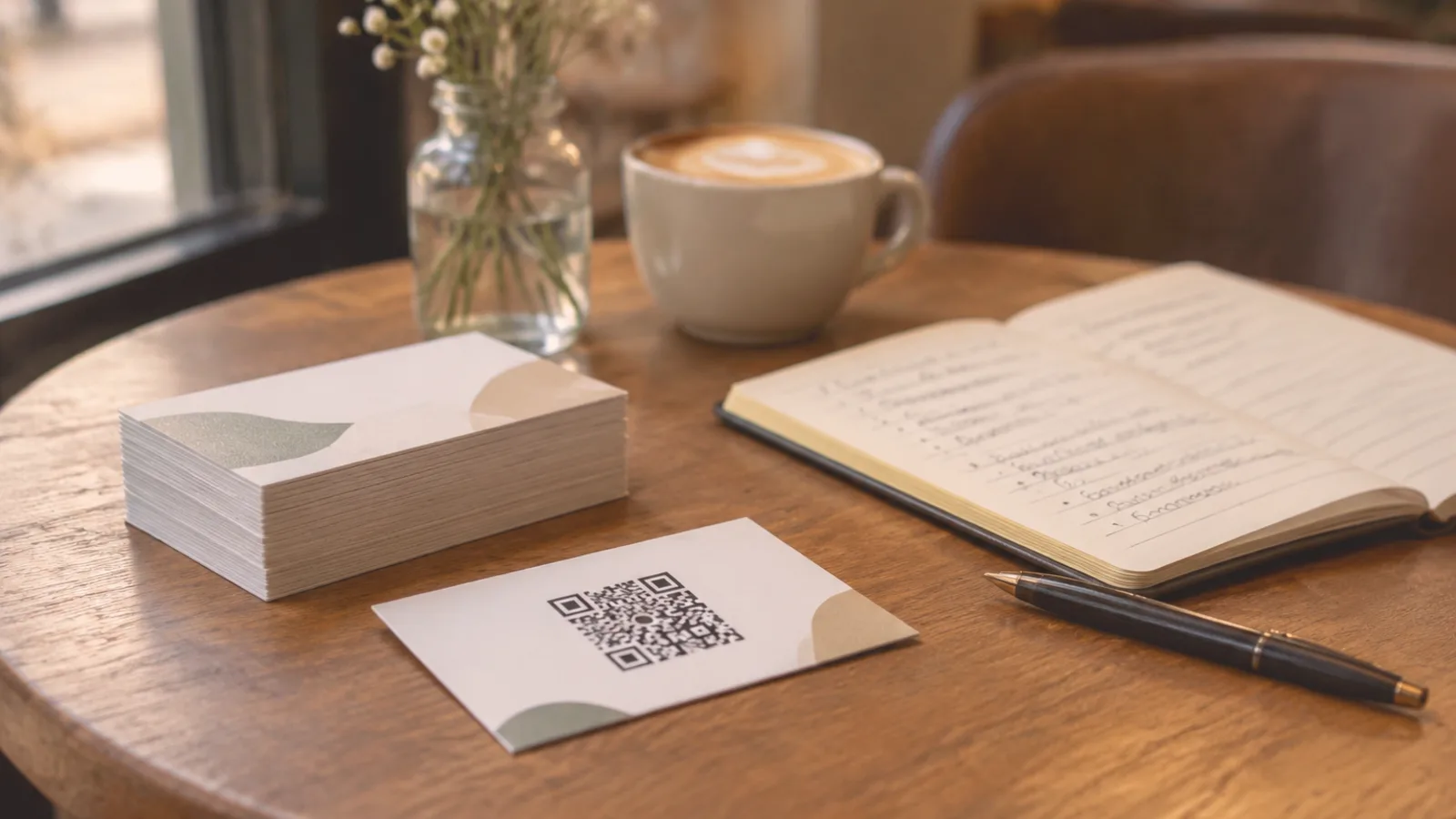
A QR code on your business card or event flyer lets someone land on your digital presence immediately, without typing a URL they'll misremember. Several tools let you build a simple linked page and attach a print-quality QR code to it. QRLivo, for instance, lets you design a mini page with photos, links, video and music, then download a high-resolution QR code — a practical option for founders who want something polished for business cards or event materials before a full website is ready. A simple Linktree-style page paired with an existing QR generator works equally well if you already have one set up.
Keep the page current
An outdated page — old pricing, a past offer, a service you no longer provide — is worse than no page. Set a monthly reminder to check it. If your offer has evolved since you built it, the page should reflect that before the next event.
Move From Warm Lead to Paid Client
Structure your discovery call
A discovery call that earns the work follows a loose structure: spend the first few minutes on their situation, then explore the actual cost of the problem — in time, money, or stress — before describing what working together would look like. Two questions that surface real stakes: "What happens if this stays unresolved for the next six months?" and "How much time is your team spending dealing with the fallout each week?" Close with a direct question: "Does this feel like the right fit, or is there something I haven't addressed?" That question surfaces objections while they're still manageable.
Send a one-page proposal within 24 to 48 hours
Not a contract — a short document that reflects what you heard on the call, names the deliverable and the timeline, and states your fee clearly. Keep it to one page. If the scope is complex enough that pricing accurately takes longer, send a brief confirmation note within 24 hours that acknowledges the conversation and commits to a proposal date. Either way, speed here signals that you were paying attention and that you operate with care.
When someone says "not yet"
A "not yet" is not a no, and it shouldn't be treated like one. A clean way to respond: "Completely understood — timing matters. Would it be alright if I checked back in a couple of months, or is there a better point to reconnect?" Then do it. Many first clients come from exactly this kind of patient follow-through.
Stay Visible With the People Who Aren't Ready Yet
A light-touch check-in cadence
Every six to eight weeks, one useful touchpoint: a relevant article, a brief congratulations on something they shared publicly, or a referral you're making on their behalf. Keep a simple list — a spreadsheet, a notes app, anything you'll actually use — with the name, where you met, and when you last reached out. The goal is to stay present without being persistent.
Give people reasons to reach back out
Direct outreach has a ceiling. Creating content — a short newsletter, a case study posted on LinkedIn, a small free Q&A session — means warm contacts can find their way back to you without you having to initiate every time. One useful thing a month is enough to keep you visible to people who weren't ready when you first met.
Frequently Asked Questions
What kinds of events are worth attending when you're just starting out?
Industry-specific meetups and local business groups tend to yield better results early on than large conferences, because the conversations are more personal and the follow-up feels less transactional. Prioritise events where your potential clients are likely to be, not where other founders are. A local chamber of commerce, board of trade, or regional business network breakfast will usually outperform a generic startup networking evening, and trade association dinners in your niche are worth the occasional entry fee.
How do I network when I'm naturally introverted?
Set a small, specific goal before you arrive — two or three real conversations rather than collecting as many cards as possible. It's easier to go deep with a few people than to work a room. Arriving slightly early, before the noise level rises, also makes the first conversations easier. Asking good questions is a networking skill that plays directly to careful listeners, so lean into it.
How many times should I follow up before I move on?
Three touchpoints over four to six weeks is a reasonable limit before you shift someone to the long-term visibility cadence rather than active follow-up. After the first follow-up email, a second check-in two weeks later is reasonable. A third, a few weeks after that, can be framed around something new and useful. After that, move them to occasional rather than active outreach, and let them come to you.
Do I need a full website before I start networking?
No. A single well-structured page — covering who you help, what result you produce, and how to reach you — is enough for the early stages. The purpose of a web presence at this point is to confirm credibility and make the next step obvious, not to demonstrate scale. You can build the full site as your offer solidifies.
How do I network in a city where I don't know anyone yet?
Start online. LinkedIn groups, industry Slack communities, and professional forums let you establish familiarity with people before you meet them in person. When you do attend a local event, reaching out beforehand — "I'll be at Thursday's event, would be good to meet in person" — means you're walking into at least one conversation you've already started, which removes most of the difficulty.
How to Network for a New Business: The System That Makes It Work
Most early-stage founders treat networking as a numbers game — the more rooms, the more cards, the more connections. The system above works differently. It makes each conversation count by giving it a direction: a prepared statement, a specific next step, a follow-up that arrives before the memory fades, and a digital presence that does the trust-building work in between. That's how to network for a new business in a way that produces clients rather than contacts — and it costs nothing except preparation and follow-through.
Disclosure: QRLivo is a sister brand of Maallure.






Join the conversation
Sign in — Sign in to join the conversation.