
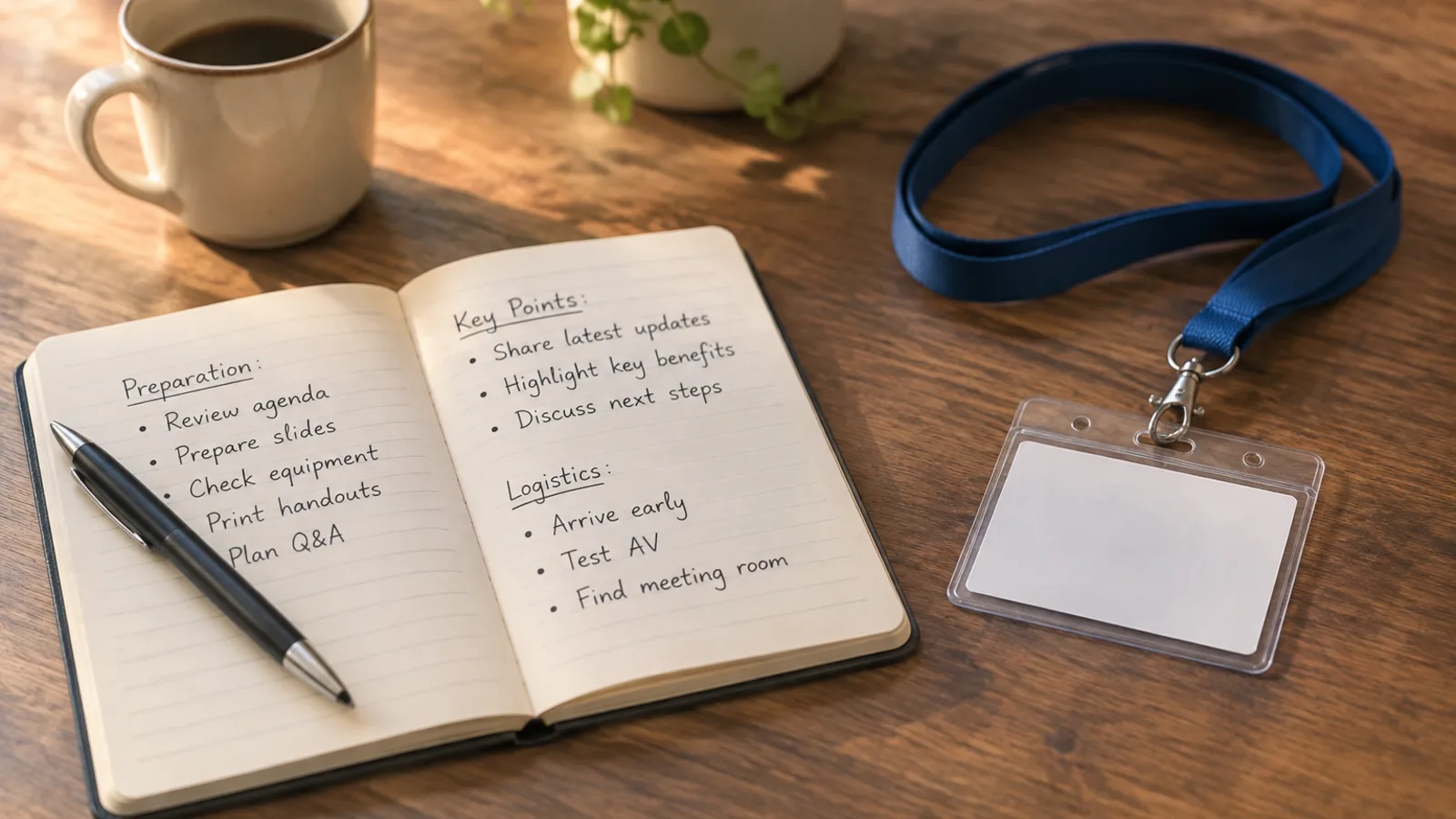
You are standing in the lift, heading up to the meeting room where your team and two clients are already settling in. You have rehearsed your opening four times this morning. Your mouth is dry. You are 38, good at your job, and right now you are running back over a remark you made in last week’s presentation, looking for evidence of embarrassment.
If that scene lands, this article is not going to explain what social anxiety is. You already know. What you need are strategies precise enough to use in a conference room, at a networking event, or at a dinner party where you know three people out of twelve — strategies that work without disclosing anything to colleagues or hosts. Learning how to deal with social anxiety as an adult means engaging with the specific situations your life actually presents, not a teenage social landscape you left behind years ago.
Why adult social anxiety has its own texture
The specific triggers your professional life creates
Workplace visibility is not the same as school visibility. When a junior team member stays quiet in a meeting, it barely registers. When a manager does the same, people notice. Seniority brings more exposure: client presentations, panel contributions, being introduced to rooms full of people who already know each other. The situations that trigger anxiety become harder to sidestep precisely as your career advances.
The triggers are worth naming clearly: speaking up when a room goes quiet and everyone turns to you; being introduced at a networking event and expected to say something interesting about yourself on the spot; asking a question at a conference when it means standing at a microphone. These are recurring, predictable, and high-stakes.
Quick win: Identify the one work situation that costs you the most energy. That is the one to build a specific strategy for first — not a general approach to all anxiety, but a plan for that exact moment.
Why anxiety can intensify in your 30s and 40s, not fade
Many women expect social anxiety to ease with experience. Sometimes it does. But life in your 30s and 40s also creates conditions that can sharpen it. Social circles narrow, so each relationship feels more weighted. Career success raises the perceived cost of a poor impression. And the persistent belief that you should be over this by now adds a layer of shame that teenagers — who are allowed to be awkward — do not carry in quite the same way.
Transitions are a particular trigger: a new job, a new city, a promotion that moves you into rooms where you have less established credibility. The familiar social scripts that helped you manage anxiety in a previous environment no longer apply, and you are starting from scratch in ways that feel disproportionate to your experience.
Preparing without over-rehearsing
Anchor yourself: prepare logistics, not lines
There is a meaningful difference between preparing logistics and rehearsing lines. Logistics preparation is reliably useful: know the room layout, arrive a few minutes early so you are not the person walking in after everyone is seated, know whose name to use when you greet the host. Small certainties reduce the number of unknowns you are managing in real time.
Script rehearsal tends to work against you. When you have memorised exact sentences, the moment the conversation shifts unexpectedly, the script becomes a source of panic rather than support. For networking events, prepare two or three genuine questions rather than a practised speech about yourself. For presentations, know your first line cold, then work from key ideas rather than a full text.
In networking, ask open-ended questions about recent projects — “What’s been keeping you busy lately?” rather than “What do you do?” Titles invite evaluation; projects invite story. The second question is both more interesting and far less loaded for everyone in the conversation.
Quick win: Write down your first sentence for the next event you are dreading. Just the first sentence — not a speech. That single anchor is enough to get you started.
Lower the stakes before you walk in
Extending your exhale can help activate the body’s natural relaxation response, offering a subtle physiological shift that many people find easier to manage discreetly in public than more overt breathing exercises. Try breathing in for four counts and out for six, done privately before entering a room. It takes under two minutes and leaves no visible trace.
The more durable reframe is about expectations. You are not at a networking event to impress everyone in the room. You are there to have two conversations worth having. Setting a specific, small goal before you arrive means you have something concrete and achievable to measure success against, rather than a performance ideal that no one could meet.
Decide what to attend — and what to skip
Attending every obligation and arriving depleted is not a strategy. Before a demanding event, ask yourself two things: If I knew no one would judge me for missing this, would I still want to go? And: Am I only skipping this because dread is making the cost feel larger than it actually is?
Declining an event because it costs more than it gives is resource allocation. Declining because anxiety has told you something bad will happen if you go is avoidance. The two can look identical from outside and feel different from inside — that distinction is worth knowing before you decide.
How to deal with social anxiety as an adult at work
The first 30 seconds rule for meetings and presentations
Anxiety peaks at initiation and drops significantly once you are underway. The first thirty seconds are the hardest part, and they are finite. Speak once early in a meeting, even briefly, so the first time you use your voice in that room is already behind you. It does not need to be a significant contribution — a short follow-up to something just said is enough.
For presentations, consider opening with a question to the room rather than a declaration. “Before I get into the findings, I’m curious what your team has been seeing on this” moves the spotlight briefly, gives you a moment to settle, and signals confidence. Start with what you know best; the rest follows more easily than your pre-event nerves suggest.
Quick win: At your next meeting, say something within the first ten minutes — anything brief and genuine. The goal is simply to make the first time behind you as early as possible.
How to network without burning out
Unstructured time in a room full of strangers is reliably harder than a formal presentation, because there is no defined structure and no clear end point. Set a specific, small goal: two substantive conversations, rather than “working the room.” Positioning near the food or drinks table gives you a natural reason to be standing still, an easy conversation opener, and an exit line that requires no explanation.
If you are attending with a colleague, the buddy system is legitimate — but use it to enter conversations together, not to stand together for the whole event. Having one person beside you when you approach a group lowers the initiation anxiety considerably without preventing you from meeting anyone new.
Quick win: Station yourself near the food table. It gives you a natural prop, a reason to be stationary, and a clean exit line: “I’m going to grab a drink — good to meet you.”
One-on-ones and performance conversations
For many people, one-on-one meetings are harder than group settings precisely because there is no crowd to blend into. The attention is undivided and sustained. Brief written notes before the meeting act as a cognitive off-load — not a script, but the two or three points you need to make, written down so you are not holding everything in your head. More of your attention is then available for the conversation itself, which is where you actually need it.
Navigating social life outside work
Dinner parties and group gatherings
Seat choice matters more than most people realise. The side of a table is lower-pressure than the head; a seat near a quieter person is less demanding than one next to the loudest voice in the room. Neither is avoidance — both are resource management.
Genuine curiosity is both a social skill and an anxiety strategy. Asking a real question and listening to the answer shifts attention outward, which reduces the self-monitoring that feeds anxiety most. Prepare one topic you know well and are happy to discuss, so when the conversation reaches you, you have something to bring without having to perform spontaneity under pressure.
After-work drinks and casual socialising
Unstructured events — no agenda, shifting sub-groups, no defined end — are often harder than formal ones. Arriving relatively early, when groups are still forming rather than settled, is a practical way to reduce the specific difficulty of entering a conversation already in progress. Those circles close quickly; getting there before they do changes the dynamic entirely.
Setting a time limit for yourself is not avoidance if it is chosen deliberately. Attending for the first hour and leaving cleanly is different from skipping the event entirely. It lets you participate and protect your energy in the same move, without the spiral of guilt that comes from not showing up at all.
Breaking the post-event replay cycle
The mental review that runs for hours after a social event — finding the moment you stumbled, the joke that didn’t land, the sentence you wish you had left unsaid — is one of the most draining features of adult social anxiety. It is also not a reliable record: anxiety distorts recall toward negative evidence while filtering out what went well.
A simple pattern-interrupt: when the replay starts, write down three things that went fine, however small. Not to cancel out the difficult moments, but to give your brain something accurate to work with. The standard for a social performance worth feeling good about is not perfection — it is good enough — and that standard is worth setting explicitly rather than letting anxiety set it for you.
Energy management is a strategy, not a consolation prize
Recovery is not laziness
Social events carry a real cost for people with anxiety, independent of how much they enjoy them. Scheduling a low-demand evening after a high-intensity work event follows the same logic as preparing beforehand: both are part of performing well. Treating recovery time as optional means arriving at the next obligation already depleted, which makes every strategy harder to execute.
Choose your commitments deliberately
Over the course of a month, it is worth auditing which obligations you attend because they add genuine value and which you attend out of fear of how your absence will be judged. Ask: If I knew no one would judge me for skipping this, would I still go? And: Am I avoiding this because it genuinely costs more than it gives, or because anxiety is making the cost feel larger than it is?
The first is a sound reason to decline. The second deserves closer examination before you act on it. That distinction is the difference between managing your energy and letting anxiety manage your calendar.
When professional support makes sense
If social anxiety is significantly impairing your daily function — limiting career decisions, preventing you from attending things that genuinely matter, narrowing your life in ways you feel unable to change — professional support should be your first step, not your last. Self-help strategies work well for mild to moderate experiences; they are not a substitute for clinical care when anxiety is severe or entrenched.
The NHS and the American Psychological Association both provide clear, reliable information on effective approaches. Cognitive behavioural therapy has a well-established evidence base for social anxiety specifically — it is structured, skill-based, and typically time-limited, which makes it different from open-ended counselling.
It is worth acknowledging that seeking help is itself a social act, and the barrier to making that first appointment is real. That does not make it less worth doing.
Frequently asked questions
Is social anxiety the same as introversion?
No. Introversion is a preference for less stimulation and a tendency to find solitude restorative. Social anxiety is a fear of negative evaluation in social situations. The two often coexist, but many extroverts experience social anxiety, and many introverts do not. Conflating them produces unhelpful advice in both directions.
While the traits can overlap, only a qualified mental health professional can determine whether your experiences meet the criteria for Social Anxiety Disorder as distinct from personality traits like introversion or ordinary shyness.
Can social anxiety get worse in adulthood even if it was manageable before?
Yes. Life transitions — a new job, a new city, a promotion, the end of a long relationship — can disrupt the environments where you had learned to cope. The strategies that worked in one context do not transfer automatically to a new one.
This is a common experience and not a sign that anxiety is worsening permanently. It usually means the coping repertoire needs updating rather than rebuilding from scratch.
Should I tell my employer or colleagues about my social anxiety?
There is no universal right answer. Disclosure can lead to reasonable adjustments, and in some workplaces the culture makes it relatively straightforward. In others it carries professional risk that is real and worth weighing carefully.
The strategies in this article are designed to work without disclosure — that is a deliberate choice, not an assumption that staying private is always correct.
How do I stop my mind going blank before a presentation?
The blank-mind experience almost always comes from trying to retrieve a memorised script under pressure. When anxiety spikes, verbal memory becomes unreliable. Prepare anchors — key ideas rather than full sentences — and know your first line cold. The aim is to reduce what you have to retrieve in that moment, not to store more material that anxiety can then block.
When does self-help stop being enough?
When anxiety is driving avoidance of things that genuinely matter to you — career opportunities, relationships, a social life that feels worthwhile — and self-help strategies have not shifted that pattern after sustained effort, that is the right time to seek professional support. That is not a failure; it is a signal that the strategies need to be more targeted and more personal than any general article can provide.
Learning how to deal with social anxiety as an adult is not about arriving at a point where you feel nothing. It is about reducing friction enough that anxiety stops making decisions for you. The goal is not a room you walk into without nerves — it is a room you walk into anyway, with a plan specific enough to actually use, and enough left in reserve to get through it without it costing you the rest of the week.




Join the conversation
Sign in — Sign in to join the conversation.