Strength is what makes ordinary life feel easier. It helps when you carry all the shopping in one trip, lift a suitcase into an overhead locker or get up off the floor after playing with a child. Yet if you are new to weights, the hardest part is rarely motivation. It is knowing exactly what to do.
This guide to strength training for women beginners gives you a simple three-day plan you can follow at home or in the gym. You will train the main movement patterns your body uses every day and choose exercises that suit your equipment. You will also learn how to progress without guessing.
Most sessions take 30–45 minutes. You do not need to be fit already, and you do not need to chase soreness. You need a plan, a little patience and weights that feel challenging but manageable.
Why strength training matters at every age
Strength training is not only about how your body looks. It is about keeping your body capable.
Muscle and strength tend to decline with age if they are not used. Resistance training gives your body a reason to maintain and build them. That can make everyday tasks easier, from carrying bags and walking uphill to getting out of a low chair.
It matters for your bones, too. Bone responds to load, and strength training is widely recommended as one way to help maintain bone strength. This becomes especially relevant around perimenopause and menopause, when bone loss can speed up for many women. If you have been diagnosed with osteoporosis or have a history of fractures, get personalised advice from a doctor or physiotherapist before you start.
Regular strength work is also associated with benefits for metabolic health, mood, sleep and confidence. Results vary from person to person, but many women find the confidence boost arrives surprisingly early.
Public health bodies, including the CDC and the NHS, recommend muscle-strengthening activities on at least two days a week. This plan uses three days. That gives you regular practice and enough recovery, in a routine that is easy to repeat.
The honest answers to common fears
“Will lifting weights make me bulky?”
Noticeable muscle growth takes time. It depends on progressive training, enough food, your hormones and sustained consistency, so it does not happen by accident after a few weeks with dumbbells. Most beginners first notice that they feel firmer, stronger and more confident.
Women can build visible muscle if they train for it. That is a choice, not an accident, and you stay in control of how far you take it.
“What if my knees, hips or back feel sensitive?”
Well-chosen, gradually progressed exercise often supports the joints. The key is to know the difference between muscle effort and pain.
A working muscle may burn or tire. Take any of the following as a sign to stop and modify the movement:
- sharp pain
- pain felt in the joint
- pain that changes how you move
- pain that worsens over time
If it continues, seek professional advice.
For example, if lunges make your knee ache, shorten your step or reduce the depth. You could also hold onto a support, switch to step-ups or use a leg press at the gym. If the pain is sharp or persistent, see a physiotherapist or doctor.
“The gym intimidates me.”
This is common, and it gets easier quickly. Go at a quieter time if you can and save the plan on your phone. Start with machines or a small corner of the weights area. Most people are focused on their own workout. If the gym still feels like too much, train at home for a few weeks first. Your strength will carry over wherever you train.
“I don’t have time.”
Three sessions of around 35 minutes is enough to make real progress. The sample week below shows how the plan can fit around work and family.
Strength training for women beginners: the six movements to learn
A good beginner plan is not a random collection of exercises. It is built around movement patterns your body uses in real life.
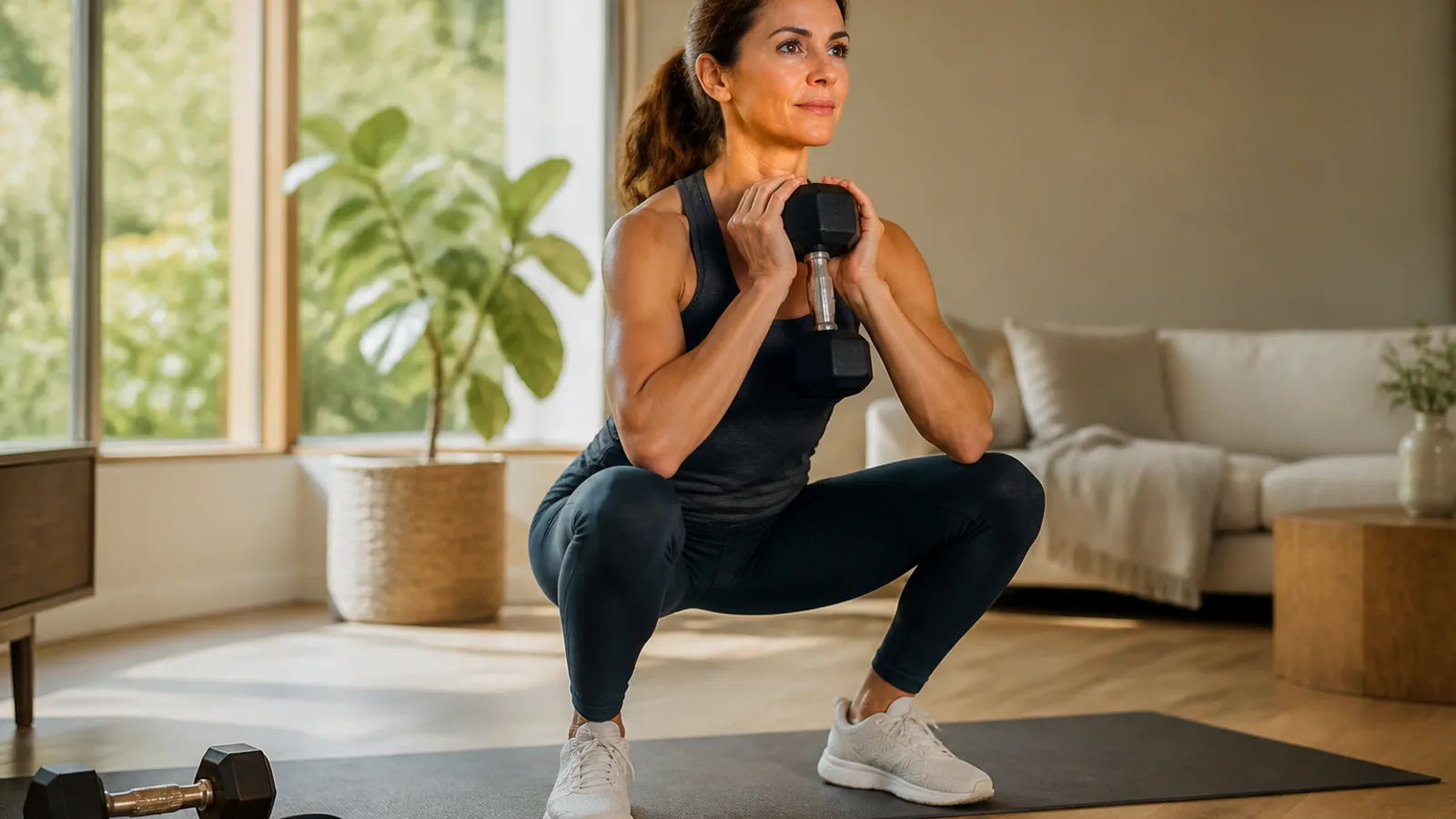
- Squat: sitting down and standing up. Examples: goblet squat, chair squat, leg press.
- Hinge: bending at the hips to pick something up safely. Examples: Romanian deadlift, hip thrust, glute bridge.
- Push: pressing away from your body, as when you push a heavy door or get up from the floor. Examples: push-up, chest press, shoulder press.
- Pull: drawing something towards you, which supports posture and lifting bags. Examples: dumbbell row, cable row, lat pulldown.
- Single-leg: building balance and side-to-side strength for stairs and walking. Examples: split squat, step-up.
- Carry and core: staying stable while you walk, lift or hold. Examples: farmer’s carry, suitcase carry, dead bug, side plank.
A note on core training: this plan treats your core as a stabiliser, not something to crunch. In daily life, your trunk’s main job is to resist unwanted movement. It stops your lower back arching, keeps you upright when you carry a bag on one side and holds steady as you twist. That is why the plan uses three kinds of exercise instead of endless sit-ups:
- Anti-extension: the dead bug.
- Anti-lateral flexion: side planks and suitcase carries.
- All-round bracing: farmer’s carries.
Before you start: equipment, warm-up and choosing weights
What you need at home
You can begin with bodyweight alone, but a little kit makes progress easier:
- a pair of dumbbells or adjustable dumbbells
- a long resistance band and a mini band
- a sturdy chair, bench or step
Think of it as a modest one-off investment. Prices vary widely by brand and type, so choose practical, safe equipment over anything flashy. You do not need everything at once.
A five-minute warm-up
- March on the spot or walk briskly for one minute.
- Do 10 hip circles each way.
- Do 10 bodyweight squats to a comfortable depth.
- Do 10 glute bridges.
- Do 10 arm circles each way.
- Do 10 band pull-aparts.
Before your first main exercise, do one lighter practice set to settle into the movement.
Master the movement before you add weight
Load comes second; control comes first. Before you pick up a dumbbell for any exercise, make sure you can do the bodyweight version smoothly. A useful benchmark: if you cannot yet do 10 steady chair squats with your chest up, start there.
Use push-ups to build up in steps. Move to the next level when you can do 3 sets of 10 with good form:
- Wall push-up
- Kitchen counter
- Sturdy table or bench
- From the knees on the floor
- Full push-up
How heavy should the weight be?
Use the “reps in reserve” rule. At the end of each set, you should feel you could do about two or three more good reps.
Here is a simple check. Your final rep should look just as controlled as your first, even though the lift naturally slows down. If you could do many more reps, the weight is too light. It is too heavy for now if:
- your form breaks down
- you have to hold your breath
- you grind through every rep
Sets, reps and rest: For most exercises, do 2–3 sets of 8–12 reps. Rest 60–90 seconds between sets, or up to two minutes after harder lower-body exercises. Carries and planks are timed.
Your 3-day beginner strength plan
Train on any three non-consecutive days, such as Monday, Wednesday and Friday. Rest days can include walking or gentle mobility work. Alternate two workouts:
- Week 1: A, B, A
- Week 2: B, A, B
Then keep alternating.
Workout A
- Squat (2–3 x 8–12): Home: goblet squat or chair squat. Gym: goblet squat or leg press.
- Push (2–3 x 8–12): Home: incline push-up, using the ladder above. Gym: dumbbell bench press or chest press machine.
- Hinge (2–3 x 8–12): Home: dumbbell Romanian deadlift or glute bridge. Gym: dumbbell or barbell Romanian deadlift.
- Pull (2–3 x 8–12): Home: one-arm dumbbell row supported on a chair, or a band row. Gym: seated cable row.
- Core (2 x 6–10 slow reps per side): Dead bug.
- Carry (2–3 rounds of 20–40 seconds): Farmer’s carry with a dumbbell in each hand.
Workout B
- Single-leg (2–3 x 8–10 per side): Home: split squat or step-up. Gym: split squat, step-up or narrow-stance leg press.
- Vertical push (2–3 x 8–12): Home: seated or half-kneeling dumbbell shoulder press. Gym: dumbbell or machine shoulder press.
- Glutes (2–3 x 8–12): Home: hip thrust or single-leg glute bridge. Gym: hip thrust or cable pull-through.
- Vertical pull (2–3 x 8–12): Home: band lat pulldown anchored securely overhead. Gym: lat pulldown or assisted pull-up.
- Core (2 rounds of 15–30 seconds per side): Side plank from the knees or feet.
- Carry (2–3 rounds of 20–30 seconds per side): Suitcase carry with one dumbbell.
A realistic sample week
- Monday, 7am: Workout A at home before work.
- Wednesday, lunchtime: Workout B at the gym.
- Saturday morning: Workout A at home, followed by a walk.
Short on time? Pair exercises as supersets. For example, do a set of squats, rest briefly, then do a set of rows. Pairing a lower-body move with an upper-body move can bring a session closer to 30 minutes.
Form cues that actually help
- Squat: Sit between your heels. Keep your whole foot on the floor. Let your knees track over your toes.
- Hinge: Push your hips back as if closing a car door with your bum. Keep a long spine and soft knees. You should feel your hamstrings and glutes working.
- Push: Keep your body like a plank and lower with control.
- Row: Think “elbow to back pocket.” Keep your shoulders away from your ears.
- Carry: Stand tall with your ribs down. Walk slowly and resist leaning.
Breathe out on the effort, as you stand, press or pull. If you are unsure about your form, film one set from the side on your phone. A session or two with a qualified personal trainer or physiotherapist can be a worthwhile investment, especially if you have old injuries.
How to progress over your first 8 weeks
Use the double progression rule
Stay at the same weight until you can complete every set at the top of your rep range with good form. Then increase the weight slightly and drop back to the lower end of the range.
For example, you might start goblet squats with 8 kg (about 17.5 lb) for 3 sets of 8. Over several sessions, you build to 3 sets of 12. Then you move to 10 kg (about 22.5 lb), go back to 3 sets of 8 and build again.
If you cannot add weight at home
Change one thing at a time:
- Lower more slowly, for example over three seconds.
- Pause at the hardest point of the movement.
- Add a rep or two per set, or add a third set.
- Move to a harder variation.
- Shorten your rest periods slightly.
For example, if split squats feel easy, try a three-second lowering phase with a brief pause at the bottom.
Your 8-week roadmap
- Weeks 1–2: Learn the movements. Keep the weights on the lighter side.
- Weeks 3–6: Progress steadily with reps, weight or control.
- Weeks 7–8: Consolidate. Resist the urge to change everything.
If you feel unusually tired or run down, ease off for a few sessions. Do fewer sets or use lighter weights, then reassess.
Track your workouts
Log each session in a notes app or notebook. Record the date, exercise, weight, sets and reps, plus a short comment.
Monday: Goblet squat, 8 kg / 17.5 lb, 3 x 10. Felt steady. Try 3 x 11 next time.
Rest, recovery and fuelling
Soreness is not the goal
Some soreness is common when you start, but it is not a measure of a good workout. Walking and gentle movement often help. If soreness is severe or feels like joint pain, rest and reassess.
Sleep
Your body adapts to training while you recover, and sleep is a big part of that. If your nights are short or broken, keep training, but progress more gradually.
Eat enough to support strength
Aim for regular meals, with protein spread through the day. Good options include eggs, Greek yoghurt, cottage cheese, tofu, tempeh, beans, lentils, fish and chicken. Carbohydrates such as oats, potatoes, rice, fruit and wholegrain bread help fuel your sessions. Supplements are optional, not essential. If you have specific dietary needs, a registered dietitian can help.
Your cycle, perimenopause and energy
Evidence on precise “cycle syncing” for training is limited and mixed. The practical approach is to adjust by how you feel on the day. On lower-energy days, use lighter weights, fewer sets or longer rests.
During perimenopause, sleep disruption, hot flushes or stress may affect recovery. That usually means adjusting how much you do, not stopping.
Common beginner mistakes and quick fixes
- Going too heavy too soon: Build from clean reps. Your joints and connective tissue need time to adapt.
- Staying too light for too long: If the last reps feel easy, progress.
- Programme-hopping: Repeat the same workouts long enough to improve at them.
- Skipping pulls and hinges: These moves balance your strength and support your posture.
- Rushing reps: Slow, controlled reps build more strength.
- Exhausting cardio first: Lift first, or train cardio and strength on separate days.
- Expecting change in weeks: Strength improves quickly. Visible change takes months.
When to check with a professional first
Get personalised advice from a GP, doctor or physiotherapist before you start if any of these apply:
- you are pregnant or recently postpartum
- you are recovering from surgery or injury
- you have a heart or blood pressure condition
- you have diagnosed osteoporosis
- you have persistent joint pain
For pelvic floor symptoms or abdominal separation after birth, a women’s health physiotherapist can be especially helpful.
Save this: your plan at a glance
- Schedule: 3 non-consecutive days a week, alternating Workouts A and B.
- Volume: 2–3 sets of 8–12 reps, with 60–90 seconds of rest between sets.
- Effort: Finish each set with 2–3 good reps left.
- Progression: Reach the top of the rep range on every set, then add a little weight.
Three golden rules for week 1:
- Master each movement with your bodyweight before adding load.
- Stop every set two or three reps short of failure.
- Log your numbers after every session.
FAQ
How long does it take to see results from strength training?
Many beginners feel stronger and more confident within a few weeks. Visible changes usually take longer. They depend on consistency, nutrition, sleep, genetics and your starting point.
Do I need to lift heavy weights to benefit?
“Heavy” is relative. A weight is heavy enough if your final reps feel challenging while your form stays solid. What matters is gradual progress over time.
Can I start strength training in my 40s, 50s or during menopause?
Yes. It can be especially valuable then for maintaining muscle and bone health. Start gradually, and get individual advice if you have medical conditions, pain or osteoporosis.
Should I do cardio and strength training on the same day?
You can. If strength is your priority, lift first or do cardio on separate days. Daily walking fits well alongside this plan.
Is it okay to train when I am sore?
Light soreness is usually fine if you warm up and can move normally. If soreness is severe, painful or changes your form, rest or choose gentler movement.
Your next step
The best plan is the one you repeat. This week, book three sessions into your calendar and choose the home or gym version. Then start Workout A at a weight that feels manageable.
Strength training for women beginners does not need to be intimidating or complicated. Learn the movements, track what you do and progress when you are ready. Then give yourself time to feel the difference.





Join the conversation
Sign in — Sign in to join the conversation.