
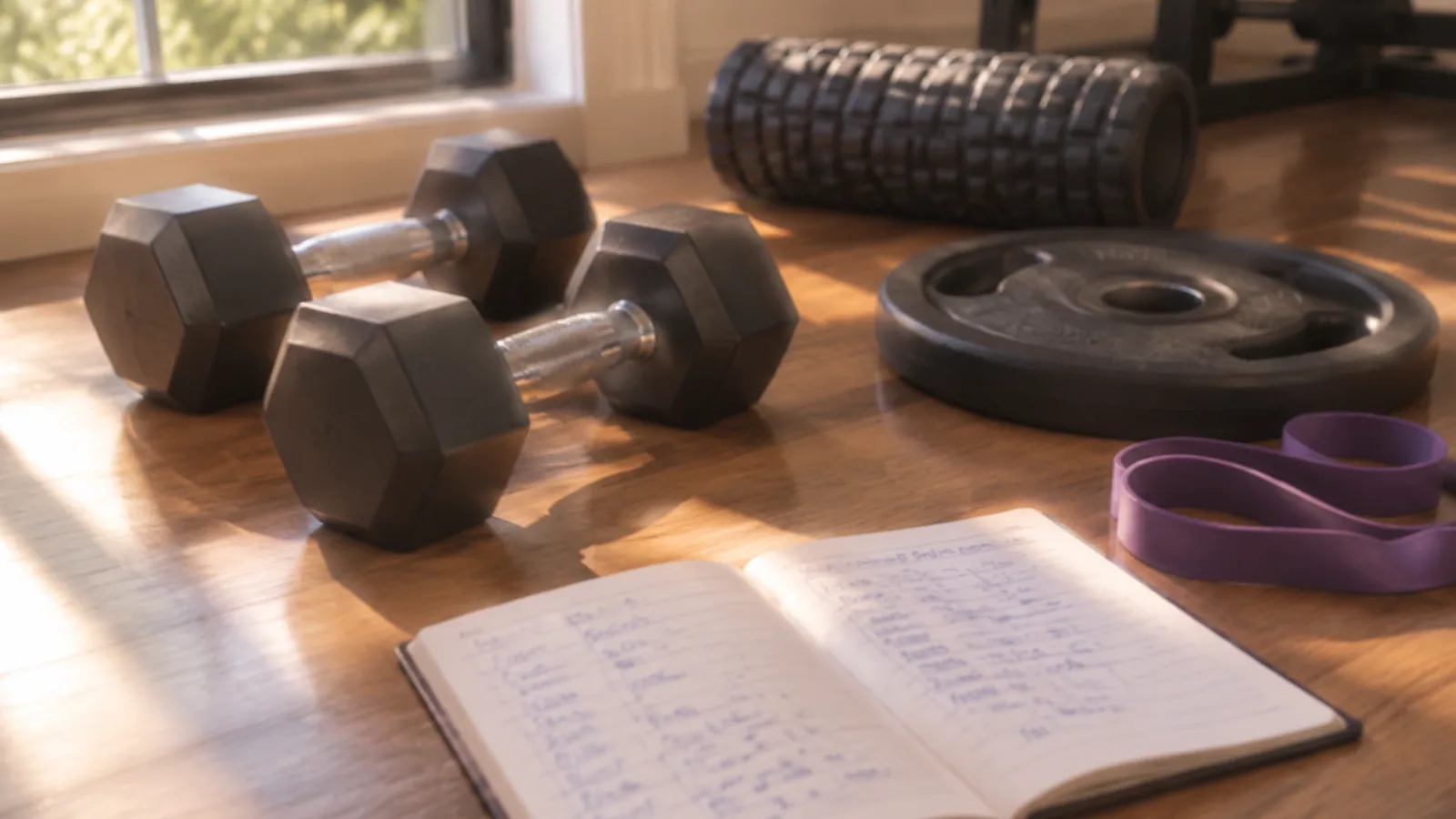
If you have been strength training for years and suddenly your usual routine feels harder, recovery drags longer, and the results you used to count on have stalled, you are not imagining it. Perimenopause strength training demands a different approach because the physiology underneath it has genuinely shifted. The same workouts that built lean muscle and steady energy in your thirties can stop working — or even work against you — once hormones begin to fluctuate. This is not a discipline problem. It is a signal that your training needs to catch up with what your body is actually doing now.
The good news: once you understand what changed, the adjustments are specific and manageable. You do not need a new programme every month or a trainer redesigning your weeks. You need to understand the mechanism, then shift a handful of variables that matter more than the rest.
What perimenopause actually does to muscle
Most women are told perimenopause is about hot flashes and irregular periods. Few are told that the hormonal shifts underneath it also change how muscle is built, repaired, and retained. Understanding this part makes every other decision easier, because you stop guessing and start working with what is happening.
Estrogen's quiet role in muscle repair
Estrogen is usually framed as a reproductive hormone, but it does substantial work in muscle tissue. It supports satellite cell activation — the repair process that heals muscle fibers after training — and it influences protein synthesis, the mechanism that turns the food you eat into new muscle. As estrogen levels fluctuate and eventually decline during perimenopause, that repair machinery slows down. The workout still sends the signal to build muscle. The body just responds to it less efficiently.
This is why a session that felt productive at 38 can leave you flattened at 47. The stimulus is the same. The return on it is not.
The cortisol problem
Sleep architecture changes during perimenopause. Falling asleep gets harder, staying asleep gets patchier, and the deeper stages of sleep that drive recovery become less reliable. Fragmented sleep raises baseline cortisol — the body's primary stress hormone.
Chronically elevated cortisol is catabolic, meaning it encourages the breakdown of muscle tissue rather than its growth. It also promotes fat storage, particularly around the middle. Training hard on top of poor sleep piles more stress onto a system already struggling to recover. The instinct to push harder — to earn back the progress — is exactly the instinct that tends to make things worse.
Anabolic resistance and why nutrition matters more now
Exercise scientists use the term anabolic resistance to describe what happens when muscles need a larger protein stimulus to trigger the same muscle-building response they once got from less. The threshold — the minimum amount of protein per meal needed to switch on muscle protein synthesis — moves upward as hormones shift.
Practically, this means the eating pattern that held your muscle at 35 may no longer be enough at 48. Not because you are doing anything wrong, but because the dose required to get the same response has gone up. This is why training and nutrition become more tightly linked in perimenopause. You cannot out-train a protein intake that is no longer clearing the threshold.
The body composition shift that is not about willpower
Many women notice fat accumulating around the middle during perimenopause and assume they have let themselves go. Usually they have not. Reduced estrogen changes where the body stores fat, shifting it from hips and thighs toward the abdomen. The hormonal shift also lowers basal metabolic rate by reducing lean muscle retention, so the same calorie intake produces a different outcome than it did a decade ago — even when nothing else appears to have changed.
The common response — eating less, training more — often backfires. Under-eating while training hard pushes cortisol higher and protein intake lower, accelerating muscle loss while doing little for the fat. The more useful frame is fueling for recovery: eat enough protein to clear the anabolic threshold, and resist the instinct to slash calories as a first response to body composition changes.
The training habits that make things worse
When progress stalls, most active women reach for one of three responses. All are understandable. All tend to backfire.
Adding more cardio
Cardio feels productive because it burns calories and produces sweat. But cardio without sufficient resistance work, especially under elevated cortisol, shifts body composition toward less lean mass — the opposite of what you want in perimenopause. Cardio is not the enemy. Cardio as the primary tool, replacing the heavy work that holds muscle, is.
Pushing through fatigue
Training through the kind of deep fatigue that lingers for days does not make you tougher. It raises cortisol further and delays recovery. A session that used to leave you pleasantly sore and now leaves you wrung out for two days is data. It is telling you the load exceeds your current recovery capacity. Ignoring the signal does not make it go away.
Dropping the heaviest work
Heavy lifting feels harder in perimenopause, so many women drop it. But heavier loading is one of the most important stimuli for both muscle retention and bone density — which matters more now, not less. The answer is not to abandon heavy work. It is to change the structure around it — more recovery, better timing, smarter progression — so you can keep it in.
Adapting perimenopause strength training: the variables that matter
The adjustments below are specific enough to act on and flexible enough to fit a real life.
Warm up for your joints, not just your heart rate
Estrogen decline affects connective tissue elasticity and synovial fluid production, which is why joints can feel stiff or tender in a way that is distinct from ordinary muscle soreness. Many women mistake this for poor form, early arthritis, or overtraining. Often it is a hormonal effect on connective tissue that responds to preparation rather than rest.
Spending five to seven minutes on targeted dynamic mobility before every session — hip circles, thoracic rotations, leg swings, shoulder rolls — allows synovial fluid to circulate and connective tissue to warm before it bears load. In perimenopause, this is the difference between a productive session and a painful one.
Protein per meal, not just per day
Spreading protein evenly across the day matters more than hitting a daily total, because it is the per-meal dose that clears the anabolic threshold. A practical starting range for active women in perimenopause is roughly 1.6 to 2.0 grams per kilogram of body weight per day — about 0.7 to 0.9 grams per pound — spread across three meals. Individual needs vary based on body composition, activity level, and overall health, so treat this as a working benchmark rather than a fixed rule.
Aim for roughly 25 to 35 grams of protein per meal. What this looks like with everyday food: Greek yogurt with nuts at breakfast, a chicken or tofu bowl at lunch, salmon or lentils at dinner. Protein powder is a useful supplement when meals fall short, but whole food sources are more sustainable and more nutritious as a foundation.
Compound lifts as the foundation
Squats, deadlifts, rows, and presses recruit more muscle than isolation exercises, support bone density, and give you the highest return for the time invested. Accessory exercises can support those lifts, but they should not replace them. If time is short, the compound lifts are the last thing to cut.
Rep ranges and genuine effort
A common misconception is that perimenopause requires lighter weights and higher reps. The evidence does not support that. Moderate to heavy loads — roughly 6 to 15 repetitions, depending on the exercise — produce a similar muscle-building stimulus when each set is taken close to genuine effort. The key is honest effort within that range, not coasting through fifteen easy reps with a weight you could lift for twenty-five.
Close to effort means finishing a set knowing you had one or two reps left in reserve. Not failure every set — that drives fatigue without adding stimulus — but enough that the last reps are noticeably slower and harder.
Recovery as a training variable
Scheduled rest stops being optional. Deload weeks — planned reductions in volume or intensity every four to six weeks — become more important, not a luxury. A deload might mean dropping your weights by 20 to 30 percent and your total sets by a third for one week before returning to normal. It gives the hormonal and recovery systems space to catch up and protects against the creeping cumulative fatigue that quietly derails long-term consistency.
Sleep as the highest-leverage intervention
Sleep disruption directly undermines the muscle adaptation signal. You can train well and eat well and still see poor results if your sleep is fragmented, because the actual repair and rebuilding happens during sleep, not during the session itself.
Three adjustments that consistently help: keep a consistent wake time, even on weekends, as it anchors your circadian rhythm more reliably than bedtime alone; limit alcohol in the evening, since it fragments the deeper sleep stages most critical for recovery; and train earlier in the day when possible, as intense evening sessions can delay sleep onset. None of this is complicated. It is unglamorous and effective, which is precisely what perimenopause training tends to reward.
What a realistic training week looks like
Two to three focused sessions per week, structured around compound lifts, is enough for most women at this stage. Sessions of 40 to 50 minutes are sufficient when the structure is right. Here is a workable template.
Session A — Lower body compound focus
- Squat variation (back squat, goblet squat, or leg press): 3 sets of 6–8 reps, 90–120 seconds rest between sets
- Romanian deadlift or hip hinge variation: 3 sets of 8–10 reps, 90 seconds rest
- Single-leg or core accessory (split squat or dead bug): 2 sets of 10–12 reps, 60 seconds rest
Session B — Upper body compound focus
- Overhead press or bench press variation: 3 sets of 6–8 reps, 90–120 seconds rest
- Row or pull variation (bent-over row or lat pull-down): 3 sets of 8–10 reps, 90 seconds rest
- Smaller muscle group accessory (face pulls or bicep curl): 2 sets of 10–12 reps, 60 seconds rest
Session C (optional) — Full body or active recovery
- Lighter full-body circuit, a long walk, yoga, or mobility work
- This is where moderate-intensity cardio fits best — after the resistance work is covered for the week
Compound lifts come first in every session, when you are freshest. The decision framework for any given day: if you feel challenged but capable during the session and recovered within 24 to 48 hours, the load is working. If you are exhausted for two days afterward, reduce volume or intensity — not motivation. Developing the ability to read that signal accurately is as valuable as any specific exercise choice.
The longer reason to keep going
Progress will be slower than it was. That is worth saying plainly, because pretending otherwise sets you up to feel like you are failing when you are actually doing fine. Slower progress is still progress, and the physiological case for resistance training through perimenopause and beyond is strong: it supports bone density, metabolic health, balance, and the functional strength that keeps you capable and independent as the decades accumulate.
Making a deliberate commitment to perimenopause strength training — smarter structure, appropriate recovery, honest effort — is one of the most genuinely useful things you can do for your health in midlife and well beyond it. The women who stay consistent through this phase are not grinding through exhaustion. They adjusted early, trained with their body rather than against it, and kept showing up at a sustainable intensity.
Frequently asked questions about perimenopause strength training
I've never strength trained before — is perimenopause too late to start?
Not at all. This is one of the most valuable times to begin. Women who start resistance training in midlife build meaningful strength and lean mass, with measurable improvements in bone density and metabolic health. You do not need prior experience to benefit now. Start with two sessions a week focused on compound lifts, keep the weights moderate while you learn the movements, and progress gradually. A few sessions with a qualified trainer to establish good form before adding load is a worthwhile investment.
How much protein do I actually need, and do I have to eat it in a specific way?
A practical starting range for active women in perimenopause is roughly 1.6 to 2.0 grams per kilogram of body weight per day (about 0.7 to 0.9 grams per pound), spread across three meals. Individual needs vary based on body composition, activity level, and overall health, so treat this as a working estimate rather than a prescription. What matters most is the per-meal dose — aim for 25 to 35 grams per meal — because that is what triggers muscle protein synthesis. Whole foods are the most effective foundation; powder supplements are useful when meals fall short.
I feel exhausted after every session — am I doing something wrong?
Not necessarily wrong, but probably doing more than your current recovery capacity supports. Lingering exhaustion after training is common in perimenopause and usually signals that training load, sleep quality, and nutrition are not yet aligned. Pull back volume or intensity for two to three weeks, prioritize sleep and protein intake, and see whether recovery improves. If exhaustion persists despite those adjustments, it is worth discussing with a healthcare professional — fatigue in this phase can have other causes that deserve proper investigation.
Will lifting heavy make me bulk up?
No. Building large, visible muscle bulk requires a sustained caloric surplus, very high training volume, and genetics that strongly favor it — conditions that most women do not have and most training programmes do not create. What heavy lifting does in perimenopause is preserve the lean mass you have and help rebuild what hormonal change tends to strip away. For most women, the visible result is a firmer, more defined shape, not bulk.
My doctor hasn't mentioned any of this. Should I talk to someone before changing my training?
If you are generally healthy and already active, adjusting your training does not typically require medical sign-off. That said, perimenopause is a good moment to have a broader conversation with your healthcare provider, particularly if you are managing severe fatigue, joint pain, significant sleep disruption, or any symptoms that concern you. A provider familiar with midlife women's health can help rule out other causes, discuss whether hormone therapy is appropriate for your situation, and coordinate with a physical therapist or trainer if you are managing an injury or starting from scratch.






Join the conversation
Sign in — Sign in to join the conversation.