
You get a number. Maybe it comes from a clinic appointment, or from a finger-prick kit that arrived in the post. The figure sits on your phone screen and you stare at it, trying to work out whether it means something is wrong. Fertility testing for women has become far more accessible in the past decade, which is genuinely useful — but accessibility without context can turn a data point into unnecessary anxiety. Here is what the main tests actually measure, what they cannot tell you, and how to use the results to have a smarter conversation with a clinician rather than a sleepless night alone with a search engine.
Ovarian reserve versus fertility: the distinction that changes everything
Most fertility tests measure one specific thing: ovarian reserve — roughly, the number of eggs remaining in your ovaries. What they do not measure, and what no currently available test can measure, is fertility itself: your likelihood of conceiving, carrying a pregnancy, and delivering a baby.
That distinction matters because these tests were developed mainly to help clinicians estimate how the ovaries may respond to stimulation in IVF, not to predict natural conception in a given month.
A low reserve number does not mean you cannot conceive. A high reserve number does not mean conception will be straightforward. Reserve is one variable in a complicated picture, and treating it as a verdict is a mistake that causes real harm.
The single strongest predictor of natural conception remains age. Egg quality — which determines whether a fertilised egg will develop normally — declines with age in a way no blood test currently captures. Consider two women with identical AMH results: one is 29, the other is 39. Their clinical situations are entirely different, because reserve numbers only make sense when read against age-matched norms.
The main tests, explained
AMH — anti-Müllerian hormone
AMH is a protein produced by small follicles in the ovaries. Its concentration in the blood gives a rough proxy for how many of those follicles are present, which in turn reflects how much of your egg pool remains.
One practical advantage: AMH does not need to be timed to a specific cycle day, so the blood draw can happen whenever is convenient. That said, interpretation is not always simple. Levels can vary between tests, and recent use of hormonal contraception can affect the result in some women, so clinicians may take that into account when reading borderline numbers.
What AMH cannot tell you is anything about egg quality. A large pool of eggs with poor developmental potential and a small pool of high-quality eggs can produce similar AMH values. This is the most important limitation to hold onto when you receive a result.
Reference ranges also vary between laboratories, and the word "low" is not universal. A result flagged as below normal on one lab's printout may sit within the typical range for your age group on another lab's scale. Ask your clinician to interpret your result against age-matched norms specifically, not a general population cut-off.
Antral follicle count — the ultrasound scan
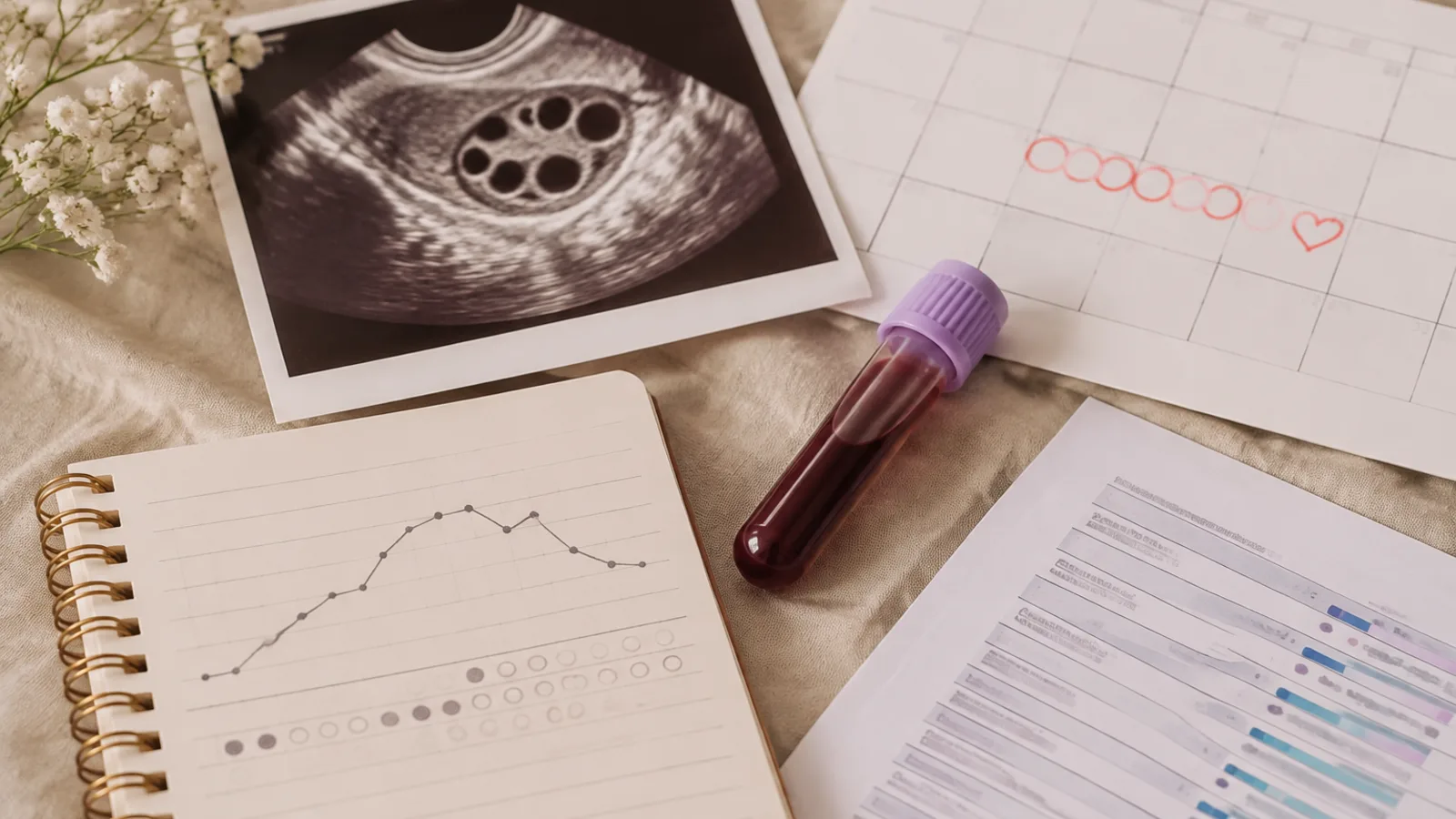
An antral follicle count (AFC) is performed via transvaginal ultrasound, usually during days 2 to 5 of the menstrual cycle. The sonographer counts small resting follicles visible in both ovaries. Like AMH, it estimates reserve — and the two results usually agree. When they diverge, the picture becomes more nuanced, not more alarming.
The scan also provides a direct look at ovarian structure. It can flag features associated with polycystic ovary syndrome (PCOS), fibroids, ovarian cysts, or other structural factors relevant to fertility or treatment planning. It is a richer data source than a blood test alone, which is why a full fertility workup typically includes both.
The day 2–5 hormone panel: FSH, LH, and estradiol
Measured together at the start of the menstrual cycle, these three hormones give a snapshot of how the brain and ovaries are communicating.
- FSH (follicle-stimulating hormone): produced by the pituitary gland to stimulate follicle development. A consistently elevated FSH can indicate that the pituitary is working harder than usual to recruit follicles — sometimes a sign of diminished reserve.
- LH (luteinising hormone): works alongside FSH. Its ratio to FSH is one of the markers used in PCOS assessment, among other applications.
- Estradiol: measured on days 2 to 5, and read alongside FSH rather than in isolation. A high estradiol early in the cycle can suppress FSH artificially, making a result look more reassuring than it is.
A single abnormal value is less meaningful than a pattern across multiple cycles, especially if testing was done while using hormonal contraception. Combined pills, for example, can suppress FSH and LH to the point that results are not very useful without medical context.
AMH has largely replaced FSH as the preferred first-line reserve marker in many clinics, but FSH and LH still appear on standard panels and are worth understanding when results arrive.
Other hormones sometimes included
Thyroid-stimulating hormone (TSH) is frequently tested alongside fertility hormones because thyroid function affects menstrual regularity, ovulation, and the ability to maintain a pregnancy. Abnormal thyroid levels are a treatable cause of cycle irregularity — worth identifying early.
Prolactin is relevant when cycles are irregular or absent. Elevated prolactin can suppress ovulation and is a manageable condition when identified.
Day 21 progesterone belongs to a different category entirely. It does not measure reserve — it tests whether ovulation occurred in that specific cycle. If you receive this result alongside an AMH, they are answering different questions.
A woman with irregular cycles might receive all of the above in one workup, because reserve is only one of several possible explanations for cycle changes.
At-home hormone test kits: a balanced view
The market for finger-prick hormone kits has grown considerably. They are widely advertised, often well-designed, and genuinely useful in a specific, limited way — but they are not a substitute for a clinical workup.
Most reputable kits measure the same hormones a clinic would, but the method differs. Finger-prick samples produce a smaller blood volume collected under less controlled conditions than a venous draw. For results that fall clearly within or outside normal ranges, the difference is usually minor. For borderline values — often the ones that cause the most concern — the variation can be clinically meaningful.
The more significant limitation is interpretive. A number without age-matched reference ranges, a clinical history, and a qualified person to contextualise it is an incomplete data point. A low AMH on a home kit, read alone at midnight, tells you far less than it appears to.
Where these kits add genuine value: they can prompt a GP appointment you might have kept postponing, or give you a rough orientation before a clinic consultation. Used as a starting point rather than a conclusion, they are a reasonable tool. For a full, contextualised workup, a GP referral remains the most reliable entry point in the UK, Canada, and Australia — and costs nothing in those systems.
Reading your results in context
A low AMH or low AFC primarily affects IVF planning — specifically, the medication protocol a clinic would use to stimulate follicle growth. Its relationship with natural conception is less direct. Many women with results flagged as low conceive without medical assistance.
A "normal" result is not a fertility guarantee, and it is not a reason to defer family planning indefinitely. Reserve declines with age regardless of where you start, and a reassuring result at 30 carries different implications at 36.
An unexpectedly high AMH is not straightforwardly positive. High values are associated with PCOS and need clinical interpretation rather than reassurance.
Any result that concerns you, combined with irregular cycles, previous difficulty conceiving, or a family history of early menopause, warrants a conversation with a gynaecologist or reproductive endocrinologist — not a solo reading of a lab printout.
How to pursue fertility testing for women: routes and questions worth asking
In the UK, Canada, and Australia, a GP is the natural first stop. They can order the core panel — AMH, FSH, LH, estradiol, and TSH — and refer you onward if results warrant it. The NHS provides clear guidance on when and how fertility investigations are initiated. In the US, a gynaecologist or reproductive endocrinologist can order the same panel; ACOG publishes patient resources on fertility evaluation that are worth reading before an appointment.
Timing matters for some tests. AMH can be drawn on any cycle day. FSH, LH, estradiol, and AFC need to be timed to days 2 to 5, so tracking your period before the appointment makes the visit more efficient. If you use hormonal contraception, mention that before testing so your clinician can decide whether results are interpretable or whether a different approach makes more sense.
When you receive results, bring these questions:
- Are these results within the normal range for my age specifically?
- What does this suggest about natural conception versus assisted options, if I wanted to explore them?
- Is there anything here that warrants further investigation?
- How often, if at all, would you recommend retesting?
- Are there lifestyle factors that reliably influence these markers?
Frequently asked questions
Can I get pregnant with a low AMH?
Yes. AMH reflects the size of your egg pool, not the quality of individual eggs or your ability to conceive naturally. Many women with low AMH conceive without medical assistance. Where low AMH becomes most clinically relevant is in IVF planning, where it influences the stimulation protocol rather than predicting whether a natural pregnancy is possible. If your result concerns you, the right conversation is with a clinician who can read it alongside your age and full medical history.
How do I know whether my AMH is low for my age, not just in absolute terms?
Ask your clinician or the laboratory to compare your result against age-stratified reference ranges rather than a general population cut-off. Many lab reports include only a single threshold, which can make a result for a 28-year-old look alarming when it falls within the typical band for her age group. If you have only a home kit result, treat it as a prompt to book a clinical test rather than a final answer.
Should I get fertility tests if I am not trying to conceive yet?
There is no universal recommendation to test proactively, and professional bodies differ on the question. The case for testing is that results can inform decisions about timing. The case against is that a single result at one point in time is not a reliable predictor of future fertility, and a low result without clinical support can cause significant distress without changing outcomes. If you are considering it, speak with your GP first rather than starting with a home kit and no context.
Do AMH levels change over time, and is it worth retesting?
AMH declines naturally with age, so a result from several years ago is not necessarily a current picture. Some clinicians recommend retesting if you are using the result to make active decisions — about timing IVF or egg freezing, for example — but routine repeated testing for general reassurance is not standard practice. How often to retest, if at all, is a clinical decision based on your individual situation, not something a lab number alone can answer.
I got different results from a home kit and a clinic test. Which should I trust?
Trust the clinic result. Venous blood draws analysed in a clinical laboratory are the standard against which home kits are measured. For borderline values, differences in sample collection can produce meaningfully different numbers. If your home and clinic results diverge significantly, bring both to your clinician and let them interpret the discrepancy in full context rather than averaging the two figures yourself.
The ultimate goal of fertility testing for women is not a verdict — it is information that becomes useful only inside a clinical conversation. A result, however it arrives, is a starting point. The questions you ask after receiving it matter as much as the number itself. If a test has prompted you to book an appointment you had been putting off, it has already done its most important job.





Join the conversation
Sign in — Sign in to join the conversation.